
口腔癌文献中程序性细胞死亡的文献计量分析:研究模式与新趋势(2000 - 2024年)
A bibliometric analysis of programmed cell death in oral cancer literature: research patterns and emerging trends (2000-2024).
作者信息
Gu Wenli
机构信息
Stomatological Hospital, School of Stomatology, Southern Medical University, S366 Jiangnan Boulevard, Haizhu District, Guangzhou, Guangdong, China.
出版信息
Discov Oncol. 2025 Apr 22;16(1):585. doi: 10.1007/s12672-025-02410-9.
BACKGROUND
Programmed cell death (PCD) plays a crucial role in oral cancer pathogenesis and treatment. However, a comprehensive bibliometric analysis of the global research landscape in this field has not been conducted. This study aims to analyze the evolution and current trends of PCD research in oral cancer from 2000 to 2024.
METHODS
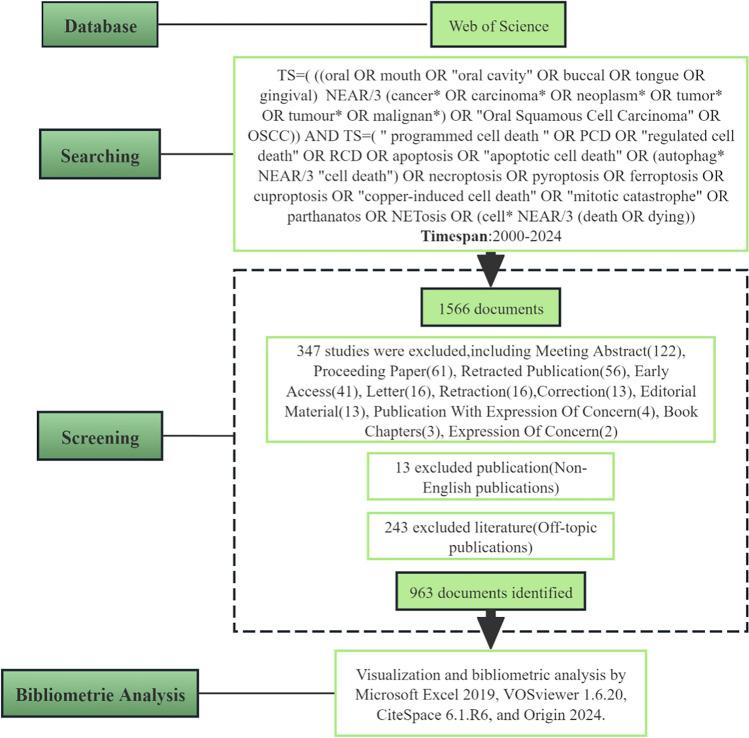
Publications were retrieved from the Web of Science Core Collection database using relevant keywords related to oral cancer and PCD. VOSviewer 1.6.20 and CiteSpace 6.1R6 software were employed to conduct bibliometric analysis, including publication trends, citation analysis, co-authorship networks, keyword co-occurrence, and research hotspots. The time span was set from January 2000 to December 2024.
RESULTS
A total of 963 publications were identified and analyzed. The annual publication output showed a steady increase, with a significant growth rate after 2010, dividing the study period into three distinct phases. The most productive countries were China (58.42%), South Korea (12.27%), and Japan (10.04%), with China Medical University and Kaohsiung Medical University being the leading institutions. Research hotspots evolved from traditional apoptosis studies to emerging forms of PCD such as autophagy, ferroptosis, and pyroptosis. Keyword analysis revealed three major research clusters: basic molecular mechanisms (centered around ROS and oxidative stress), clinical aspects (including prognosis and cell proliferation), and cell death pathways. Citation burst analysis identified emerging trends in targeting multiple PCD pathways simultaneously for oral cancer therapy, with special focus on treatment resistance and survival.
CONCLUSION
This bibliometric analysis provides a comprehensive overview of global research trends in PCD and oral cancer over the past two decades. The findings highlight the shift from basic mechanistic studies focusing on apoptosis to more diverse PCD pathways and translational research. Emerging research directions include the exploration of synergistic mechanisms among multiple PCD pathways, development of AI-based personalized treatment plans, investigation of microenvironment regulation of PCD, and application of novel drug delivery systems. These trends demonstrate the field's evolution toward more integrated, personalized approaches in oral cancer treatment. This study offers valuable insights for researchers and funding agencies to identify research gaps and potential collaboration opportunities in this rapidly developing field.
背景
程序性细胞死亡(PCD)在口腔癌的发病机制和治疗中起着关键作用。然而,尚未对该领域的全球研究格局进行全面的文献计量分析。本研究旨在分析2000年至2024年口腔癌中PCD研究的演变和当前趋势。
方法
使用与口腔癌和PCD相关的关键词从Web of Science核心合集数据库中检索出版物。采用VOSviewer 1.6.20和CiteSpace 6.1R6软件进行文献计量分析,包括出版趋势、引文分析、合著网络、关键词共现和研究热点。时间跨度设定为2000年1月至2024年12月。
结果
共识别并分析了963篇出版物。年出版量呈稳步增长,2010年后增长率显著,将研究期分为三个不同阶段。产出最多的国家是中国(58.42%)、韩国(12.27%)和日本(10.04%),中国医科大学和高雄医学大学是领先机构。研究热点从传统的凋亡研究演变为PCD的新兴形式,如自噬、铁死亡和焦亡。关键词分析揭示了三个主要研究集群:基本分子机制(以ROS和氧化应激为中心)、临床方面(包括预后和细胞增殖)以及细胞死亡途径。引文爆发分析确定了同时针对多种PCD途径进行口腔癌治疗的新兴趋势,特别关注治疗耐药性和生存率。
结论
本文献计量分析全面概述了过去二十年中PCD和口腔癌的全球研究趋势。研究结果突出了从专注于凋亡的基础机制研究向更多样化的PCD途径和转化研究的转变。新兴的研究方向包括探索多种PCD途径之间的协同机制、开发基于人工智能的个性化治疗方案、研究PCD的微环境调节以及新型药物递送系统的应用。这些趋势表明该领域在口腔癌治疗中朝着更综合、个性化的方法发展。本研究为研究人员和资助机构提供了有价值的见解,以识别这个快速发展领域中的研究空白和潜在合作机会。





 Zotero 插件