
利用HetSIREN对冷冻电镜构象状态进行实空间异质重建、精修和解缠
Real-space heterogeneous reconstruction, refinement, and disentanglement of CryoEM conformational states with HetSIREN.
作者信息
Herreros David, Mata Carlos Perez, Noddings Chari, Irene Deli, Krieger James, Agard David A, Tsai Ming-Daw, Sorzano Carlos Oscar Sanchez, Carazo Jose Maria
机构信息
Centro Nacional de Biotecnologia-CSIC, C/ Darwin, 3, Cantoblanco, Madrid, Spain.
PKF Attest innCome, Orense 81, Madrid, Spain.
出版信息
Nat Commun. 2025 Apr 22;16(1):3751. doi: 10.1038/s41467-025-59135-0.
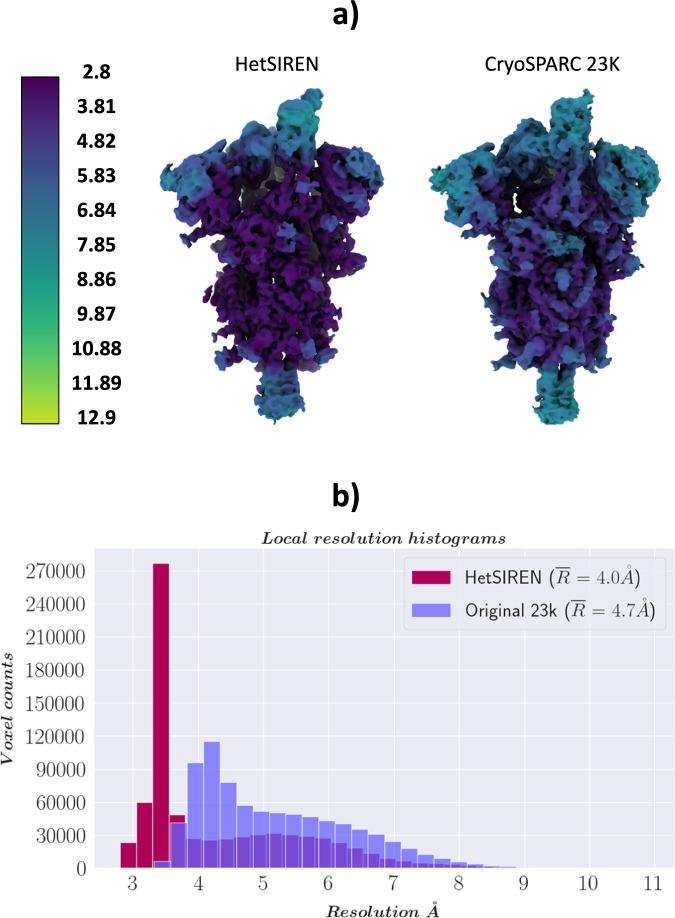
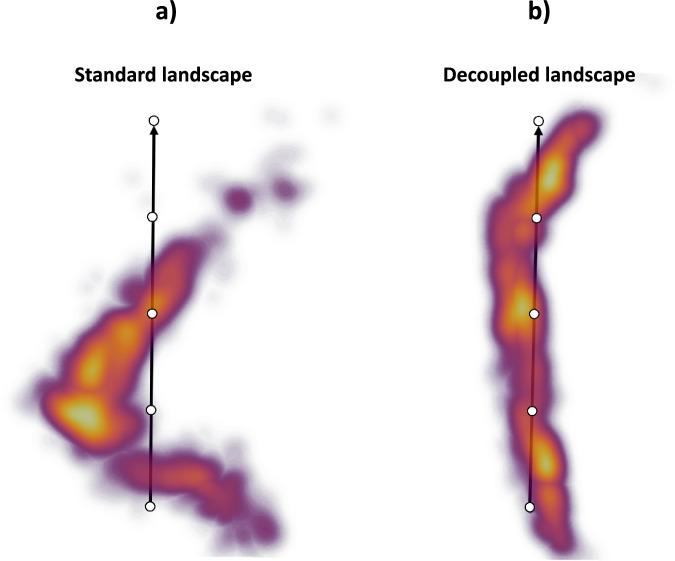
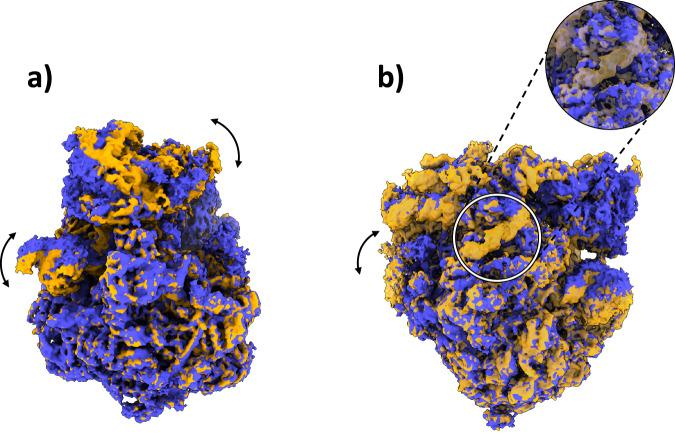
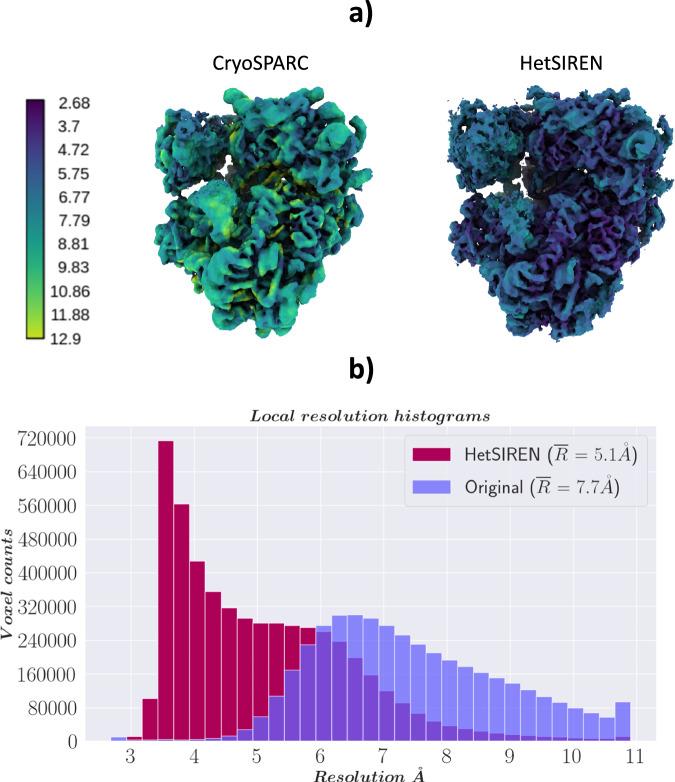
Single-particle analysis by Cryo-electron microscopy (CryoEM) provides direct access to the conformations of macromolecules. Traditional methods assume discrete conformations, while newer algorithms estimate conformational landscapes representing the different structural states a biomolecule explores. This work presents HetSIREN, a deep learning-based method that can fully reconstruct or refine a CryoEM volume in real space based on the structural information summarized in a conformational latent space. HetSIREN is defined as an accurate space-based method that allows spatially focused analysis and the introduction of sinusoidal hypernetworks with proven high analytics capacities. Continuing with innovations, HetSIREN can also refine the images' pose while conditioning the network with additional constraints to yield cleaner high-quality volumes, as well as addressing one of the most confusing issues in heterogeneity analysis, as it is the fact that structural heterogeneity estimations are entangled with pose estimation (and to a lesser extent with CTF estimation) thanks to its decoupling architecture.
冷冻电子显微镜(CryoEM)单颗粒分析可直接获取大分子的构象。传统方法假定构象是离散的,而新算法则估计代表生物分子探索的不同结构状态的构象景观。这项工作提出了HetSIREN,这是一种基于深度学习的方法,它可以基于构象潜在空间中总结的结构信息在实空间中完全重建或细化冷冻电镜体积。HetSIREN被定义为一种精确的基于空间的方法,它允许进行空间聚焦分析,并引入具有经证实的高分析能力的正弦超网络。持续创新的是,HetSIREN还可以在对网络进行额外约束的同时细化图像姿态,以生成更清晰的高质量体积,并且解决了异质性分析中最令人困惑的问题之一,即由于其解耦架构,结构异质性估计与姿态估计(以及在较小程度上与CTF估计)相互纠缠。


 Zotero 插件