
花粉母细胞和小孢子蛋白质组中细胞类型特异性的热诱导变化为高温下番茄花粉产生提供了新见解。
Cell-Type-Specific Heat-Induced Changes in the Proteomes of Pollen Mother Cells and Microspores Provide New Insights into Tomato Pollen Production Under Elevated Temperature.
作者信息
Thapa Priya, Guo Jun, Pradhan Kajol, Thapa Dibya, Madhavarapu Sudhakar, Zou Jing, Potts Jesse, Li Hui, O'Hair Joshua, Wang Chen, Zhou Suping, Yang Yong, Fish Tara, Thannhauser Theodore W
机构信息
Department of Agricultural Sciences and Engineering, College of Agriculture, Tennessee State University, 3500 John Merritt Blvd, Nashville, TN 37209, USA.
R.W. Holley Center for Agriculture and Health, USDA-ARS, Cornell University, Ithaca, NY 14853, USA.
出版信息
Proteomes. 2025 Mar 25;13(2):13. doi: 10.3390/proteomes13020013.
BACKGROUND
Tomatoes are self-pollinating plants, and successful fruit set depends on the production of functional pollen within the same flower. Our previous studies have shown that the 'Black Vernissage' tomato variety exhibits greater resilience to heat stress in terms of pollen productivity compared to the 'Micro-Tom' variety. Pollen productivity is determined by meiotic activity during microsporogenesis and the development of free microspores during gametogenesis. This study focused on identifying heat stress (HS)-induced proteomes in pollen mother cells (PMCs) and microspores.
METHODS
Tomato plants were grown under two temperature conditions: 26 °C (non-heat-treated control) and 37 °C (heat-treated). Homogeneous cell samples of meiotic PMCs (prior to the tetrad stage) and free microspores were collected using laser capture microdissection (LCM). The heat-induced proteomes were identified using tandem mass tag (TMT)-quantitative proteomics analysis.
RESULTS
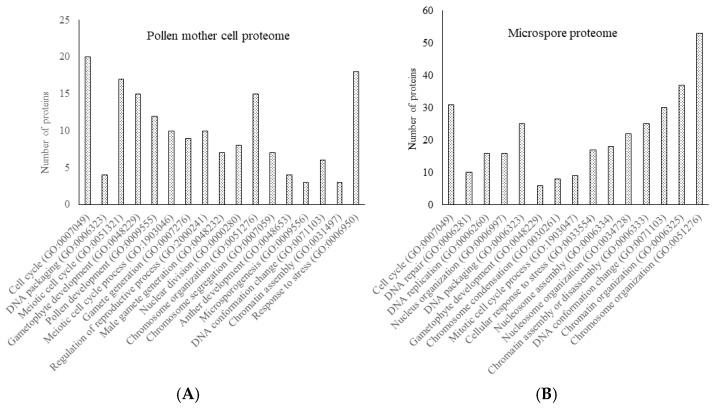
The enrichment of the meiotic cell cycle in PMCs and the pre-mitotic process in free microspores confirmed the correlation between proteome expression and developmental stage. Under HS, PMCs in both tomato varieties were enriched with heat shock proteins (HSPs). However, the 'Black Vernissage' variety exhibited a greater diversity of HSP species and a higher level of enrichment compared to the 'Micro-Tom' variety. Additionally, several proteins involved in gene expression and protein translation were downregulated in PMCs and microspores of both varieties. In the PMC proteomes, the relative abundance of proteins showed no significant differences between the two varieties under normal conditions, with very few exceptions. However, HS induced significant differential expression both within and between the varieties. More importantly, these heat-induced differentially abundant proteins (DAPs) in PMCs are directly involved in meiotic cell division, including the meiosis-specific protein ASY3 (Solyc01g079080), the cell division protein kinase 2 (Solyc11g070140), COP9 signalosome complex subunit 1 (Solyc01g091650), the kinetochore protein ndc80 (Solyc01g104570), MORC family CW-type zinc finger 3 (Solyc02g084700), and several HSPs that function in protecting the fidelity of the meiotic processes, including the DNAJ chaperone (Solyc04g009770, Solyc05g055160), chaperone protein htpG (Solyc04g081570), and class I and class II HSPs. In the microspores, most of the HS-induced DAPs were consistently observed across both varieties, with only a few proteins showing significant differences between them under heat stress. These HS-induced DAPs include proteases, antioxidant proteins, and proteins related to cell wall remodeling and the generation of pollen exine.
CONCLUSIONS
HS induced more dynamic proteomic changes in meiotic PMCs compared to microspores, and the inter-varietal differences in the PMC proteomes align with the effects of HS on pollen productivity observed in the two varieties. This research highlights the importance of the cell-type-specific proteomics approach in identifying the molecular mechanisms that are critical for the pollen developmental process under elevated temperature conditions.
背景
番茄是自花授粉植物,果实的成功坐果取决于同一朵花内有功能花粉的产生。我们之前的研究表明,与“Micro-Tom”品种相比,“Black Vernissage”番茄品种在花粉生产力方面对热胁迫表现出更强的恢复力。花粉生产力由小孢子发生过程中的减数分裂活性和配子发生过程中游离小孢子的发育决定。本研究聚焦于鉴定花粉母细胞(PMC)和小孢子中热胁迫(HS)诱导的蛋白质组。
方法
番茄植株在两种温度条件下生长:26°C(非热处理对照)和37°C(热处理)。使用激光捕获显微切割(LCM)收集减数分裂PMC(四分体阶段之前)和游离小孢子的同质细胞样本。通过串联质谱标签(TMT)定量蛋白质组学分析鉴定热诱导的蛋白质组。
结果
PMC中减数分裂细胞周期和游离小孢子中有丝分裂前期过程的富集证实了蛋白质组表达与发育阶段之间的相关性。在热胁迫下,两个番茄品种的PMC中均富含热休克蛋白(HSP)。然而,与“Micro-Tom”品种相比,“Black Vernissage”品种表现出更丰富的HSP种类和更高的富集水平。此外,两个品种的PMC和小孢子中,一些参与基因表达和蛋白质翻译的蛋白质表达下调。在PMC蛋白质组中,正常条件下两个品种之间蛋白质的相对丰度没有显著差异,只有极少数例外。然而,热胁迫诱导了品种内和品种间的显著差异表达。更重要的是,这些在PMC中热诱导的差异丰富蛋白(DAP)直接参与减数分裂细胞分裂,包括减数分裂特异性蛋白ASY3(Solyc01g079080)、细胞分裂蛋白激酶2(Solyc11g070140)、COP9信号体复合物亚基1(Solyc01g091650)、动粒蛋白ndc80(Solyc01g104570)、MORC家族CW型锌指蛋白3(Solyc02g084700),以及几种在保护减数分裂过程保真度中起作用的HSP,包括DNAJ分子伴侣(Solyc04g009770、Solyc05g055160)、分子伴侣蛋白htpG(Solyc04g081570)以及I类和II类HSP。在小孢子中,两个品种中大多数热诱导的DAP一致被观察到,只有少数蛋白质在热胁迫下表现出显著差异。这些热诱导的DAP包括蛋白酶、抗氧化蛋白以及与细胞壁重塑和花粉外壁形成相关的蛋白质。
结论
与小孢子相比,热胁迫在减数分裂的PMC中诱导了更动态的蛋白质组变化,并且PMC蛋白质组中的品种间差异与在两个品种中观察到的热胁迫对花粉生产力的影响一致。本研究强调了细胞类型特异性蛋白质组学方法在鉴定高温条件下对花粉发育过程至关重要的分子机制方面的重要性。

 Zotero 插件