
单细胞转录组学揭示成纤维细胞与活化免疫细胞之间的相互作用:慢传输型便秘促炎机制的探索性生物信息学研究
Single-cell transcriptomics reveals the interaction between fibroblasts and activated immune cells: an exploratory bioinformatics study of pro-inflammatory mechanisms in slow transit constipation.
作者信息
Chi Fengxu, Sun Weidong, Zhang Cong, Yu Xiangwen, Huang Cen, Ding Xiangchen, Chang Hanman, Gao Jun, Yan Shi, Zhu Anlong, Xing Yanwei, Jiang Xiufeng, Yan An, Ren Niansheng, Yu Linfeng, Bao Xuhui, Zhu Yuekun
机构信息
Department of Colorectal Surgery, The First Affiliated Hospital of Harbin Medical University, Harbin, Heilongjiang, China.
Department of Emergency Medicine, Sir Run Run Shaw Hospital, Zhejiang University School of Medicine, Hangzhou, Zhenjiang, China.
出版信息
Int J Surg. 2025 Jun 1;111(6):3767-3780. doi: 10.1097/JS9.0000000000002415. Epub 2025 Apr 22.
BACKGROUND
Slow transit constipateion (STC) is an intestinal disease characterized by colonic dyskinesia, which involves multiple factors such as neuroendocrine, substance metabolism, gut microbiota, ion channels, and aquaporin. Increasing evidence indicates that modulation of immune signaling, activation of immune cells, and secretion of cytokines impact oxidative stress, disruption of the intestinal mucosal barrier, and the subsequent intestinal dysfunction in STC. However, the landscape of the immune microenvironment (IME) and the disease-specific cell type in STC patients is unclear, and the detailed mechanism of how immune cells affect stromal cells during chronic inflammation is still lacking.
MATERIALS AND METHODS
We performed single-cell RNA sequencing (scRNA-seq) on six STC cases and six control cases to elucidate the IME in STC patients. By identifying differentially expressed genes and pathways between groups, tracking cell differentiation trajectories, and constructing an integrated analysis of intercellular communication, we aimed to elucidate the potential mechanisms of specific immune cell types.
RESULTS
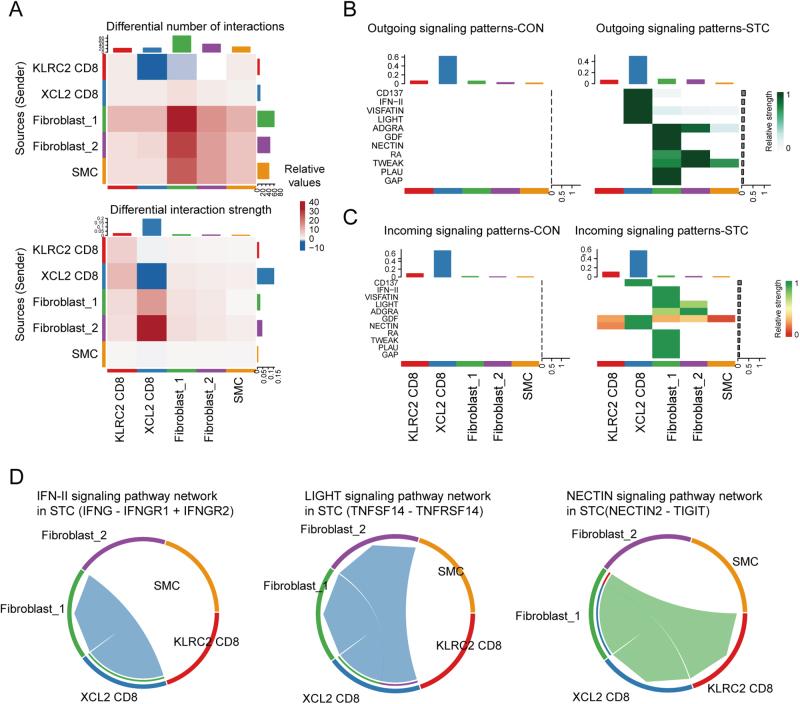
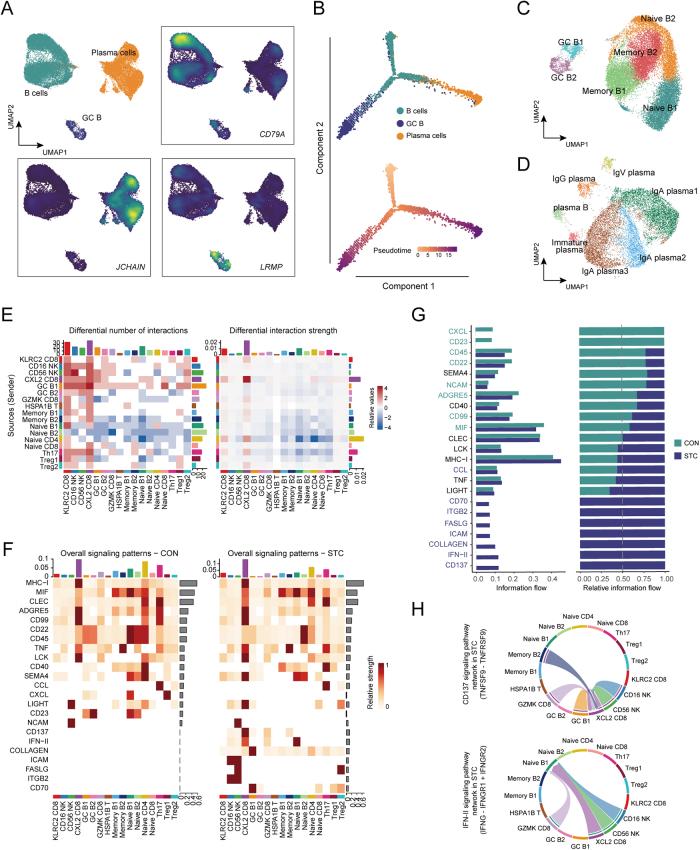
We identified STC-specific XCL2 + CD8 + T cells, which exhibit extensive intercellular communication with other immune cells and intestinal stromal cells. B cells and myeloid cells could promote the immune function of XCL2 + CD8 + T cells by CD137 co-stimulatory molecules. Afterward, the activated XCL2 + CD8 + T cells enhanced the secretion of pro-inflammatory cytokines of fibroblasts through IFNG and TNFSF14 signaling pathways. Additionally, fibroblasts exert immune regulation on XCL2 + CD8 + T cells through the NECTIN signaling pathway.
CONCLUSION
These results suggested that STC-specific XCL2 + CD8 + T cells might influence the homeostasis of the IME and further disrupt intestinal function.
背景
慢传输型便秘(STC)是一种以结肠运动障碍为特征的肠道疾病,涉及神经内分泌、物质代谢、肠道微生物群、离子通道和水通道蛋白等多种因素。越来越多的证据表明,免疫信号的调节、免疫细胞的激活和细胞因子的分泌会影响氧化应激、肠黏膜屏障的破坏以及STC随后的肠道功能障碍。然而,STC患者免疫微环境(IME)和疾病特异性细胞类型的情况尚不清楚,慢性炎症期间免疫细胞如何影响基质细胞的详细机制仍然缺乏。
材料和方法
我们对6例STC病例和6例对照病例进行了单细胞RNA测序(scRNA-seq),以阐明STC患者的IME。通过识别组间差异表达的基因和通路、追踪细胞分化轨迹以及构建细胞间通讯的综合分析,我们旨在阐明特定免疫细胞类型的潜在机制。
结果
我们鉴定出了STC特异性的XCL2 + CD8 + T细胞,其与其他免疫细胞和肠道基质细胞表现出广泛的细胞间通讯。B细胞和髓样细胞可通过CD137共刺激分子促进XCL2 + CD8 + T细胞的免疫功能。随后,活化的XCL2 + CD8 + T细胞通过IFNG和TNFSF14信号通路增强成纤维细胞促炎细胞因子的分泌。此外,成纤维细胞通过NECTIN信号通路对XCL2 + CD8 + T细胞发挥免疫调节作用。
结论
这些结果表明,STC特异性的XCL2 + CD8 + T细胞可能影响IME的稳态,并进一步破坏肠道功能。



 Zotero 插件