
一种用于从MRI图像自动预测心肌梗死的混合分割与分类CAD框架。
A hybrid segmentation and classification CAD framework for automated myocardial infarction prediction from MRI images.
作者信息
Al-Antari Mugahed A, Al-Tam Riyadh M, Al-Hejri Aymen M, Al-Huda Zaid, Lee Soojeong, Yıldırım Özal, Gu Yeong Hyeon
机构信息
Department of Artificial Intelligence and Data Science, College of AI Convergence, Daeyang AI Center, Sejong University, Seoul, 05006, Korea.
School of Computational Sciences, Swami Ramanand Teerth Marathwada University, Nanded, 431606, Maharashtra, India.
出版信息
Sci Rep. 2025 Apr 23;15(1):14196. doi: 10.1038/s41598-025-98893-1.
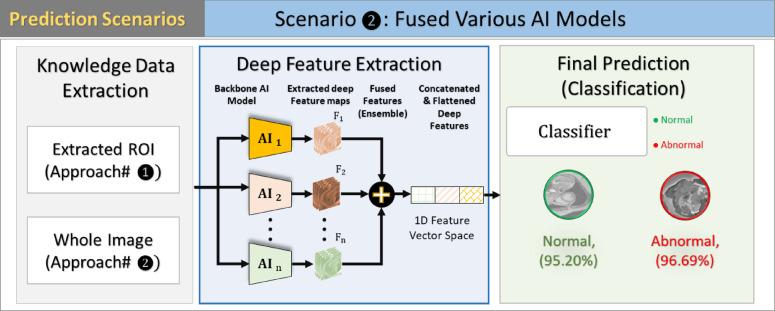
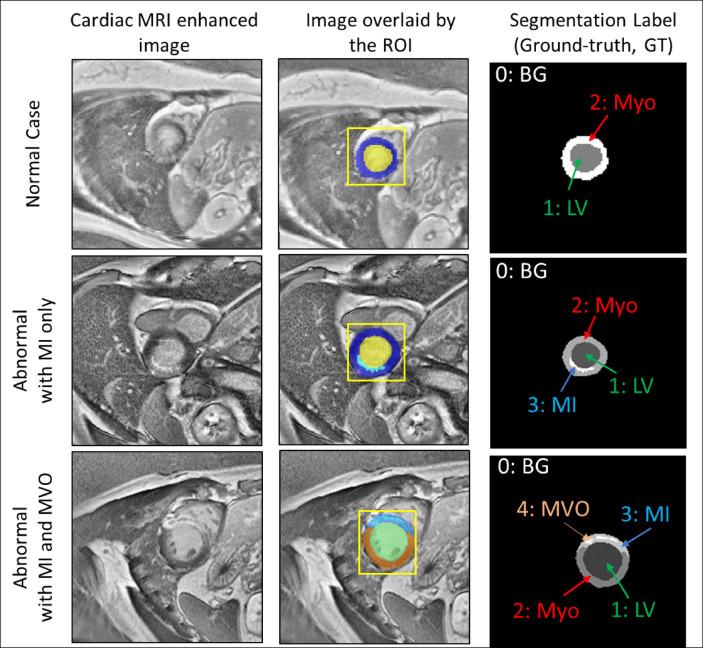
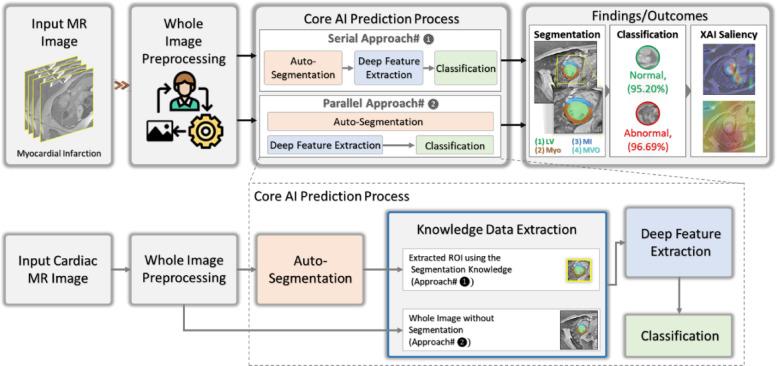
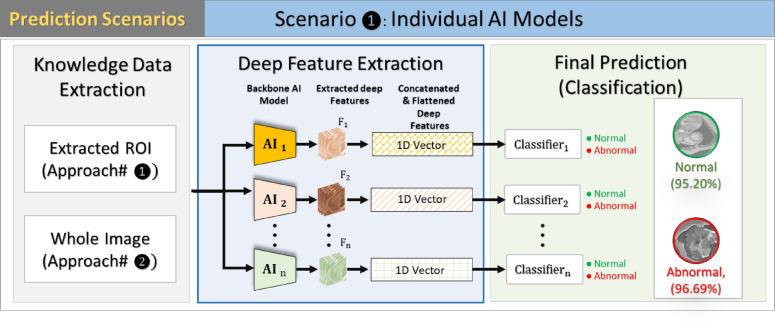
Early diagnosis of myocardial infarction (MI) is critical for preserving cardiac function and improving patient outcomes through timely intervention. This study proposes an annovaitive computer-aided diagnosis (CAD) system for the simultaneous segmentation and classification of MI using MRI images. The system is evaluated under two primary approaches: a serial approach, where segmentation is first applied to extract image patches for subsequent classification, and a parallel approach, where segmentation and classification are performed concurrently using full MRI images. The multi-class segmentation model identifies four key heart regions: left ventricular cavity (LV), normal myocardium (Myo), myocardial infarction (MI), and persistent microvascular obstruction (MVO). The classification stage employs three AI-based strategies: a single deep learning model, feature-based fusion of multiple AI models, and a hybrid ensemble model incorporating the Vision Transformer (ViT). Both segmentation and classification models are trained and validated on the EMIDEC MRI dataset using five-fold cross-validation. The adopted ResU-Net achieves high F1-scores for segmentation: 91.12% (LV), 88.39% (Myo), 80.08% (MI), and 68.01% (MVO). For classification, the hybrid CNN-ViT model in the parallel approach demonstrates superior performance, achieving 98.15% accuracy and a 98.63% F1-score. These findings highlight the potential of the proposed CAD system for real-world clinical applications, offering a robust tool to assist healthcare professionals in accurate MI diagnosis, improved treatment planning, and enhanced patient care.
心肌梗死(MI)的早期诊断对于通过及时干预保护心脏功能和改善患者预后至关重要。本研究提出了一种创新的计算机辅助诊断(CAD)系统,用于使用MRI图像同时对MI进行分割和分类。该系统在两种主要方法下进行评估:串行方法,即首先应用分割来提取图像块以进行后续分类;并行方法,即使用完整的MRI图像同时进行分割和分类。多类分割模型识别四个关键心脏区域:左心室腔(LV)、正常心肌(Myo)、心肌梗死(MI)和持续性微血管阻塞(MVO)。分类阶段采用三种基于人工智能的策略:单个深度学习模型、多个人工智能模型的基于特征的融合以及包含视觉Transformer(ViT)的混合集成模型。分割和分类模型均在EMIDEC MRI数据集上使用五折交叉验证进行训练和验证。所采用的ResU-Net在分割方面取得了较高的F1分数:LV为91.12%,Myo为88.39%,MI为80.08%,MVO为68.01%。对于分类,并行方法中的混合CNN-ViT模型表现出卓越的性能,准确率达到98.15%,F1分数达到98.63%。这些发现突出了所提出的CAD系统在实际临床应用中的潜力,为医疗保健专业人员提供了一个强大的工具,以协助进行准确的MI诊断、改进治疗计划并加强患者护理。
 Zotero 插件