
社会参与在住院老年人认知衰弱与健康相关生活质量关联中的中介作用:中国西安的一项横断面研究
Mediating effect of social participation in the association between cognitive frailty and health-related quality of life among hospitalized older adults: a cross-sectional study in Xi'an, China.
作者信息
Hui Zhaozhao, Zhao Yayi, Gong Qianhui, Li Yajing, Liu Feng, Zhao Xiaoyun, Liu Xiaohong
机构信息
School of Public Health, Xi'an Jiaotong University Health Science Center, Xi'an, China.
School of Nursing, Nanjing University of Chinese Medicine, Nanjing, China.
出版信息
BMC Geriatr. 2025 Apr 23;25(1):264. doi: 10.1186/s12877-025-05937-2.
BACKGROUND
Cognitive frailty, the co-occurrence of physical frailty and cognitive impairment, has emerged as an essential factor affecting the health-related quality of life (HRQoL) among older adults; however, the role of social participation remains unknown. Our study aimed to explore the mediating role of social participation in the association between cognitive frailty and HRQoL among hospitalized older adults.
METHODS
A total of 467 older adults were recruited from three tertiary hospitals in Xi'an, China. Cognitive frailty was ascertained by the FRAIL scale and the Montreal Cognitive Assessment. Social participation was assessed by the questionnaire that was developed based on the China Health and Retirement Longitudinal Study. HRQoL was measured by the 36-item Short Form Health Survey. Bootstrap mediation effects were employed to estimate the mediating effect of social participation in the association between cognitive frailty and HRQoL.
RESULTS
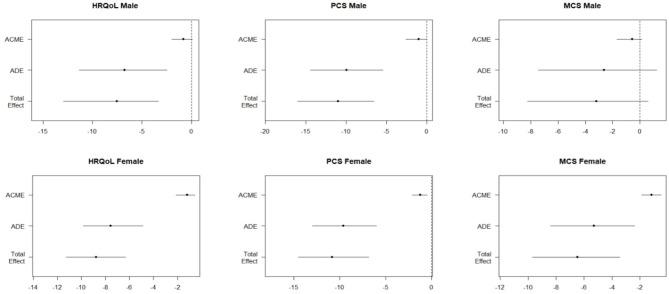
The average age of the participants was 70.8 years and 51.8% were female. Individuals with cognitive frailty had significantly lower levels of social participation (5.9 ± 3.7 vs. 7.8 ± 4.1) and HRQoL (57.8 ± 15.5 vs. 68.1 ± 13.9) (physical component summary [PCS]: 52.4 ± 19.0 vs. 66.0 ± 16.7; mental component summary [MCS]: 63.2 ± 16.5 vs. 70.2 ± 15.4) compared to those without cognitive frailty. Social participation partially mediated the association between cognitive frailty and HRQoL (average causal mediation effect [ACME] = -1.22, 95% confidence interval [CI]: - 2.20, -0.51) as well as on its dimensions of PCS (ACME = -1.12, 95% CI: - 2.13, - 0.55) and MCS (ACME = -1.29, 95% CI: - 2.35, - 0.49). Gender moderated the mediating effect of social participation in the association between cognitive frailty and HRQoL, which was more pronounced in women than that in men.
CONCLUSIONS
The findings suggest that social participation mediates the association between cognitive frailty and HRQoL, particularly for women. This study expands the current literature on designing policy solutions to promote participation in social activities among older adults with cognitive frailty, with the goal of maintaining their HRQoL at a favorable level.
背景
认知衰弱,即身体衰弱与认知障碍同时出现,已成为影响老年人健康相关生活质量(HRQoL)的一个重要因素;然而,社会参与的作用仍不明确。我们的研究旨在探讨社会参与在住院老年人认知衰弱与HRQoL之间的关联中所起的中介作用。
方法
从中国西安的三家三级医院招募了467名老年人。通过衰弱量表(FRAIL scale)和蒙特利尔认知评估来确定认知衰弱。社会参与通过基于中国健康与养老追踪调查(China Health and Retirement Longitudinal Study)开发的问卷进行评估。HRQoL通过36项简短健康调查问卷进行测量。采用自抽样中介效应来估计社会参与在认知衰弱与HRQoL之间的关联中所起的中介作用。
结果
参与者的平均年龄为70.8岁,51.8%为女性。与无认知衰弱的个体相比,认知衰弱个体的社会参与水平(5.9±3.7对7.8±4.1)和HRQoL(57.8±15.5对68.1±13.9)显著更低(身体成分总结[PCS]:52.4±19.0对66.0±16.7;心理成分总结[MCS]:63.2±16.5对70.2±15.4)。社会参与部分中介了认知衰弱与HRQoL之间的关联(平均因果中介效应[ACME]= -1.22,95%置信区间[CI]:-2.20,-0.51)以及其PCS维度(ACME = -1.12,95% CI:-2.13,-0.55)和MCS维度(ACME = -1.29,95% CI:-2.35,-0.49)。性别调节了社会参与在认知衰弱与HRQoL之间关联中的中介作用,在女性中比在男性中更显著。
结论
研究结果表明,社会参与中介了认知衰弱与HRQoL之间的关联(尤其是对女性而言)。本研究扩展了当前关于设计政策解决方案以促进认知衰弱老年人参与社会活动的文献,目标是将他们的HRQoL维持在良好水平。

 Zotero 插件