
使用机器学习预测胶质母细胞瘤患者的总生存期:治疗疗效和患者预后分析。
Predicting overall survival in glioblastoma patients using machine learning: an analysis of treatment efficacy and patient prognosis.
作者信息
Onciul Razvan, Brehar Felix-Mircea, Dumitru Adrian Vasile, Crivoi Carla, Covache-Busuioc Razvan-Adrian, Serban Matei, Radoi Petrinel Mugurel, Toader Corneliu
机构信息
Department of Neurosurgery, "Carol Davila" University of Medicine and Pharmacy, Bucharest, Romania.
Neurosurgery Department, Emergency University Hospital, Bucharest, Romania.
出版信息
Front Oncol. 2025 Apr 9;15:1539845. doi: 10.3389/fonc.2025.1539845. eCollection 2025.
INTRODUCTION
Glioblastoma (GBM), the most aggressive primary brain tumor, poses a significant challenge in predicting patient survival due to its heterogeneity and resistance to treatment. Accurate survival prediction is essential for optimizing treatment strategies and improving clinical outcomes.
METHODS
This study utilized metadata from 135 GBM patients, including demographic, clinical, and molecular variables such as age, Karnofsky Performance Status (KPS), MGMT promoter methylation, and EGFR amplification. Six machine learning models-XGBoost, Random Forests, Support Vector Machines, Artificial Neural Networks, Extra Trees Regressor, and K- Nearest Neighbors-were employed to classify patients into predefined survival categories. Data preprocessing included label encoding for categorical variables and MinMax scaling for numerical features. Model performance was assessed using ROC-AUC and accuracy metrics, with hyperparameters optimized through grid search.
RESULTS
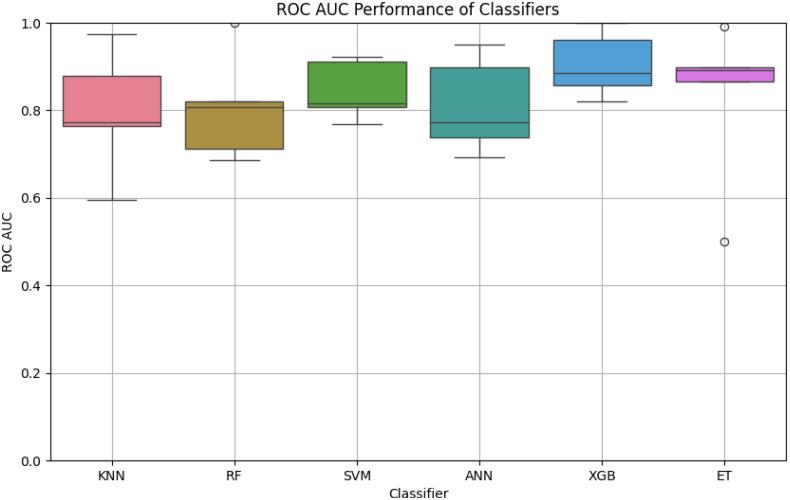
XGBoost demonstrated the highest predictive accuracy, achieving a mean ROC-AUC of 0.90 and an accuracy of 0.78. Ensemble models outperformed simpler classifiers, emphasizing the predictive value of metadata. The models identified key prognostic markers, including MGMT promoter methylation and KPS, as significant contributors to survival prediction.
CONCLUSIONS
The application of machine learning to GBM metadata offers a robust approach to predicting patient survival. The study highlights the potential of ML models to enhance clinical decision-making and contribute to personalized treatment strategies, with a focus on accuracy, reliability, and interpretability.
引言
胶质母细胞瘤(GBM)是最具侵袭性的原发性脑肿瘤,由于其异质性和对治疗的抗性,在预测患者生存方面构成重大挑战。准确的生存预测对于优化治疗策略和改善临床结果至关重要。
方法
本研究利用了135例GBM患者的元数据,包括人口统计学、临床和分子变量,如年龄、卡氏功能状态(KPS)、MGMT启动子甲基化和EGFR扩增。采用六种机器学习模型——XGBoost、随机森林、支持向量机、人工神经网络、极端随机树回归器和K近邻算法——将患者分类为预定义的生存类别。数据预处理包括对分类变量进行标签编码和对数值特征进行MinMax缩放。使用ROC-AUC和准确率指标评估模型性能,并通过网格搜索优化超参数。
结果
XGBoost表现出最高的预测准确性,平均ROC-AUC为0.90,准确率为0.78。集成模型优于简单分类器,强调了元数据的预测价值。这些模型确定了关键的预后标志物,包括MGMT启动子甲基化和KPS,是生存预测的重要因素。
结论
将机器学习应用于GBM元数据为预测患者生存提供了一种强大的方法。该研究强调了机器学习模型在增强临床决策和为个性化治疗策略做出贡献方面的潜力,重点在于准确性、可靠性和可解释性。




 Zotero 插件