
代谢组学与脑成像数据的整合凸显了创伤后应激障碍、糖蛋白乙酰化和苍白球结构之间的多效性。
Integration of Metabolomic and Brain Imaging Data Highlights Pleiotropy Among Posttraumatic Stress Disorder, Glycoprotein Acetyls, and Pallidum Structure.
作者信息
Løkhammer Solveig, Tesfaye Markos, Cabrera-Mendoza Brenda, Sandås Kristoffer, Pathak Gita A, Friligkou Eleni, Le Hellard Stéphanie, Polimanti Renato
机构信息
Department of Psychiatry, Yale School of Medicine, New Haven, Connecticut.
Department of Clinical Science, University of Bergen, Bergen, Norway.
出版信息
Biol Psychiatry Glob Open Sci. 2025 Mar 17;5(4):100482. doi: 10.1016/j.bpsgos.2025.100482. eCollection 2025 Jul.
BACKGROUND
The development of posttraumatic stress disorder (PTSD) is attributable to the interplay between exposure to severe traumatic events, environmental factors, and biological characteristics. Blood and brain imaging markers have been associated with PTSD. However, to our knowledge, no study has systematically investigated the genetic relationship between PTSD, metabolic biomarkers, and brainwide imaging.
METHODS
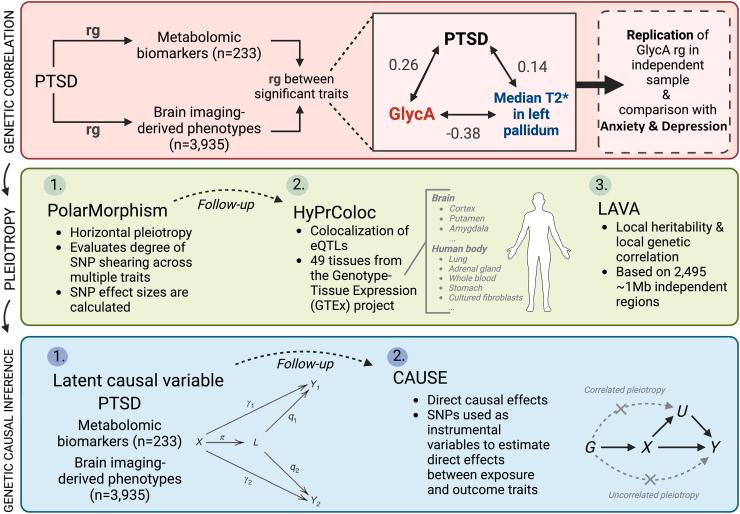
We integrated genome-wide data informative of PTSD, 233 metabolic biomarkers, and 3935 brain imaging-derived phenotypes (IDPs). Pleiotropy was assessed by applying global and local genetic correlation, colocalization, and genetically inferred causality.
RESULTS
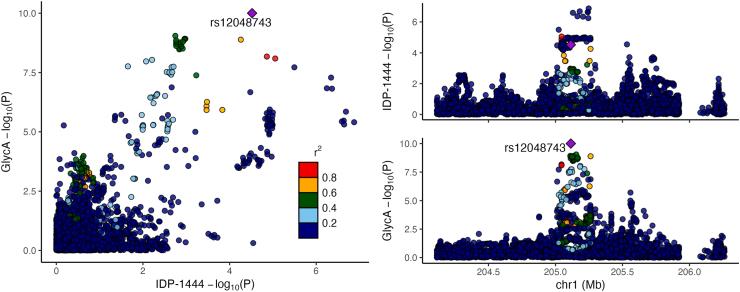
We observed significant genetic overlap between PTSD and glycoprotein acetyls (GlycA) (a stable inflammatory biomarker) in 2 independent cohorts (discovery = 0.26, = 1.00 × 10; replication = 0.23, = 5.99 × 10). Interestingly, there was no genetic correlation between anxiety and GlycA ( = .33). PTSD and GlycA were both genetically correlated with median T2∗ in the left pallidum (IDP-1444: = 0.14, = 1.39 × 10; = -0.38, = 2.50 × 10, respectively). Local genetic correlation between PTSD and GlycA was observed in 7 genetic regions ( < 2.0 × 10), mapping genes related to immune and stress response, inflammation, and metabolic processes. Furthermore, we identified 1 variant, rs12048743, with evidence of horizontal pleiotropy linking GlycA and IDP-1444 ( = 17.14, = -6.07, theta = 2.06 × 10). Regional colocalization was observed among GlycA, IDP-1444, and tissue-specific transcriptomic regulation for brain frontal cortex and testis (rs12048743-chr1q32.1; posterior probability > 0.8). While we also tested causality between PTSD, metabolomic biomarkers, and brain IDPs, these were not consistent across different genetically informed causal inference methods.
CONCLUSIONS
Our findings highlight a new putative pleiotropic mechanism that links systemic inflammation and pallidum structure to PTSD.
背景
创伤后应激障碍(PTSD)的发生归因于暴露于严重创伤事件、环境因素和生物学特征之间的相互作用。血液和脑成像标志物与PTSD有关。然而,据我们所知,尚无研究系统地调查PTSD、代谢生物标志物和全脑成像之间的遗传关系。
方法
我们整合了有关PTSD的全基因组数据、233种代谢生物标志物和3935种脑成像衍生表型(IDP)。通过应用全局和局部遗传相关性、共定位和遗传推断因果关系来评估多效性。
结果
我们在2个独立队列中观察到PTSD与糖蛋白乙酰化物(GlycA,一种稳定的炎症生物标志物)之间存在显著的遗传重叠(发现队列:r = 0.26,p = 1.00×10⁻⁶;复制队列:r = 0.23,p = 5.99×10⁻⁴)。有趣的是,焦虑与GlycA之间没有遗传相关性(r = 0.33)。PTSD和GlycA均与左侧苍白球的T2∗中位数遗传相关(IDP - 1444:发现队列r = -0.14,p = 1.39×10⁻⁴;复制队列r = -0.38,p = 2.50×10⁻⁵)。在7个遗传区域观察到PTSD与GlycA之间的局部遗传相关性(p < 2.0×10⁻⁵),这些区域的基因与免疫和应激反应、炎症及代谢过程相关。此外,我们鉴定出1个变异体rs12048743,有证据表明其存在连接GlycA和IDP - 1444的水平多效性(β = 17.14,γ = -6.07,θ = 2.06×10⁻⁵)。在GlycA、IDP - 1444与脑额叶皮质和睾丸的组织特异性转录组调控之间观察到区域共定位(rs1204
 Zotero 插件