
基于多靶点粪便DNA的结直肠癌筛查(COLOTECT)、粪便免疫化学检测(FIT)、结肠镜检查及不进行筛查的成本效益分析
The Cost-Effectiveness of a Multi-Target Stool DNA-Based Screening (COLOTECT), FIT, Colonoscopy and No Screening for Colorectal Cancer.
作者信息
Huang Junjie, Chen Mingtao, Chan Victor C W, Liu Xianjing, Zhong Chaoying, Lin Jianli, Hang Junjie, Zhong Claire Chenwen, Yuan Jinqiu, Wong Martin C S
机构信息
Jockey Club School of Public Health and Primary Care, Faculty of Medicine, The Chinese University of Hong Kong, Hong Kong SAR.
Centre for Health Education and Health Promotion, Faculty of Medicine, The Chinese University of Hong Kong, Hong Kong SAR.
出版信息
Cancer Rep (Hoboken). 2025 Apr;8(4):e70176. doi: 10.1002/cnr2.70176.
BACKGROUND
Around 1.9 million new cases and 1 million deaths worldwide were attributed to colorectal cancer (CRC) in 2020.
AIMS
The aims of this study are to assess the cost-effectiveness of a multi-target stool DNA-based screening strategy, COLOTECT, compared to faecal immunochemical tests (FIT), colonoscopy, and no screening in the Asian population to inform more choices for policymakers in colorectal cancer screening.
METHOD AND RESULTS
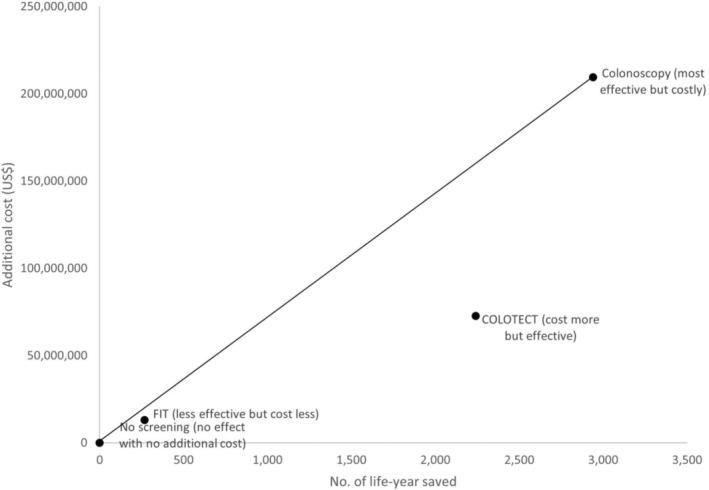
We assume that 100,000 persons aged 50 undergo annual FIT, annual COLOTECT multi-target testing, or colonoscopies every 10 years until age 75. The data used in this study was retrieved from different sources including the Hong Kong Cancer Registry and previously published studies on the population aged 50 to 75 years old between 2010 and 2023. This study accessed the most cost-effective screening strategy available. If a positive result of FIT or COLOTECT were observed, the participants would undergo a colonoscopy. The participants who used the colonoscopy as the main screening method conducted colonoscopies every 3 years. The Markov models were utilized to compare the outcomes from different strategies including life-years saved, years of life lost, and incremental cost-effectiveness ratio (primary outcome). The highest ICER was observed in colonoscopy (USD 160808), followed by FIT (USD 108952), and COLOTECT (USD 82206). A higher detection rate of CRC (COLOTECT: 39.3% vs. FIT: 4.5%), more CRC cases prevented (1272 vs. 146), and life-years saved (2295 vs. 337) were observed in the COLOTECT strategy than in FIT. Additionally, a lower total cost per life-year saved of COLOTECT (USD 180097) was observed than colonoscopy (USD 238356), which identified the more affordable and cost-saving COLOTECT strategy.
CONCLUSION
This study highlighted the better performance of COLOTECT than FIT in detecting CRC. Additionally, given its lower cost and higher acceptance, the COLOTECT strategy might be more cost-effective than colonoscopy for massive CRC screening.
背景
2020年,全球约有190万例新的结直肠癌(CRC)病例和100万人死于结直肠癌。
目的
本研究的目的是评估一种基于多靶点粪便DNA的筛查策略COLOTECT与粪便免疫化学检测(FIT)、结肠镜检查以及不进行筛查相比,在亚洲人群中的成本效益,以为政策制定者在结直肠癌筛查方面提供更多选择。
方法与结果
我们假设10万名50岁的人每年进行FIT、每年进行COLOTECT多靶点检测或每10年进行一次结肠镜检查,直至75岁。本研究中使用的数据来自不同来源,包括香港癌症登记处以及之前发表的关于2010年至2023年期间50至75岁人群的研究。本研究采用了最具成本效益的筛查策略。如果观察到FIT或COLOTECT结果为阳性,参与者将接受结肠镜检查。以结肠镜检查作为主要筛查方法的参与者每3年进行一次结肠镜检查。利用马尔可夫模型比较不同策略的结果,包括挽救的生命年数、损失的生命年数和增量成本效益比(主要结果)。结肠镜检查的最高增量成本效益比为160808美元,其次是FIT为108952美元,COLOTECT为82206美元。与FIT相比,COLOTECT策略观察到更高的结直肠癌检测率(COLOTECT:39.3% vs. FIT:4.5%)、更多预防的结直肠癌病例(1272例 vs. 146例)和挽救的生命年数(2295年 vs. 337年)。此外,观察到COLOTECT每挽救一个生命年的总成本(180097美元)低于结肠镜检查(238356美元),这表明COLOTECT策略更经济实惠且节省成本。
结论
本研究强调了COLOTECT在检测结直肠癌方面比FIT表现更好。此外,鉴于其成本较低且接受度较高,COLOTECT策略在大规模结直肠癌筛查中可能比结肠镜检查更具成本效益。


 Zotero 插件