
台湾地区流感疫苗与他汀类药物相互作用对横纹肌溶解症风险的影响:一项全国性以病例为中心的分析
Interaction between influenza vaccine and statins affecting the risk of rhabdomyolysis in Taiwan: a nationwide case-centred analysis.
作者信息
Chen Che-Yu, Hsieh Miyuki Hsing-Chun, Huang Wan-Ting, Lai Edward Chia-Cheng
机构信息
School of Pharmacy, Institute of Clinical Pharmacy and Pharmaceutical Sciences, College of Medicine, National Cheng Kung University, Tainan 70101, Taiwan.
Population Health Data Centre, National Cheng Kung University, Tainan 70101, Taiwan.
出版信息
EClinicalMedicine. 2025 Apr 10;82:103171. doi: 10.1016/j.eclinm.2025.103171. eCollection 2025 Apr.
BACKGROUND
Literature suggests a potential interaction between influenza vaccination, statin use and rhabdomyolysis, but evidence is limited to case reports.
METHODS
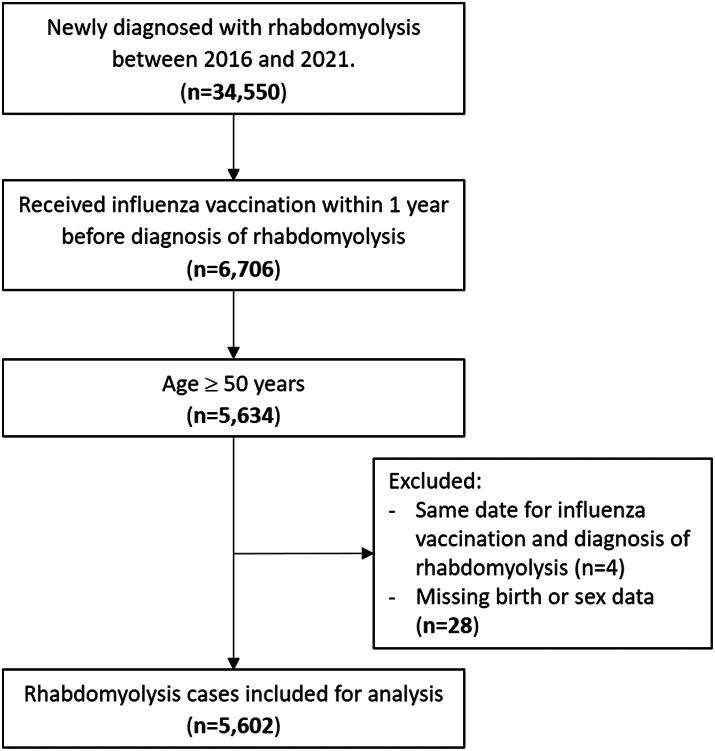
Using out- and inpatient health records from Taiwan's National Health Insurance Research Database (NHIRD) between January 2016 and December 2021, we retrospectively constructed a nationwide cohort of patients aged 50 years and older, first-ever diagnosed with rhabdomyolysis, focusing on those who received an influenza vaccine within the preceding one year. We applied a case-centred analysis to evaluate the interaction between statin use and influenza vaccination within specific risk intervals: 1-7 days and 8-14 days post-vaccination, as well as 30-day and 60-day windows for statin use prior to rhabdomyolysis diagnosis. The main outcome measures were odds ratios (ORs) for statin-associated rhabdomyolysis, stratified by timing of influenza vaccination.
FINDINGS
Among the 5,602 rhabdomyolysis cases analysed, 1,765 patients were exposed to statins within 30 days, and 1,838 patients were exposed within 60 days. 74 individuals were vaccinated within 7 days prior to their diagnosis, 30 of which were taking statins inside the 30-day interval, these individuals were found to be at a significantly higher risk of statin-related rhabdomyolysis (OR: 1.67, 95% confidence interval: 1.04-2.69). A similar risk was observed when the statin risk interval was extended to 60 days, 74 vaccinated rhabdomyolysis patients with 32 within the 60 day window (OR: 1.79, 95% confidence interval: 1.12-2.87). However, this increased risk was not observed among the 97 individuals (24 patients in the 30 day window and 26 in the 60 day) who received vaccination 8-14 days before rhabdomyolysis onset (OR: 0.85, 95% confidence interval: 0.53-1.36), and not in those vaccinated outside these risk intervals.
INTERPRETATION
Our results suggest a significant temporal association between recent influenza vaccination and increased risk of statin-associated rhabdomyolysis within 7 days post-vaccination. These findings highlight the need for healthcare providers to monitor for rhabdomyolysis symptoms following influenza vaccination in patients receiving statin therapy. Further confirmation in larger prospective international studies is warranted to better understand this potential association.
FUNDING
National Science and Technology Council of Taiwan (NSTC 112-2628-B-006-003-; NSTC 113-2628-B-006-009-) and the National Health Research Institutes of Taiwan (NHRI-11A1-CG-CO-04-2225-1; NHRI-12A1-CG-CO-04-2225-1; NHRI-13A1-CG-CO-04-2225-1; NHRI-14A1-CG-CO-04-2225-1).
背景
文献表明流感疫苗接种、他汀类药物使用与横纹肌溶解之间可能存在相互作用,但证据仅限于病例报告。
方法
利用台湾国民健康保险研究数据库(NHIRD)2016年1月至2021年12月的门诊和住院健康记录,我们回顾性构建了一个全国性队列,纳入50岁及以上首次诊断为横纹肌溶解的患者,重点关注在过去一年内接种流感疫苗的患者。我们采用以病例为中心的分析方法,评估他汀类药物使用与流感疫苗接种在特定风险区间内的相互作用:接种后1 - 7天和8 - 14天,以及横纹肌溶解诊断前他汀类药物使用的30天和60天窗口期。主要结局指标是他汀类药物相关横纹肌溶解的比值比(OR),按流感疫苗接种时间分层。
结果
在分析的5602例横纹肌溶解病例中,1765例患者在30天内使用了他汀类药物,1838例患者在60天内使用了他汀类药物。74例患者在诊断前7天内接种了疫苗,其中30例在30天内服用他汀类药物,这些患者被发现他汀类药物相关横纹肌溶解风险显著更高(OR:1.67,95%置信区间:1.04 - 2.69)。当他汀类药物风险区间延长至60天时观察到类似风险,74例接种疫苗的横纹肌溶解患者中有32例在60天窗口期内(OR:1.79,95%置信区间:1.12 - 2.87)。然而,在横纹肌溶解发作前8 - 14天接种疫苗的97例患者(30天窗口期内24例,60天窗口期内26例)中未观察到这种风险增加(OR:0.85,95%置信区间:0.53 - 1.36),在这些风险区间之外接种疫苗的患者中也未观察到。
解读
我们的结果表明近期流感疫苗接种与接种后7天内他汀类药物相关横纹肌溶解风险增加之间存在显著的时间关联。这些发现凸显了医疗保健提供者对接受他汀类药物治疗的患者在接种流感疫苗后监测横纹肌溶解症状的必要性。需要在更大规模的前瞻性国际研究中进一步证实,以更好地理解这种潜在关联。
资助
台湾国家科学技术委员会(NSTC 112 - 2628 - B - 006 - 003 - ;NSTC 113 - 2628 - B - 006 - 009 - )和台湾国家卫生研究院(NHRI - 11A1 - CG - CO - 04 - 2225 - 1;NHRI - 12A1 - CG - CO - 04 - 2225 - 1;NHRI - 13A1 - CG - CO - 04 - 2225 - 1;NHRI - 14A1 - CG - CO - 04 - 2225 - 1)。

 Zotero 插件