
不同长期运动干预对儿童和青少年工作记忆的影响:一项网状Meta分析
Effects of different long-term exercise interventions on working memory in children and adolescents: a network meta-analysis.
作者信息
Guo Xuejun, Wang Junyu, Liang Jie, Xie Ting, Zhang Lin
机构信息
Officers College of PAP, Chengdu, China.
School of Exercise and Health, Shanghai University of Sport, Shanghai, China.
出版信息
Front Psychol. 2025 Apr 10;16:1373824. doi: 10.3389/fpsyg.2025.1373824. eCollection 2025.
OBJECTIVES
To compare the relative efficacy of different exercise modalities on working memory accuracy and reaction time in healthy children and adolescents.
METHODS
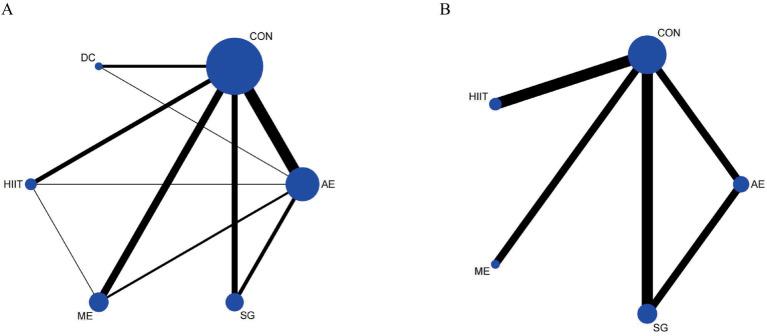
A systematic review and network meta-analysis was conducted in accordance with PRISMA guidelines (CRD420251005303). PubMed, Medline, Embase, the Cochrane Central Register of Controlled Trials, and Web of Science were searched from inception to March 1, 2025. Randomized controlled trials examining the impact of any exercise intervention (e.g., aerobic exercise, dance, high-intensity interval training, sports games, mixed exercise) versus control on working memory accuracy and/or reaction time were eligible. Standardized mean differences (SMDs) with 95% confidence intervals (CIs) were calculated, and a random-effects model was applied to account for between-study heterogeneity. The surface under the cumulative ranking curve (SUCRA) was used to determine the relative ranking of each modality.
RESULTS
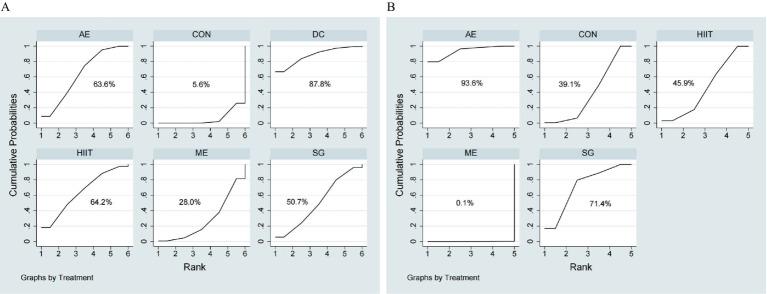
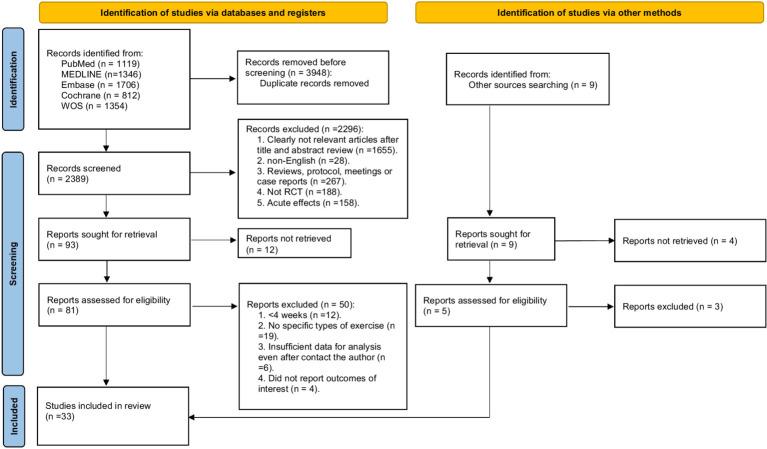
Thirty-three studies met inclusion criteria for working memory accuracy, and eight studies contributed data on reaction time. Dance demonstrated the highest SUCRA ranking for accuracy (87.8%), and was significantly superior to control (SMD = 0.67, 95% CI 0.13 to 1.21). Aerobic exercise ranked first for reaction time (93.6%), outperforming control (SMD = -0.40, 95% CI -0.69 to -0.11 for accuracy; SMD = -0.82, 95% CI -1.26 to -0.38 for reaction time compared with mixed exercise). Mixed exercise consistently showed lower rankings for both outcomes.
CONCLUSION
Distinct exercise modalities differentially affect working memory components in young populations. Dance and aerobic exercise appear most beneficial-dance maximizes accuracy, while aerobic exercise optimizes reaction time. Tailoring exercise interventions to specific cognitive targets may enhance working memory development and inform practical, evidence-based strategies in educational and clinical settings.
SYSTEMATIC REVIEW REGISTRATION
RD420251005303.
目的
比较不同运动方式对健康儿童和青少年工作记忆准确性及反应时间的相对疗效。
方法
按照PRISMA指南(CRD420251005303)进行系统评价和网状Meta分析。检索了从数据库建库至2025年3月1日的PubMed、Medline、Embase、Cochrane对照试验中央注册库和Web of Science。纳入考察任何运动干预(如有氧运动、舞蹈、高强度间歇训练、体育游戏、混合运动)与对照相比对工作记忆准确性和/或反应时间影响的随机对照试验。计算标准化均数差(SMD)及95%置信区间(CI),并应用随机效应模型处理研究间的异质性。累积排序曲线下面积(SUCRA)用于确定每种运动方式的相对排名。
结果
33项研究符合工作记忆准确性的纳入标准,8项研究提供了反应时间的数据。舞蹈在准确性方面的SUCRA排名最高(87.8%),且显著优于对照组(SMD = 0.67,95%CI 0.13至1.21)。有氧运动在反应时间方面排名第一(93.6%),与混合运动相比,在准确性方面优于对照组(SMD = -0.40,95%CI -0.69至-0.11;反应时间方面SMD = -0.82,95%CI -1.26至-0.38)。混合运动在这两个结果上的排名一直较低。
结论
不同的运动方式对年轻人群的工作记忆成分有不同影响。舞蹈和有氧运动似乎最有益——舞蹈可最大化准确性,而有氧运动可优化反应时间。根据特定认知目标定制运动干预措施可能会促进工作记忆发展,并为教育和临床环境中的实用、循证策略提供依据。
系统评价注册
RD420251005303。
 Zotero 插件