
基于等温信号放大的级联荧光传感器用于汞离子和银离子的检测
Cascade Fluorescent Sensors Based on Isothermal Signal Amplification for the Detection of Mercury and Silver Ions.
作者信息
Liu Zhen, Liu Xing, Sun Jie, Xiao Xilin
机构信息
School of Public Health, Hengyang School of Medicine, University of South China, Hengyang 421001, China.
State Key Laboratory of Chemo/Biosensing and Chemometrics, Hunan University, Changsha 410082, China.
出版信息
Biosensors (Basel). 2025 Mar 26;15(4):213. doi: 10.3390/bios15040213.
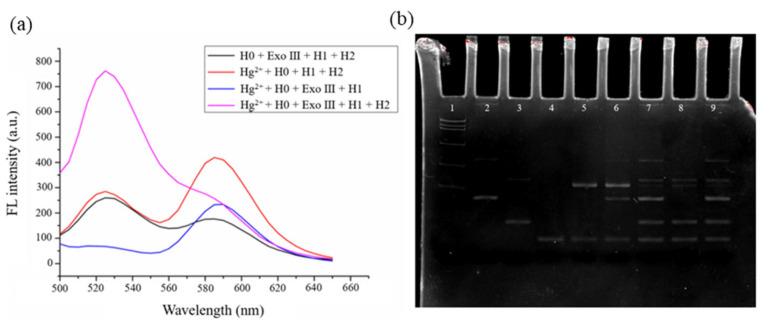
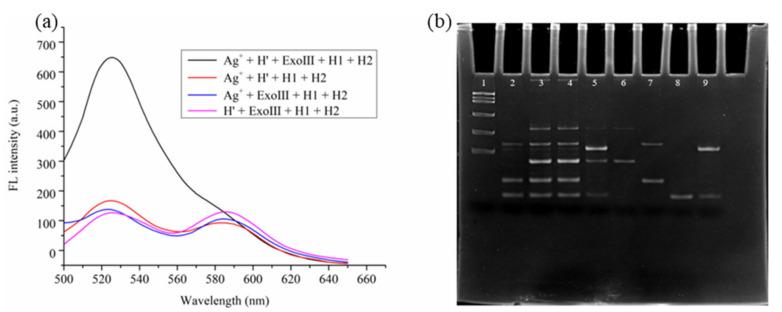
In this study, novel fluorescent DNA biosensors for mercury (Hg) and silver (Ag) ions were developed based on thymine (T)- and cytosine (C)-rich recognition elements in combination with exonuclease III and a mismatch-catalyzed hairpin assembly (MCHA)-based cascade isothermal signal-amplification strategy. In the presence of the respective target analytes, the recognition element terminals form so-called T-Hg-T or C-Ag-C structures, resulting in cleavage by Exo III and the release of the trigger strand for MCHA. This binds to the H1 hairpin, which is fluorescently labeled with carboxyfluorescein (FAM) and tetramethylrhodamine (TAMRA), disrupting fluorescence resonance energy transfer between them and, thus, restoring FAM fluorescence, generating a strong signal at 520 nm. The linear range of the Hg sensor is 0.5 to 3 pM, with a detection limit of 0.07 pM. The recovery range in actual spiked water samples is between 98.5% and 105.2%, with a relative standard deviation (RSD) ranging from 2.0% to 4.2%. The linear range of the Ag sensor is 10 to 90 pM, with a detection limit of 7.6 pM. The recovery range in actual spiked water samples is between 96.2% and 104.1%, with an RSD ranging from 3.2% to 6.3%. The cascade isothermal signal amplification strategy effectively enhances sensor sensitivity, while MCHA decreases the false-positive rate. The aptamer sensor exhibits high specificity, is resistant to interference, and can be used for the detection of Hg and Ag in environmental water samples.
在本研究中,基于富含胸腺嘧啶(T)和胞嘧啶(C)的识别元件,结合外切核酸酶III和基于错配催化发夹组装(MCHA)的级联等温信号放大策略,开发了用于汞(Hg)和银(Ag)离子的新型荧光DNA生物传感器。在各自目标分析物存在的情况下,识别元件末端形成所谓的T-Hg-T或C-Ag-C结构,导致外切核酸酶III切割并释放用于MCHA的触发链。该触发链与用羧基荧光素(FAM)和四甲基罗丹明(TAMRA)进行荧光标记的H1发夹结合,破坏它们之间的荧光共振能量转移,从而恢复FAM荧光,在520 nm处产生强信号。Hg传感器的线性范围为0.5至3 pM,检测限为0.07 pM。实际加标水样中的回收率范围在98.5%至105.2%之间,相对标准偏差(RSD)为2.0%至4.2%。Ag传感器的线性范围为10至90 pM,检测限为7.6 pM。实际加标水样中的回收率范围在96.2%至104.1%之间,RSD为3.2%至6.3%。级联等温信号放大策略有效地提高了传感器的灵敏度,而MCHA降低了假阳性率。该适体传感器具有高特异性,抗干扰能力强,可用于环境水样中Hg和Ag的检测。




 Zotero 插件