
小檗碱通过BCL6抑制IgE启动子处的STAT6结合活性来抑制人IgE而非IgG的产生。
Berberine Suppression of Human IgE but Not IgG Production via Inhibition of STAT6 Binding Activity at IgE Promoter by BCL6.
作者信息
Maskey Anish R, Carnazza Michelle, Spears Madison, Hemmindinger Steven, Kopulos Daniel, Yang Nan, Islam Humayun K, Moscatello Augustine L, Geliebter Jan, Tiwari Raj K, Li Xiu-Min
机构信息
Department of Pathology, Microbiology & Immunology, New York Medical College, Valhalla, NY 10595, USA.
Division of R&D, General Nutraceutical Technology LLC., Elmsford, NY 10523, USA.
出版信息
Cells. 2025 Apr 14;14(8):591. doi: 10.3390/cells14080591.
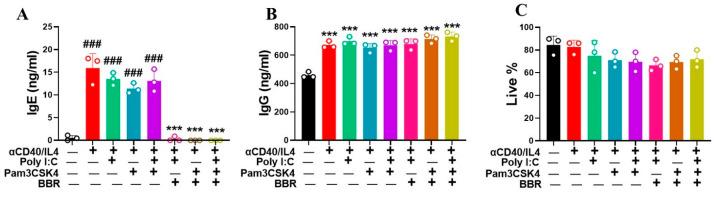
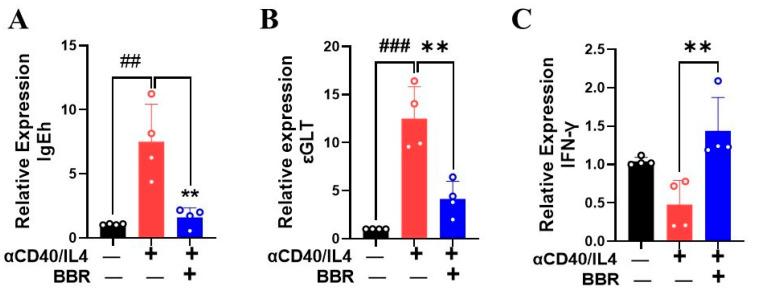
IgE may lead to life-threatening anaphylaxis. Currently, no satisfactory treatment to inhibit IgE production exists. This study aims to explore the anti-IgE effect of berberine (BBR) and possible mechanisms using human tonsil cells. Tonsil cells were treated with BBR at different doses following stimulation with anti-CD40/IL4 alone or in combination with poly I:C and Pam3CSK4 for 10 or 4 days. IgE and IgG levels were determined by ELISA and cell viability by trypan blue exclusion. Gene expression was analyzed by qRT-PCR and affinity binding assay was performed by chromatin immunoprecipitation assay (ChIP). BBR showed dose-dependent inhibition of IgE production following anti-CD40/IL4 stimulation without affecting cell viability and IgG levels. BBR (10 µg/mL) completely inhibited IgE production by B cells stimulated with anti-CD40/IL4 in combination with vaccine adjuvants-poly I:C and Pam3CSK4 without affecting IgG levels and cell viability. BBR inhibited IgE heavy chain (IgEh), epsilon germline-transcript (εGLT), STAT6, and NFκB1 and enhanced IFN-γ, NFκB1A, and BCL6 gene expression. ChIP assay showed that BBR inhibited STAT6 binding in the IgEh promoter region by enhancing BCL6 binding. This study shows BBR regulates IgE in human tonsil cells by inhibiting STAT6 binding through BCL6 at the IgEh promoter showing its potential for treating IgE-mediated allergies.
IgE可能导致危及生命的过敏反应。目前,尚无抑制IgE产生的令人满意的治疗方法。本研究旨在利用人扁桃体细胞探索黄连素(BBR)的抗IgE作用及其可能的机制。在用抗CD40/IL4单独或与多聚肌苷酸:胞苷酸(poly I:C)和Pam3CSK4联合刺激10天或4天后,用不同剂量的BBR处理扁桃体细胞。通过酶联免疫吸附测定(ELISA)测定IgE和IgG水平,通过台盼蓝排斥法测定细胞活力。通过定量逆转录聚合酶链反应(qRT-PCR)分析基因表达,并通过染色质免疫沉淀测定(ChIP)进行亲和结合测定。BBR在抗CD40/IL4刺激后显示出对IgE产生的剂量依赖性抑制,而不影响细胞活力和IgG水平。BBR(10μg/mL)完全抑制了抗CD40/IL4与疫苗佐剂多聚肌苷酸:胞苷酸和Pam3CSK4联合刺激的B细胞产生的IgE,而不影响IgG水平和细胞活力。BBR抑制IgE重链(IgEh)、ε种系转录本(εGLT)、信号转导和转录激活因子6(STAT6)以及核因子κB1(NFκB1),并增强干扰素γ(IFN-γ)、NFκB1A和B细胞淋巴瘤/白血病6(BCL6)基因表达。ChIP分析表明,BBR通过增强BCL6结合来抑制STAT6在IgEh启动子区域的结合。本研究表明,BBR通过在IgEh启动子处通过BCL6抑制STAT6结合来调节人扁桃体细胞中的IgE,显示出其治疗IgE介导的过敏反应 的潜力。



 Zotero 插件