
短期静态、动态以及结合拮抗肌收缩的收缩-放松拉伸方式对垂直跳高度和柔韧性的急性影响
Acute Effects of Short Static, Dynamic, and Contract-Relax with Antagonist Contraction Stretch Modalities on Vertical Jump Height and Flexibility.
作者信息
Cheurlin Clément, Cometti Carole, Mrabet Jihane, Opplert Jules, Babault Nicolas
机构信息
Centre d'expertise de la Performance, Faculté des Sciences du Sport, Université Bourgogne Europe, 3 Allée des Stades Universitaires, BP27877, 21078 Dijon, France.
Maison de Santé, 50 Place du Château de Randens, 73270 Beaufort, France.
出版信息
Sports (Basel). 2025 Apr 10;13(4):115. doi: 10.3390/sports13040115.
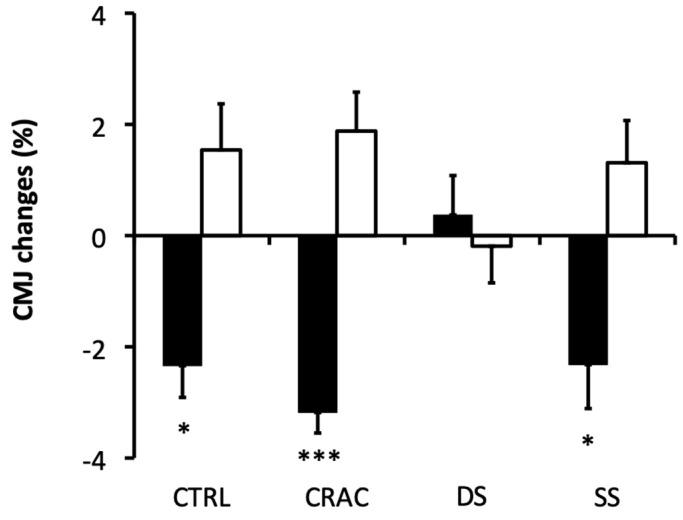
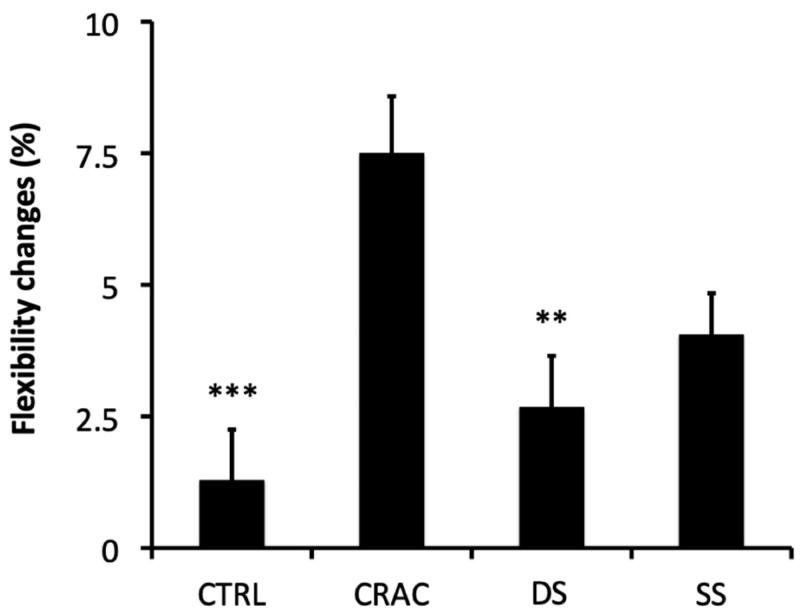
The present study investigated the acute effects of different stretching modalities applied within a warm-up on flexibility and vertical jump height. Thirty-seven young adults participated in four randomized experimental sessions, each corresponding to a different condition: static stretch (SS), dynamic stretch (DS), contract-relax with antagonist contraction (CRAC) or a control condition with no stretch (CTRL). Conditions were five min in total duration, including 2 × 15 s stretches for each muscle group (knee flexor, knee extensor, and plantar flexor muscles). Ten min and five min of cycling preceded and followed these procedures, respectively. Hamstring flexibility and a series of countermovement jump (CMJ) measurements were interspersed within this procedure. Except for CTRL, hamstring flexibility significantly increased ( < 0.01) after all experimental procedures (7.5 ± 6.6%, 4.1 ± 4.9%, and 2.7 ± 6.0% for CRA, SS, and DS, respectively). The relative increase was significantly greater for CRAC as compared CTRL ( < 0.001). Vertical jump height significantly decreased ( < 0.05) immediately after SS (-2.3 ± 3.9%), CTRL (-2.3 ± 3.5%), and CRAC (-3.2 ± 3.3%). Jump height was unchanged after DS (0.4 ± 4.5%). Whatever the condition, no additional jump height alteration was obtained after the re-warm-up. The main findings of the present study revealed that DS is more appropriate for maintaining vertical jump height. However, stretching has no major effect when performed within a warm-up. In contrast, if the main objective is to increase flexibility, CRAC is recommended.
本研究调查了热身过程中应用不同拉伸方式对柔韧性和垂直跳高度的急性影响。37名年轻人参加了四个随机实验环节,每个环节对应一种不同的条件:静态拉伸(SS)、动态拉伸(DS)、对抗肌收缩的收缩-放松(CRAC)或无拉伸的对照条件(CTRL)。每个条件的总时长为5分钟,包括对每个肌肉群(屈膝肌、伸膝肌和跖屈肌)进行2×15秒的拉伸。在这些程序之前和之后分别进行10分钟和5分钟的骑行。在这个过程中穿插进行了绳肌柔韧性测试和一系列纵跳(CMJ)测量。除CTRL外,所有实验程序后绳肌柔韧性均显著提高(<0.01)(CRAC、SS和DS分别提高7.5±6.6%、4.1±4.9%和2.7±6.0%)。与CTRL相比,CRAC的相对提高幅度显著更大(<0.001)。在SS(-2.3±3.9%)、CTRL(-2.3±3.5%)和CRAC(-3.2±3.3%)后,垂直跳高度立即显著下降(<0.05)。DS后跳高度没有变化(0.4±4.5%)。无论哪种条件,再次热身之后跳高度没有进一步变化。本研究的主要发现表明,DS更适合维持垂直跳高度。然而,在热身过程中进行拉伸没有显著效果。相比之下,如果主要目标是提高柔韧性,推荐使用CRAC。

 Zotero 插件