
血脂异常与衰老:血浆致动脉粥样硬化指数(AIP)与衰老加速之间的非线性关联。
Dyslipidemia and aging: the non-linear association between atherogenic index of plasma (AIP) and aging acceleration.
作者信息
Yang QianKun, Zhu XianJie, Zhang Li, Luo Fei
机构信息
National & Regional United Engineering Lab of Tissue Engineering, Department of Orthopedics, Southwest Hospital, Army Medical University, No.29 Gaotanyan St., Shapingba District, Chongqing, 400038, China.
Graduate School of Dalian Medical University, Dalian, 116000, China.
出版信息
Cardiovasc Diabetol. 2025 Apr 25;24(1):181. doi: 10.1186/s12933-025-02695-8.
BACKGROUND
Dyslipidemia has been proved to play a pivotal role in biological aging. Atherogenic Index of Plasma (AIP), derived from serum triglyceride (TG) and high-density lipoprotein cholesterol (HDL-C), is an effective biomarker of dyslipidemia. However, whether AIP can be used as an indicator of biological aging remains unclear. This study aims to investigate the relationship between AIP and biological aging in the US adult population.
METHODS
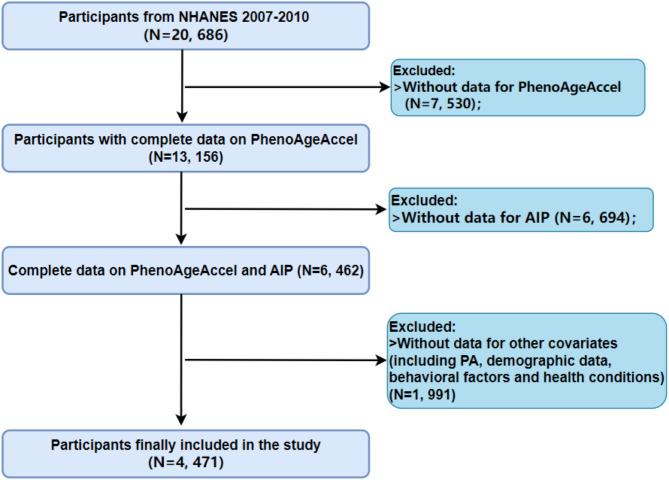
4,471 American adults with age over 20 years from the National Health and Nutrition Examination Survey (NHANES) database were included in this study. Biological aging was assessed by phenotypic age acceleration (PhenoAgeAccel). Multivariable linear regression models, subgroup analyses and interaction tests were employed to explore the association between AIP and PhenoAgeAccel. Furthermore, adjusted restricted cubic spline (RCS) analyses were employed to assess potential nonlinear relationships, while mediation analysis was utilized to identify the mediating effects of homeostatic model assessment of insulin resistance (HOMA-IR). Besides, network pharmacology was performed to determine the potential mechanisms underlying dyslipidemia-related aging acceleration.
RESULTS
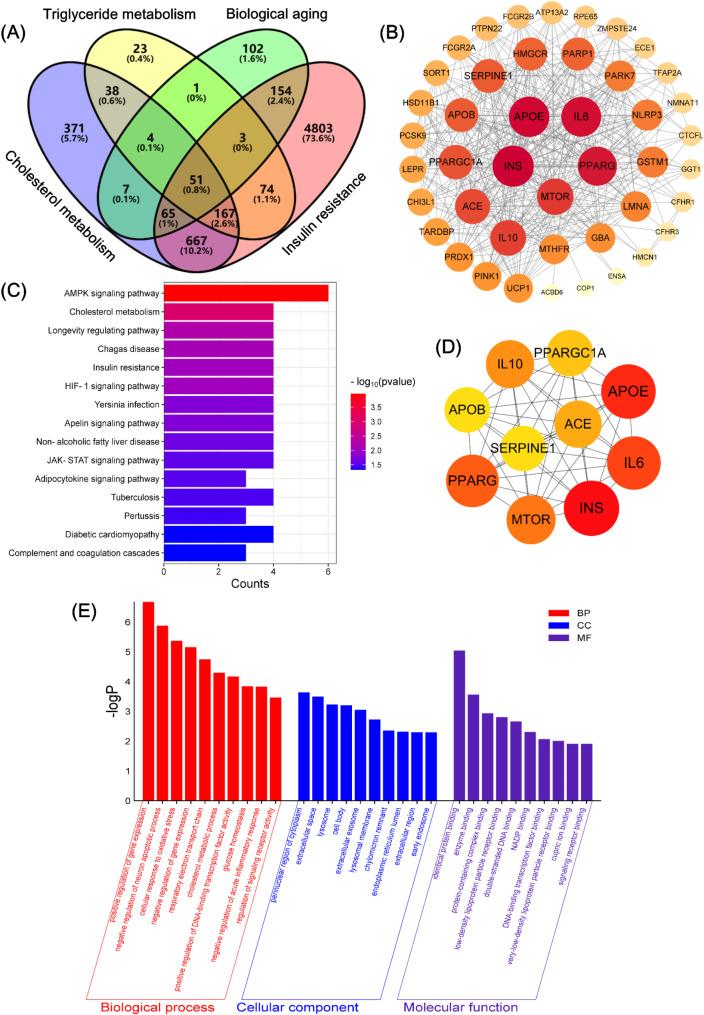
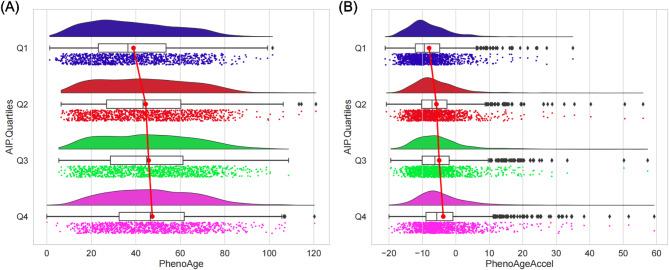
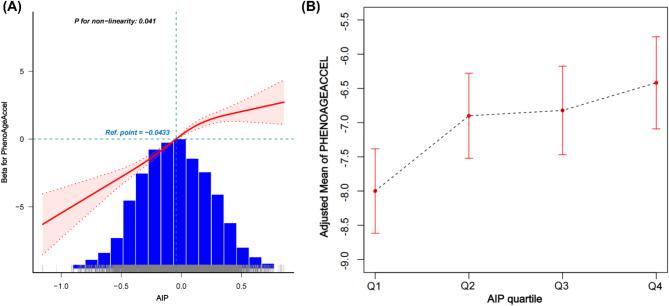
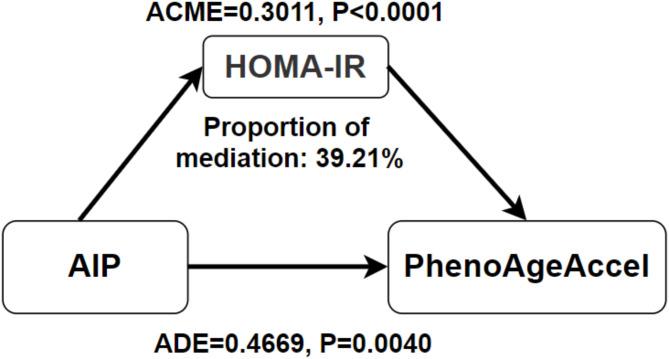
A total of 4,471 participants were included in this study, the median chronological age, PhenoAge and PhenoAgeAccel for the overall population were 49 (35-64) years, 42.85 (27.30-59.68) years, and - 6.92 (- 10.52 to -2.46) years, respectively. In the fully adjusted model, one unit increase of AIP was correlated with 1.820-year increase in PhenoAgeAccel (β = 1.820, 95% CI: 1.085-2.556), which was more pronounced among individuals being female, diabetic and hypertensive. Furthermore, RCS analysis revealed a nonlinear relationship between AIP and PhenoAgeAccel, with an inflection point identified at -0.043 for AIP via threshold and saturation effect analysis. AIP demonstrated a positive correlation with PhenoAgeAccel both before (β = 6.550, 95% CI: 5.070-8.030) and after (β = 3.898, 95% CI: 2.474-5.322) this inflection point. Additionally, HOMA-IR was found to mediate 39.21% of the association between AIP and PhenoAgeAccel. Finally, network pharmacology analysis identified INS, APOE, APOB, IL6, IL10, PPARG, MTOR, ACE, PPARGC1A, and SERPINE1 as core targets in biological aging, which were functionally linked to key signaling pathways like AMPK, apelin, JAK-STAT, FoxO, etc. CONCLUSIONS: An elevated AIP was notably and positively correlated with accelerated aging, suggesting that AIP may serve as an effective predictor to evaluate accelerated aging.
背景
血脂异常已被证明在生物衰老过程中起关键作用。血浆致动脉粥样硬化指数(AIP)由血清甘油三酯(TG)和高密度脂蛋白胆固醇(HDL-C)得出,是血脂异常的有效生物标志物。然而,AIP是否可用作生物衰老的指标仍不清楚。本研究旨在调查美国成年人群中AIP与生物衰老之间的关系。
方法
本研究纳入了来自国家健康与营养检查调查(NHANES)数据库的4471名年龄超过20岁的美国成年人。通过表型年龄加速(PhenoAgeAccel)评估生物衰老。采用多变量线性回归模型、亚组分析和交互作用检验来探讨AIP与PhenoAgeAccel之间的关联。此外,采用调整后的受限立方样条(RCS)分析来评估潜在的非线性关系,同时利用中介分析来确定胰岛素抵抗稳态模型评估(HOMA-IR)的中介作用。此外,进行网络药理学研究以确定血脂异常相关衰老加速的潜在机制。
结果
本研究共纳入4471名参与者,总体人群的年龄中位数、PhenoAge和PhenoAgeAccel分别为49(35 - 64)岁、42.85(27.30 - 59.68)岁和 -6.92(-10.52至 -2.46)岁。在完全调整模型中,AIP每增加一个单位与PhenoAgeAccel增加1.820岁相关(β = 1.820,95%CI:1.085 - 2.556),在女性、糖尿病患者和高血压患者中更为明显。此外,RCS分析显示AIP与PhenoAgeAccel之间存在非线性关系,通过阈值和饱和效应分析确定AIP的拐点为 -0.043。在该拐点之前(β = 6.550,95%CI:5.070 - 8.030)和之后(β = 3.898,95%CI:2.474 - 5.322),AIP与PhenoAgeAccel均呈正相关。此外,发现HOMA-IR介导了AIP与PhenoAgeAccel之间39.21%的关联。最后,网络药理学分析确定胰岛素(INS)、载脂蛋白E(APOE)、载脂蛋白B(APOB)、白细胞介素6(IL6)、白细胞介素10(IL10)、过氧化物酶体增殖物激活受体γ(PPARG)、雷帕霉素靶蛋白(MTOR)、血管紧张素转换酶(ACE)、过氧化物酶体增殖物激活受体γ辅激活因子1α(PPARGC1A)和丝氨酸蛋白酶抑制剂E1(SERPINE1)为生物衰老的核心靶点,它们在功能上与AMPK、apelin、JAK-STAT、FoxO等关键信号通路相关。结论:AIP升高与衰老加速显著正相关,表明AIP可能作为评估衰老加速的有效预测指标。

 Zotero 插件