
社交隔离与心房颤动的发病率及预后的关联:一项多州分析
Association of Social Disconnection With the Incidence and Prognosis of Atrial Fibrillation: A Multistate Analysis.
作者信息
Qiao Yu, Wang Yuyang, Ge Tingting, Liu Yahong, Chen Yuzhu, Niu Guodong, Yuan Yifang
机构信息
Department of Cardiac Arrhythmia Fuwai Yunnan Hospital, Chinese Academy of Medical Sciences, Kunming Medical University Kunming Yunnan China.
Key Laboratory of Medicinal Chemistry for Natural Resource, Ministry of Education, Yunnan Key Laboratory of Research and Development for Natural Products, School of Pharmacy Yunnan University Kunming Yunnan China.
出版信息
J Am Heart Assoc. 2025 May 6;14(9):e039885. doi: 10.1161/JAHA.124.039885. Epub 2025 Apr 25.
BACKGROUND
Social disconnection, including loneliness and social isolation, is associated with increased morbidity and death. However, its impact on the incidence and prognosis of atrial fibrillation (AF) remains inconclusive.
METHODS AND RESULTS
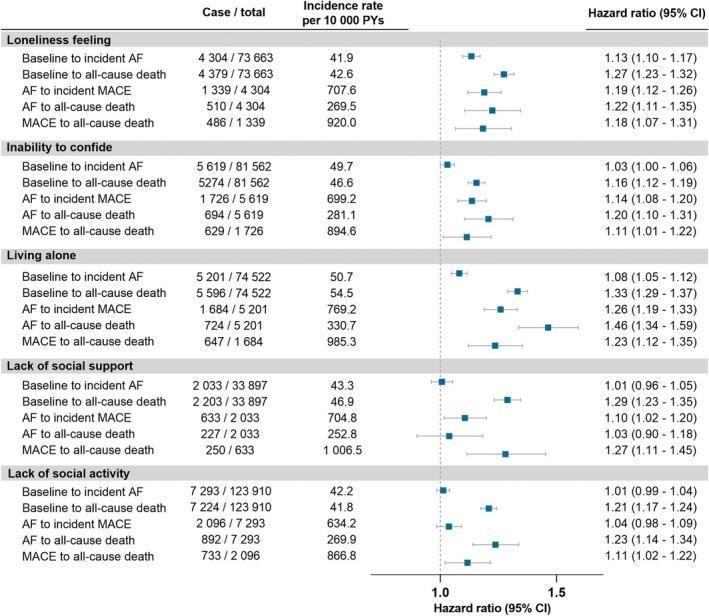
The present prospective cohort study enrolled 418 656 participants without AF and cardiovascular disease from the UK Biobank. A loneliness scale was constructed with 2 domains (loneliness feeling, inability to confide) and social isolation scale was constructed with 3 domains (living alone, lack of social support, and lack of social activity). We used a multistate model to analyze the impacts of the 2 scales on the progression from baseline to incident AF and subsequent major adverse cardiovascular events and further to death. Over a median follow-up of 14.7 years, 25 539 participants developed incident AF, among whom 7283 developed incident major adverse cardiovascular events, and 5165 died. Social isolation and loneliness scales were associated with both a higher incidence and worse prognosis of AF, with hazard ratios per 1-point increase of 1.06 (95% CI, 1.04-1.09) for the loneliness scale and 1.03 (95% CI, 1.02-1.05) for the social isolation scale for incident AF, and 1.12 to 1.14 for the loneliness scale (all <0.001) and 1.12 to 1.27 for the social isolation scale (all <0.001) after AF development. Loneliness feeling and living alone may be important contributors.
CONCLUSIONS
Loneliness and social isolation were both associated with a higher incidence and a worse prognosis of AF but to different extents. These observations highlight the importance of integrating social connection into the prevention and management of AF.
背景
社会脱节,包括孤独感和社会孤立,与发病率和死亡率增加相关。然而,其对心房颤动(AF)发病率和预后的影响仍无定论。
方法与结果
本前瞻性队列研究纳入了英国生物银行的418656名无AF和心血管疾病的参与者。构建了一个包含2个领域(孤独感、无法倾诉)的孤独量表和一个包含3个领域(独居、缺乏社会支持、缺乏社交活动)的社会孤立量表。我们使用多状态模型分析这两个量表对从基线到发生AF以及随后的主要不良心血管事件并进一步到死亡的进展的影响。在中位随访14.7年期间,25539名参与者发生了AF,其中7283人发生了主要不良心血管事件,5165人死亡。社会孤立和孤独量表与AF的较高发病率和较差预后均相关,对于发生AF,孤独量表每增加1分的风险比为1.06(95%CI,1.04-1.09),社会孤立量表为1.03(95%CI,1.02-1.05),AF发生后孤独量表为1.12至1.14(均<0.001),社会孤立量表为1.12至1.27(均<0.001)。孤独感和独居可能是重要因素。
结论
孤独感和社会孤立均与AF的较高发病率和较差预后相关,但程度不同。这些观察结果凸显了将社会联系纳入AF预防和管理的重要性。


 Zotero 插件