
CRISPR-Cas9介导的ATF6B基因编辑增强了HEK293T细胞中膜蛋白的产生。
CRISPR-Cas9-Mediated ATF6B Gene Editing Enhances Membrane Protein Production in HEK293T Cells.
作者信息
Choi Ho Joong, Kim Ba Reum, Kim Ok-Hee, Kim Say-June
机构信息
Department of Surgery, Division of Hepatobiliary Pancreatic Surgery, Seoul St. Mary's Hospital, College of Medicine, The Catholic University of Korea, 222, Banpo-daero, Seocho-gu, Seoul 06591, Republic of Korea.
Catholic Central Laboratory of Surgery, College of Medicine, The Catholic University of Korea, Seoul 06591, Republic of Korea.
出版信息
Bioengineering (Basel). 2025 Apr 11;12(4):409. doi: 10.3390/bioengineering12040409.
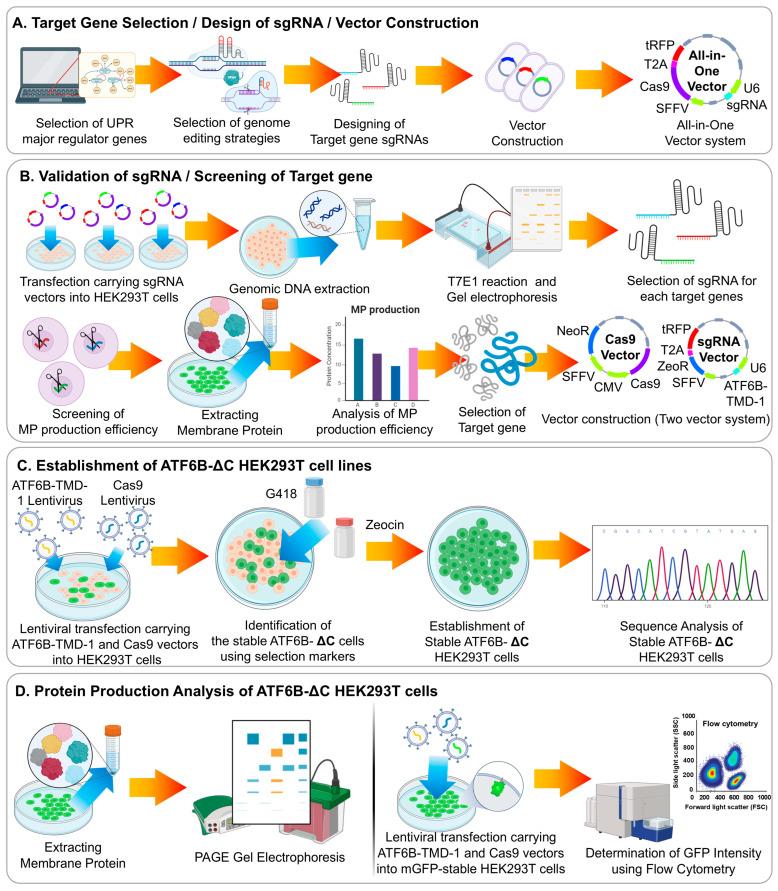
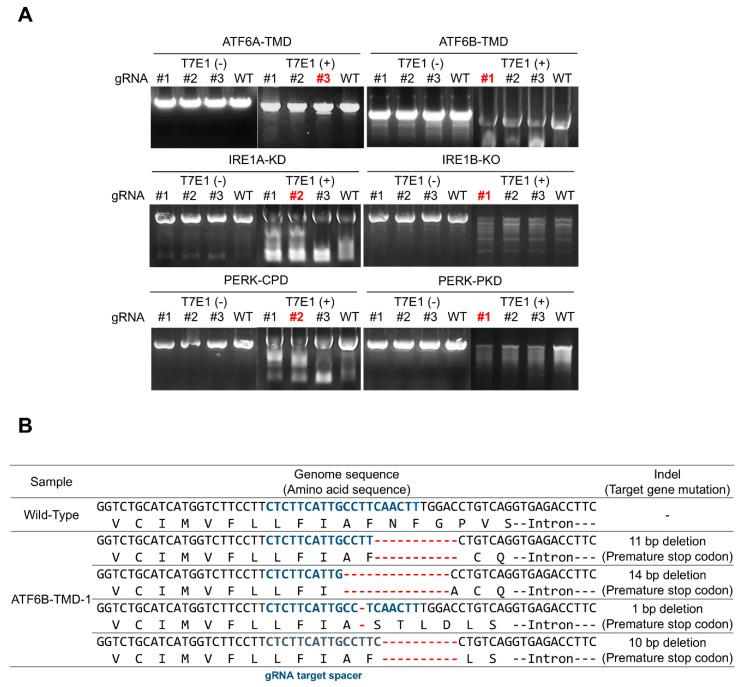
This study aims to enhance membrane protein production in HEK293T cells through genetic modification. HEK293T cells are used for recombinant protein and viral vector production due to their human origin and post-translational modification capabilities. This study explores enhancing membrane protein production in these cells by deleting the C-terminal of the ATF6B gene using CRISPR-Cas9 technology. The objective of this research is to investigate the effect of C-terminal deletion of the ATF6B gene on membrane protein production in HEK293T cells using CRISPR-Cas9 technology. To identify effective gene targets, sgRNAs were initially designed against multiple UPR-related genes, including ATF6A, IRE1A, IRE1B, PERK, and ATF6B. Among them, ATF6B was selected as the primary target for further investigation due to its superior editing efficiency. The efficiency of sgRNAs was evaluated using the T7E1 assay, and sequencing was performed to verify gene editing patterns. Membrane proteins were extracted from both ATF6B C-terminally deleted (ATF6B-ΔC) and wild-type (WT) cell lines for comparison. Flow cytometry was employed to assess membrane protein production by analyzing GFP expression in Membrane-GFP-expressing cells. HEK293T cells with C-terminally deleted ATF6B (ATF6B-ΔC) significantly increased membrane protein production by approximately 40 ± 17.6% compared to WT cells ( < 0.05). Sequencing revealed 11, 14, 1, and 10 bp deletions in the ATF6B-ΔC edited cells, which disrupted exon sequences, induced exon skipping, and introduced premature stop codons, suppressing normal protein expression. Flow cytometry confirmed a 23.9 ± 4.2% increase in GFP intensity in ATF6B-ΔC cells, corroborating the enhanced membrane protein production. These findings suggest that CRISPR-Cas9-mediated C-terminal deletion of the ATF6B gene can effectively enhance membrane protein production in HEK293T cells by activating the unfolded protein response pathway and improving the cell's capacity to manage misfolded proteins. This strategy presents significant potential for the biotechnology and pharmaceutical industries, where efficient membrane protein production is essential for drug development and various applications.
本研究旨在通过基因改造提高HEK293T细胞中膜蛋白的产量。由于HEK293T细胞来源于人类且具有翻译后修饰能力,因此被用于重组蛋白和病毒载体的生产。本研究探索利用CRISPR-Cas9技术删除ATF6B基因的C末端来提高这些细胞中膜蛋白的产量。本研究的目的是利用CRISPR-Cas9技术研究ATF6B基因C末端缺失对HEK293T细胞中膜蛋白产量的影响。为了确定有效的基因靶点,最初针对多个与未折叠蛋白反应(UPR)相关的基因设计了单向导RNA(sgRNA),包括ATF6A、IRE1A、IRE1B、PERK和ATF6B。其中,由于ATF6B具有更高的编辑效率,因此被选为进一步研究的主要靶点。使用T7E1分析法评估sgRNA的效率,并进行测序以验证基因编辑模式。从ATF6B C末端缺失(ATF6B-ΔC)细胞系和野生型(WT)细胞系中提取膜蛋白进行比较。通过分析表达膜结合型绿色荧光蛋白(Membrane-GFP)的细胞中的绿色荧光蛋白(GFP)表达,采用流式细胞术评估膜蛋白产量。与WT细胞相比,ATF6B C末端缺失(ATF6B-ΔC)的HEK293T细胞的膜蛋白产量显著增加,约提高了40±17.6%(P<0.05)。测序显示,在ATF6B-ΔC编辑的细胞中存在11、14、1和10个碱基对的缺失,这些缺失破坏了外显子序列,诱导外显子跳跃,并引入了过早的终止密码子,从而抑制了正常蛋白表达。流式细胞术证实,ATF6B-ΔC细胞中GFP强度增加了23.9±4.2%,证实了膜蛋白产量的提高。这些发现表明,CRISPR-Cas9介导的ATF6B基因C末端缺失可通过激活未折叠蛋白反应途径和提高细胞处理错误折叠蛋白的能力,有效提高HEK293T细胞中膜蛋白的产量。该策略在生物技术和制药行业具有巨大潜力,在这些行业中,高效的膜蛋白生产对于药物开发和各种应用至关重要。




 Zotero 插件