
晚期癌症患者伦理问题的患病率:对姑息治疗需求复杂性PALCOM量表开发与验证队列汇总数据的二次分析
Prevalence of Ethical Issues in Patients with Advanced Cancer: Secondary Analysis of Pooled Data from the Development and Validation Cohorts of the PALCOM Scale for the Complexity of Palliative Care Needs.
作者信息
Tuca Albert, Viladot Margarita, Barrera Carmen, Chicote Manoli, Gabarró Teresa, Carrera Gemma, Pascual Anais, Font Elena, Angulo Elena, Hernández-Godoy Ester, Marco-Hernández Javier, Llavata Lucia, Padrosa Joan, Zamora-Martínez Carles, Codorniu Nuria
机构信息
Unit of Supportive Care in Cancer, Medical Oncology Department, Hospital Clinic and Translational Genomics and Targeted Therapies in Solid Tumours, August Pi i Sunyer Biomedical Research Institute, IDIBAPS, University of Barcelona, 08036 Barcelona, Spain.
Psychosocial Support Team, "La Caixa" Foundation (EAPS), Clinic Hospital of Barcelona, 08036 Barcelona, Spain.
出版信息
Cancers (Basel). 2025 Apr 16;17(8):1345. doi: 10.3390/cancers17081345.
INTRODUCTION
The life experience of patients with advanced cancer and limited life expectancy is unique and profoundly complex, often leading to moral discrepancies among the various individuals involved in decision making. There are no data in the literature on the prevalence of ethical issues in the end-of-life care of patients with advanced cancer.
OBJECTIVES
The primary objective of this study is to identify the overall and specific prevalence of ethical issues in the end-of-life care process for patients with advanced cancer.
METHOD
We performed a secondary analysis using pooled data from the prospective development and validation cohorts of the PALCOM scale, focusing on the complexity of palliative care needs. This was performed to determine the overall and specific prevalence of ethical issues, describe their evolution over a 6-month follow-up period, and analyze their association with the level of palliative care complexity.
RESULTS
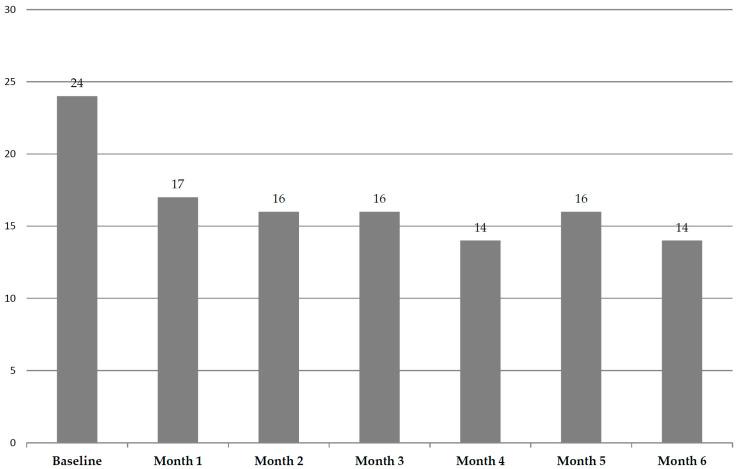
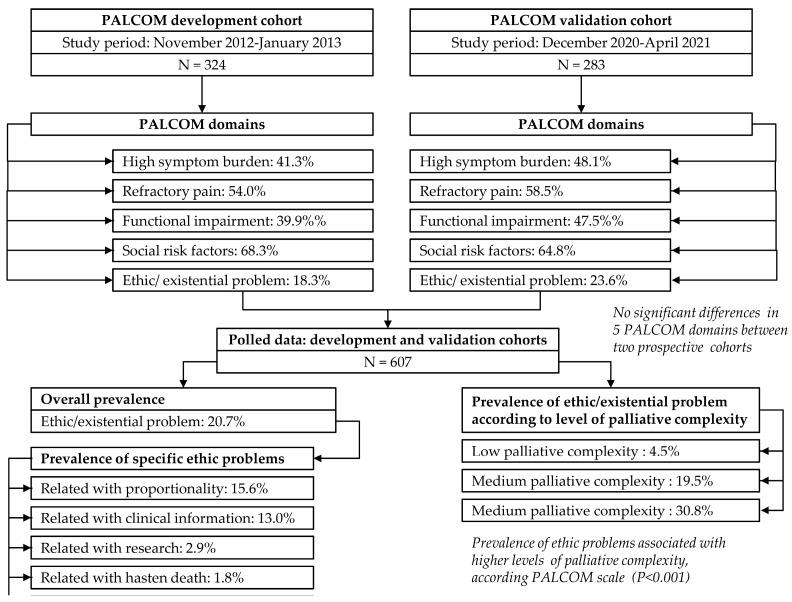
A total of 607 patients with advanced cancer and a life expectancy of 6 months or less were included. The consistency in clinical data and the frequencies of the PALCOM scale domains between the development and validation cohorts, conducted in various settings and times, confirmed the reliability of the pooled data sample. Systematic application of the PALCOM scale identified 126 patients (20.7%) who experienced at least one ethical issue. A total of 204 ethical issues (1.6 per patient) were recorded, related to the following: the proportionality of healthcare intervention (15.6%); information (13.0%); research (2.9%); the desire to hasten death (1.8%); and palliative sedation (0.15%). The monthly probability of presenting an ethical issue was significantly higher at the baseline visit (24.0%) compared to the rest of the 6-month follow-up period (14-17%) ( < 0.001). The prevalence of ethical issues was notably higher in patients with greater palliative care complexity as measured by the PALCOM scale: 4.5% in low complexity, 19.5% in medium complexity, and 30.8% in high complexity ( < 0.001).
CONCLUSIONS
The prevalence of ethical issues in patients with advanced cancer is high. Most of these issues are directly or indirectly related to the preservation of patient autonomy in the decision-making process. The presence of ethical issues is significantly associated with the greater complexity of palliative care needs. In this context, it is crucial for healthcare professionals to strengthen both communication skills and basic competencies to effectively identify, assess, and manage these ethical issues.
引言
晚期癌症且预期寿命有限的患者的生活经历独特且极为复杂,常常导致参与决策的各方出现道德分歧。文献中尚无关于晚期癌症患者临终关怀中伦理问题发生率的数据。
目的
本研究的主要目的是确定晚期癌症患者临终关怀过程中伦理问题的总体及具体发生率。
方法
我们使用PALCOM量表前瞻性开发和验证队列的汇总数据进行了二次分析,重点关注姑息治疗需求的复杂性。这样做是为了确定伦理问题的总体及具体发生率,描述其在6个月随访期内的演变情况,并分析其与姑息治疗复杂性水平的关联。
结果
共纳入607例预期寿命为6个月或更短的晚期癌症患者。在不同时间和环境下进行的开发队列和验证队列之间,临床数据及PALCOM量表各领域的频率一致性证实了汇总数据样本的可靠性。PALCOM量表的系统应用确定了126例(20.7%)经历过至少一个伦理问题的患者。共记录了204个伦理问题(每位患者1.6个),涉及以下方面:医疗干预的比例(15.6%);信息(13.0%);研究(2.9%);加速死亡的意愿(1.8%);以及姑息性镇静(0.15%)。与6个月随访期的其余时间(14 - 17%)相比,基线访视时出现伦理问题的月度概率显著更高(24.0%)(<0.001)。根据PALCOM量表衡量,姑息治疗复杂性较高的患者中伦理问题的发生率明显更高:低复杂性患者中为4.5%,中等复杂性患者中为19.5%,高复杂性患者中为30.8%(<0.001)。
结论
晚期癌症患者中伦理问题的发生率很高。这些问题大多直接或间接与决策过程中患者自主权的维护有关。伦理问题的存在与姑息治疗需求的更大复杂性显著相关。在此背景下,医疗保健专业人员加强沟通技巧和基本能力以有效识别、评估和管理这些伦理问题至关重要。
 Zotero 插件