
气候变量、土壤特性和花生品种对根瘤菌群落的影响。
The Effect of Climate Variables, Soil Characteristics, and Peanut Cultivars on the Rhizobial Bacteria Community.
作者信息
Li Juan, Yang Zhong-De, Wang En-Tao, Sun Li-Qin, Li Yan
机构信息
Yantai Key Laboratory of Characteristic Agricultural Bioresource Conservation & Germplasm Innovative Utilization, College of Life Sciences, Yantai University, Yantai 264005, China.
Departamento de Microbiología, Escuela Nacional de Ciencias Biológicas, Instituto Politécnico Nacional, Ciudad de México 11340, Mexico.
出版信息
Microorganisms. 2025 Apr 17;13(4):926. doi: 10.3390/microorganisms13040926.
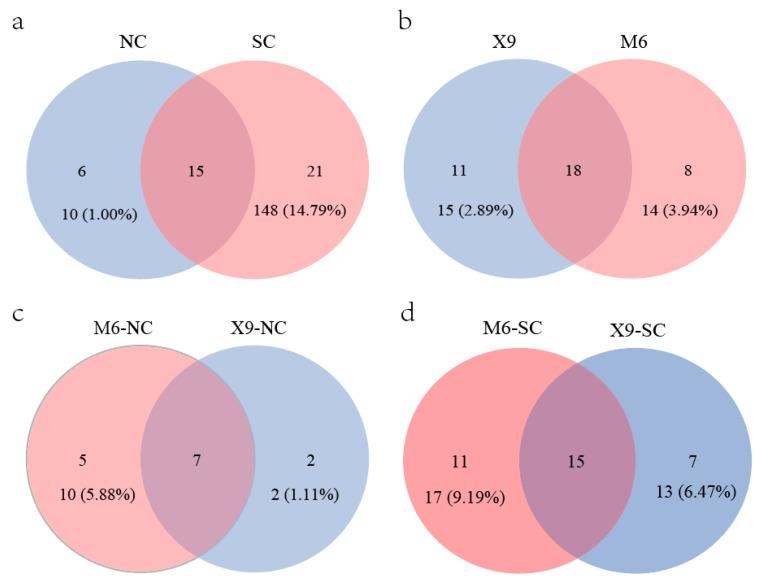
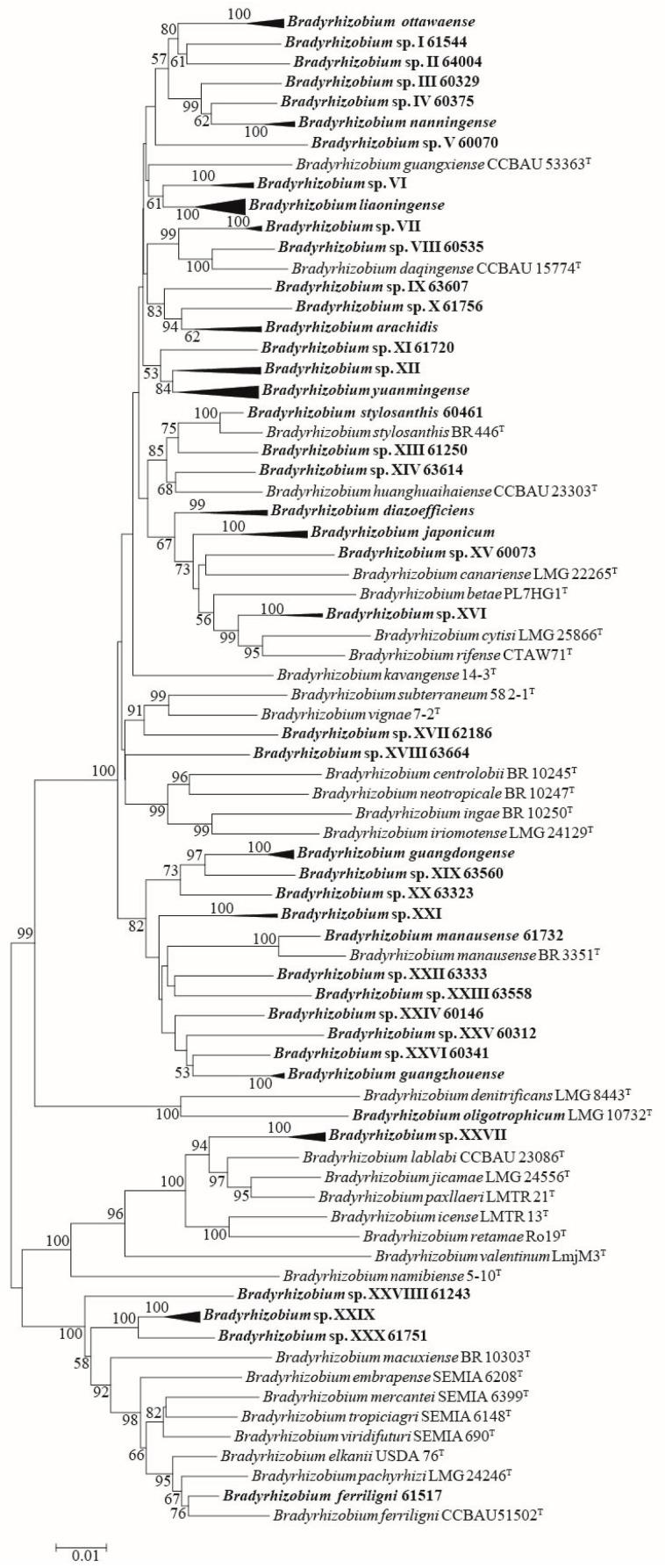
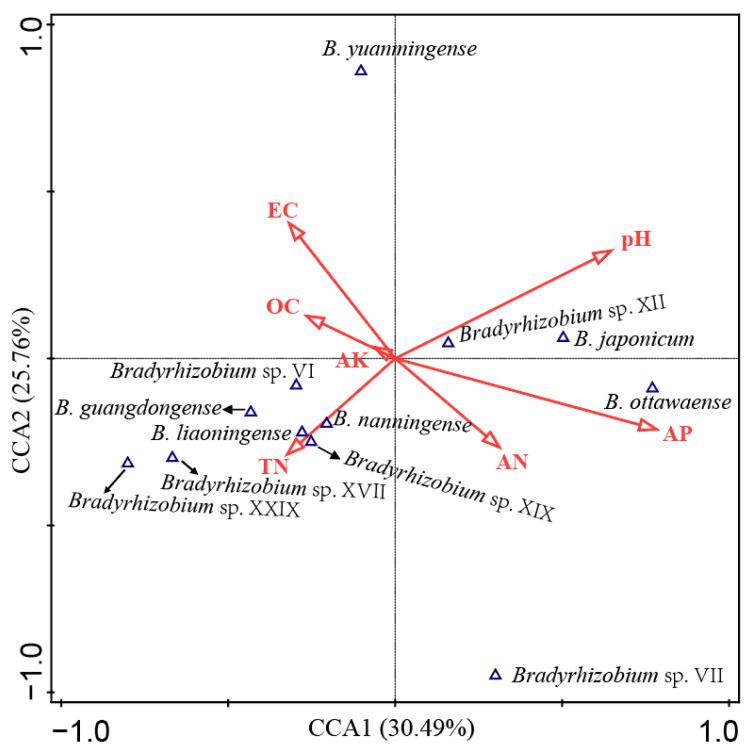
Peanuts are widely cultivated across the world; however, peanut's rhizobial community and the determinant factors of their composition are still to be elucidated. This study investigates the biogeography and determinant soil environmental factors for peanut rhizobia. A total of 1001 rhizobial isolates were obtained from the peanut root nodules, mainly belonging to two cultivars (X9 and M6) cultivated in 20 sampling sites across China. According to sequence analysis, all the isolates were classified as 84 haplotypes, and a representative strain for each haplotype was randomly selected to perform subsequent analyses. Based on multilocus sequence analysis (MLSA) of housekeeping genes , , , , and , all the representative strains were classified as 42 genospecies in the genus , including 12 effectively published and 30 undefined genospecies. Strains belonging to six genospecies were predominant (>5%), including , , , sp. XXIX, , and . However, only a single isolate was obtained for 15 genospecies. The diversity indices of peanut rhizobia distributed in South China are obviously higher than those in North China, but no obvious peanut cultivar selection for rhizobial genospecies was found. Correlation analyses indicated that the community composition of peanut rhizobia was mainly affected by MAP, MAT, soil AP, and pH. Nodulation tests indicated that the 79 representative strains belonging to 37 genospecies with both and could perform nitrogen-fixing symbiosis with peanuts. This study revealed the great diversity and varied composition of communities of peanut rhizobia in different geographic regions across China.
花生在全球广泛种植;然而,花生的根瘤菌群落及其组成的决定因素仍有待阐明。本研究调查了花生根瘤菌的生物地理学和决定性土壤环境因素。从花生根瘤中总共获得了1001株根瘤菌分离株,主要来自在中国20个采样点种植的两个品种(X9和M6)。根据序列分析,所有分离株被分为84个单倍型,并随机选择每个单倍型的一个代表性菌株进行后续分析。基于看家基因、、、和的多位点序列分析(MLSA),所有代表性菌株被分为属中的42个基因种,包括12个有效发表的和30个未定义的基因种。属于6个基因种的菌株占主导地位(>5%),包括、、、XXIX种、和。然而,15个基因种仅获得了一个分离株。分布在中国南方的花生根瘤菌的多样性指数明显高于北方,但未发现对根瘤菌基因种有明显的花生品种选择。相关性分析表明,花生根瘤菌的群落组成主要受年均降水量、年均气温、土壤有效磷和pH值的影响。结瘤试验表明,属于37个基因种的79个代表性菌株,兼具和,能够与花生进行固氮共生。本研究揭示了中国不同地理区域花生根瘤菌群落的巨大多样性和不同组成。


 Zotero 插件