
酒渣鼻与咽喉癌之间的因果关系及潜在致病机制
Causal relationship and potential pathogenic mechanisms between rosacea with pharyngeal and laryngeal cancer.
作者信息
Zhu Zexin, Wang Xiaoxue
机构信息
Department of Surgical Oncology, The Comprehensive Breast Care Center, The Second Affiliated Hospital of Xi'an Jiaotong University, Xi'an, China.
Department of Dermatology, The Second Affiliated Hospital of Xi'an Jiaotong University, Xi'an, China.
出版信息
Braz J Otorhinolaryngol. 2025 Apr 25;91(4):101636. doi: 10.1016/j.bjorl.2025.101636.
OBJECTIVE
Rosacea is a common chronic inflammatory skin disease. Observational studies reported the association between rosacea and cancer. The causal relationship between rosacea and cancer has been reported rarely.
METHODS
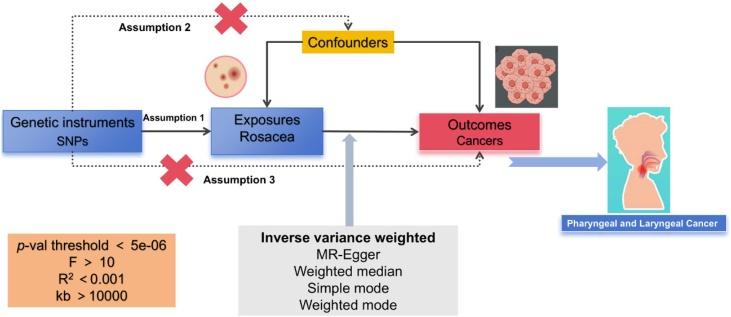
We employed a two-sample Mendelian Randomization (MR) study to assess the causality between rosacea and 17 subtypes of cancers. Rosacea and cancers' association Genome-Wide Association Study (GWAS) data were collected. The Inverse Variance Weighted (IVW) method was utilized as the principal method in our Mendelian Randomization (MR) study, with additional using the MR-Egger, weighted median, simple mode, and weighted mode methods. The MR-Egger intercept test, Cochran's Q test, MR-Pleiotropy RESidual Sum and Outlier (MR-PRESSO) and leave-one-out analysis were conducted to identify heterogeneity and pleiotropy. After that, Disease-related genes were also referenced from GeneCard.
RESULTS
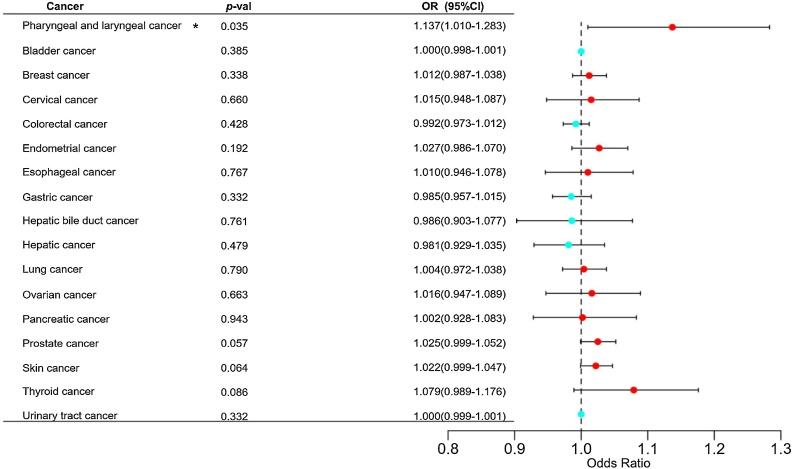
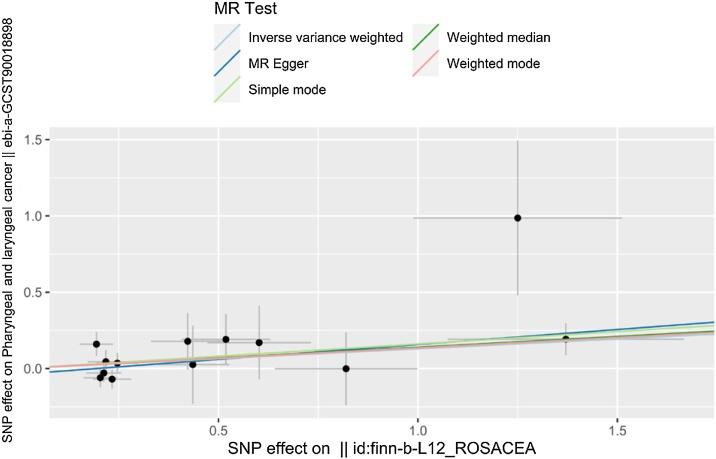
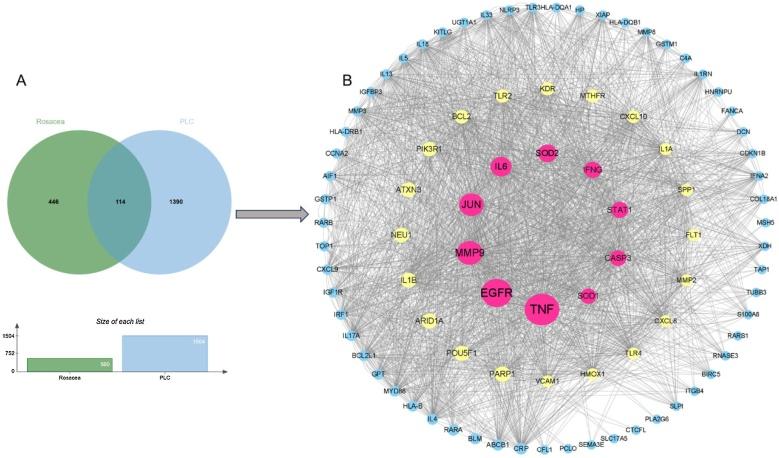
After our MR analysis, we found rosacea has a causal relationship with pharyngeal and laryngeal cancer (PLC, Odds Ratio [OR = 1.137], 95% CI 1.010‒1.283, p-value = 0.035). Rosacea may increase the risk of PLC. No causal link between rosacea and other cancer was observed. No heterogeneity or pleiotropy was observed. Reversed MR showed PLC has no causal effect on rosacea. Furthermore, disease-related genes were obtained. The intersecting genes between rosacea and PLC were identified. Gene Ontology (GO) and Kyoto Encyclopedia of Genes and Genomes (KEGG) enrichment analyses were performed, these intersecting genes were associated with pathways related to immunity inflammation procedures or pathways.
CONCLUSION
This study provided new evidence of the relationship between rosacea and PLC. Rosacea may play a facilitative role in PLC progression. Identification of related genes related to rosacea and PLC offers new scene for investigating the potential pathogenesis of PLC, this could provide innovative and efficient ways to address PLC treatment.
LEVEL OF EVIDENCE
Level II. Mendelian Randomized (MR) studies are second only to randomized controlled trials in terms of the level of evidence.
目的
酒渣鼻是一种常见的慢性炎症性皮肤病。观察性研究报告了酒渣鼻与癌症之间的关联。酒渣鼻与癌症之间的因果关系鲜有报道。
方法
我们采用两样本孟德尔随机化(MR)研究来评估酒渣鼻与17种癌症亚型之间的因果关系。收集了酒渣鼻与癌症的全基因组关联研究(GWAS)数据。在我们的孟德尔随机化(MR)研究中,采用逆方差加权(IVW)方法作为主要方法,另外还使用了MR-Egger、加权中位数、简单模式和加权模式方法。进行了MR-Egger截距检验、 Cochr an's Q检验、MR-多效性残差和异常值(MR-PRESSO)以及留一法分析,以识别异质性和多效性。之后,还从基因卡中参考了疾病相关基因。
结果
经过我们的MR分析,我们发现酒渣鼻与咽喉癌(PLC,优势比[OR = 1.137],95%置信区间1.010‒1.283,p值 = 0.035)存在因果关系。酒渣鼻可能会增加患PLC的风险。未观察到酒渣鼻与其他癌症之间存在因果联系。未观察到异质性或多效性。反向MR显示PLC对酒渣鼻没有因果影响。此外,还获得了疾病相关基因。确定了酒渣鼻与PLC之间的交叉基因。进行了基因本体(GO)和京都基因与基因组百科全书(KEGG)富集分析,这些交叉基因与免疫炎症程序或途径相关的通路有关。
结论
本研究为酒渣鼻与PLC之间的关系提供了新证据。酒渣鼻可能在PLC进展中起促进作用。鉴定与酒渣鼻和PLC相关的基因,为研究PLC的潜在发病机制提供了新视角,这可为解决PLC治疗提供创新且有效的方法。
证据水平
二级。孟德尔随机化(MR)研究在证据水平方面仅次于随机对照试验。


 Zotero 插件