
长期肠外营养增加极低出生体重儿合并症风险:韩国一项前瞻性全国队列研究
Prolonged Parenteral Nutrition Increases the Risk of Comorbidities in Very-Low-Birth-Weight Infants: A Prospective National Cohort Study in South Korea.
作者信息
Kim Seong Wan, Suh Yoong-A, Choi Seoheui, Park Moon Sung, Lee Jang Hoon
机构信息
Department of Pediatrics, Ajou University Hospital, Suwon 16499, Republic of Korea.
出版信息
Nutrients. 2025 Mar 12;17(6):996. doi: 10.3390/nu17060996.
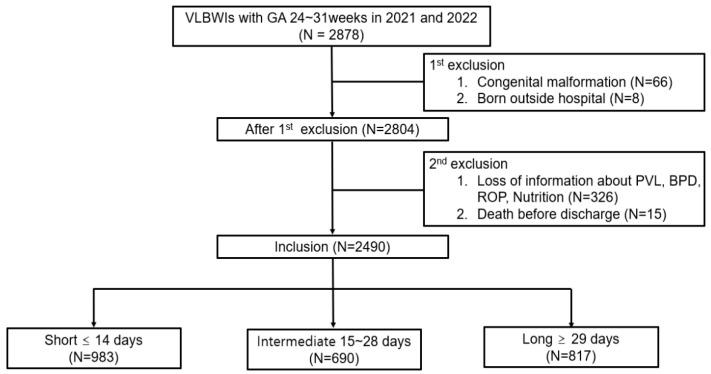
: There has been an increase in the incidence of comorbidities among very-low-birth-weight infants (VLBWIs), including periventricular leukomalacia (PVL), bronchopulmonary dysplasia (BPD), and retinopathy of prematurity (ROP). Parenteral nutrition is essential for very-low-birth-weight infants (VLBWIs) who are born with a birth weight of less than 1500 g, but a longer duration of parenteral nutrition is known to have a risk of comorbidity, such as ROP. This study aims to investigate the relationship between the duration of parenteral nutrition and the comorbidities of the VLBWIs. : Using the prospective cohort of Korean neonatal network, we analyzed the perinatal and postnatal data before discharge of the total 2490 subjects born in 2021 and 2022. The primary outcomes were the diagnoses of PVL, BPD, and ROP. The secondary outcomes were the severity of BPD and ROP, treatment of ROP, and proposing the predictive model of comorbidities using the duration of parenteral nutrition. : This study found that prolonged parenteral nutrition exceeding 28 days was associated with a higher risk of PVL (odds ratio [OR] 1.71, 95% confidence interval [CI] [1.11, 2.64], = 0.002) and BPD (OR 1.51, 95% CI [1.10, 2.08], = 0.011). Furthermore, an intermediate duration of parenteral nutrition was found to be significantly associated with an increased risk of ROP in male subjects. Additionally, a prolonged duration of parenteral nutrition was observed to be linked to greater severity of BPD. Predictive models incorporating the duration of parenteral nutrition demonstrated a high degree of explanatory power in relation to both BPD and ROP. : Longer duration of parenteral nutrition has a risk of critical comorbidities in VLBWIs. The nutrition strategy for shorter parenteral nutrition should be encouraged for the prevention of comorbidities.
极低出生体重儿(VLBWIs)的合并症发病率有所上升,包括脑室周围白质软化症(PVL)、支气管肺发育不良(BPD)和早产儿视网膜病变(ROP)。肠外营养对于出生体重低于1500克的极低出生体重儿至关重要,但已知较长时间的肠外营养存在合并症风险,如ROP。本研究旨在调查肠外营养持续时间与极低出生体重儿合并症之间的关系。:利用韩国新生儿网络的前瞻性队列,我们分析了2021年和2022年出生的2490名受试者出院前的围产期和产后数据。主要结局是PVL、BPD和ROP的诊断。次要结局是BPD和ROP的严重程度、ROP的治疗,以及使用肠外营养持续时间建立合并症预测模型。:本研究发现,肠外营养超过28天与PVL风险升高相关(比值比[OR]1.71,95%置信区间[CI][1.11,2.64], = 0.002)和BPD(OR 1.51,95%CI[1.10,2.08], = 0.011)。此外,发现肠外营养的中等持续时间与男性受试者ROP风险增加显著相关。此外,观察到较长时间的肠外营养与BPD的更严重程度有关。纳入肠外营养持续时间的预测模型在BPD和ROP方面均显示出高度的解释力。:较长时间的肠外营养在极低出生体重儿中有发生严重合并症的风险。应鼓励采用缩短肠外营养时间的营养策略以预防合并症。
 Zotero 插件