
糖尿病患者血尿素氮与血清白蛋白比值与心血管疾病、心血管死亡率及全因死亡率之间的关系。
The relationship between blood urea nitrogen to serum albumin ratio and cardiovascular diseases, cardiovascular mortality, and all-cause mortality in patients with diabetes mellitus.
作者信息
Zhu Hongwei, Xie Wei, Wang Peng, Jiang ShuYuan, Hua YunQi, Shao Guo, Li ZhiHui
机构信息
Department of Emergency, The Second Affiliated Hospital of Baotou Medical College, Inner Mongolia University of Science and Technology, Baotou, China.
Inner Mongolia Key laboratory of Hypoxic Translational Medicine, Baotou Medical College, Inner Mongolia, Baotou, China.
出版信息
Front Endocrinol (Lausanne). 2025 Apr 11;16:1456731. doi: 10.3389/fendo.2025.1456731. eCollection 2025.
BACKGROUND
The relationship between the Blood Urea Nitrogen to Albumin Ratio (BAR) and cardiovascular diseases in diabetes, as well as cardiovascular and all-cause mortality, is not yet entirely understood. This study aimed to examine the correlation between the serum urea nitrogen to albumin ratio and cardiovascular diseases, cardiovascular mortality, and all-cause mortality in diabetes.
METHODS
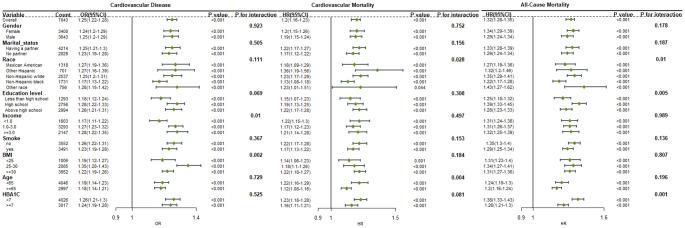
A total of 7043 adult diabetes patients were included from the NHANES database from 2001 to 2018. The relationship between BAR and cardiovascular diseases, cardiovascular mortality and all-cause mortality in patients with diabetes mellitus was verified using baseline characteristic analysis, multivariate logistic regression analysis, multivariate Cox proportional hazards model, Kaplan-Meier (K-M) analysis, smoothed fitted curves, and subgroup analysis.
RESULTS
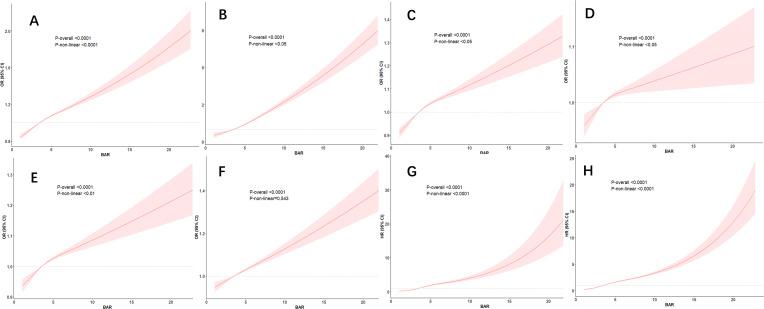
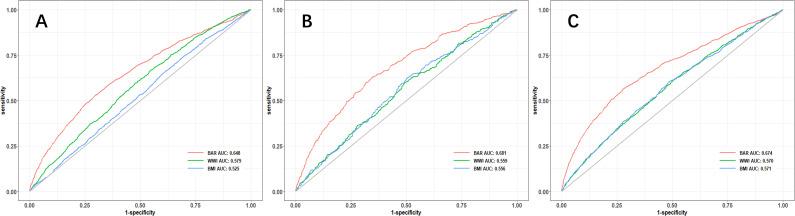
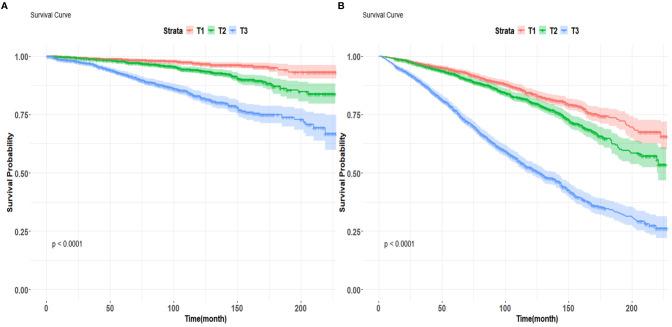
Results of the logistic regression analysis indicated a substantial positive association, between the BAR and the risk of cardiovascular disease in individuals with diabetes (HR, 1.09 [95% CI 1.06-1.12], p < 0.001). Cox regression analysis revealed a substantial positive association between the BAR and the risk of cardiovascular (OR, 1.13 [95% CI, 1.10-1.17], p < 0.001) and all-cause mortality (OR, 1.12 [95% CI 1.11-1.14], p < 0.001) in diabetes. The restricted cubic spline (RCS) curves indicated a non-linear relationship between BAR and the risk of cardiovascular disease, cardiovascular mortality, and all-cause mortality in diabetes (p < 0.01). The receiver operating characteristic (ROC) curves demonstrated that the BAR had superior predictive performance for cardiovascular risk (AUC: 0.648), cardiovascular mortality (AUC: 0.618), and all-cause mortality (AUC: 0.674) compared to the body mass index (BMI) (cardiovascular risk AUC: 0.525, cardiovascular mortality AUC: 0.563, all-cause mortality AUC: 0.571) and the weight-adjusted-waist index (WWI) (cardiovascular risk AUC: 0.579, cardiovascular mortality AUC: 0.497, all-cause mortality AUC: 0.570). These results underscore the enhanced ability of the BAR to discriminate between positive and negative outcomes, making it a more effective predictor than WWI. Kaplan-Meier analysis further verified the predictive capacity of BAR, for cardiovascular mortality and all-cause mortality in diabetes patients. Subgroup analysis revealed consistent associations between BAR and a variety of subgroups.
CONCLUSION
The incidence of cardiovascular disease, cardiovascular mortality, and all-cause mortality was substantially elevated, in patients with diabetes with a higher BAR level. Cardiovascular disease, cardiovascular mortality, and all-cause mortality may be more prevalent among diabetic patients with elevated BAR levels. BAR is a novel marker for the prediction of cardiovascular disease, cardiovascular mortality, and all-cause mortality in diabetes.
背景
糖尿病患者的血尿素氮与白蛋白比值(BAR)与心血管疾病以及心血管和全因死亡率之间的关系尚未完全明确。本研究旨在探讨血清尿素氮与白蛋白比值与糖尿病患者心血管疾病、心血管死亡率和全因死亡率之间的相关性。
方法
从2001年至2018年的美国国家健康与营养检查调查(NHANES)数据库中纳入了7043例成年糖尿病患者。通过基线特征分析、多因素逻辑回归分析、多因素Cox比例风险模型、Kaplan-Meier(K-M)分析、平滑拟合曲线和亚组分析,验证了糖尿病患者中BAR与心血管疾病、心血管死亡率和全因死亡率之间的关系。
结果
逻辑回归分析结果表明,糖尿病患者中BAR与心血管疾病风险之间存在显著正相关(HR,1.09 [95% CI 1.06 - 1.12],p < 0.001)。Cox回归分析显示,糖尿病患者中BAR与心血管(OR,1.13 [95% CI,1.10 - 1.17],p < 0.001)和全因死亡率(OR,1.12 [95% CI 1.11 - 1.14],p < 0.001)之间存在显著正相关。受限立方样条(RCS)曲线表明,糖尿病患者中BAR与心血管疾病、心血管死亡率和全因死亡率风险之间存在非线性关系(p < 0.01)。受试者工作特征(ROC)曲线显示,与体重指数(BMI)(心血管风险AUC:0.525,心血管死亡率AUC:0.563,全因死亡率AUC:0.571)和体重调整腰围指数(WWI)(心血管风险AUC:0.579,心血管死亡率AUC:0.497,全因死亡率AUC:0.570)相比,BAR对心血管风险(AUC:0.648)、心血管死亡率(AUC:0.618)和全因死亡率(AUC:0.674)具有更好的预测性能。这些结果强调了BAR在区分阳性和阴性结果方面的增强能力,使其成为比WWI更有效的预测指标。Kaplan-Meier分析进一步验证了BAR对糖尿病患者心血管死亡率和全因死亡率的预测能力。亚组分析揭示了BAR与各种亚组之间的一致关联。
结论
BAR水平较高的糖尿病患者心血管疾病、心血管死亡率和全因死亡率的发生率显著升高。BAR水平升高的糖尿病患者中,心血管疾病、心血管死亡率和全因死亡率可能更为普遍。BAR是预测糖尿病患者心血管疾病、心血管死亡率和全因死亡率的一种新型标志物。

 Zotero 插件