
埃塞俄比亚现代避孕方法使用情况的演变态势:二十年分析
Evolving Landscape of Modern Contraceptive Use in Ethiopia: A Two-Decade Analysis.
作者信息
Beyene Ermias Tadesse, Kim Sumin, Cha Seungman, Jin Yan, Jung Myunggu
机构信息
Department of Global Development and Entrepreneurship, Graduate School of Global Development and Entrepreneurship, Handong Global University, Pohang, Republic of Korea.
Department of Microbiology, Dongguk University College of Medicine, Gyeongju, Republic of Korea.
出版信息
Int J Public Health. 2025 Apr 11;70:1607680. doi: 10.3389/ijph.2025.1607680. eCollection 2025.
OBJECTIVE
The prevalence of modern contraceptive use in Ethiopia has increased in the past two decades. Despite these efforts, unmet needs for modern contraception persist, with limited knowledge on regional variations and determining factors.
METHOD
We analyzed data from the Ethiopian Demographic and Health Surveys (EDHS) from 2000, 2005, 2011, 2016, and 2019. Descriptive statistics examined regional variations and trends in modern contraceptive use among married, non-pregnant women. Multilevel analysis identified individual and community-level factors influencing modern contraceptive use.
RESULT
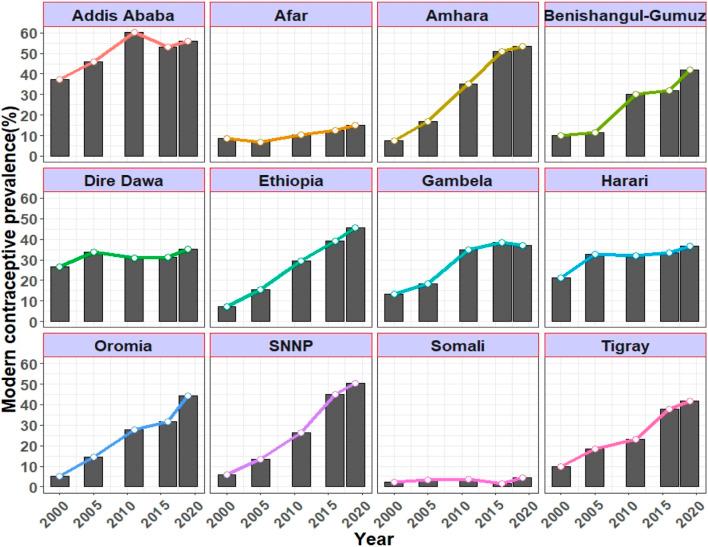
Nationally, modern contraceptive prevalence (mCP) increased, but regional disparities widened, notably between Addis Ababa and Somalia, from 34.8 to 51.8 percentage points. Factors such as community wealth, residence, age, education, and number of children significantly influenced contraceptive use. The greatest increase in mCP was among women aged 15-24, with a rise of 49.4 percentage points from 2000 to 2019.
CONCLUSION
Tailored reproductive health services at both individual and community levels are essential to address the growing regional disparities in modern contraceptive use among married women in Ethiopia.
目的
在过去二十年中,埃塞俄比亚现代避孕方法的使用率有所上升。尽管做出了这些努力,但现代避孕方法的未满足需求仍然存在,对地区差异和决定因素的了解有限。
方法
我们分析了2000年、2005年、2011年、2016年和2019年埃塞俄比亚人口与健康调查(EDHS)的数据。描述性统计分析了已婚非孕妇女性中现代避孕方法使用的地区差异和趋势。多层次分析确定了影响现代避孕方法使用的个人和社区层面因素。
结果
在全国范围内,现代避孕普及率(mCP)有所上升,但地区差距扩大,特别是亚的斯亚贝巴和索马里之间,从34.8个百分点增至51.8个百分点。社区财富、居住地、年龄、教育程度和子女数量等因素对避孕方法的使用有显著影响。现代避孕普及率上升幅度最大的是15至24岁的女性,从2000年到2019年上升了49.4个百分点。
结论
在个人和社区层面提供量身定制的生殖健康服务,对于解决埃塞俄比亚已婚女性在现代避孕方法使用方面日益扩大的地区差异至关重要。

 Zotero 插件