
用于成骨分化的3D挤出打印含颗粒水凝胶的优化
Optimization of 3D Extrusion-Printed Particle-Containing Hydrogels for Osteogenic Differentiation.
作者信息
Doyle Stephanie E, Winrow Deirdre, Buckley Fiona, Pernevik Elin, Johnson Martin, Thompson Kerry, Howard Linda, Coleman Cynthia M
机构信息
College of Medicine, Nursing and Health Science, School of Medicine, Regenerative Medicine Institute (REMEDI), University of Galway, County Galway, Galway H91 W2TY, Ireland.
CELLINK Bioprinting AB, Långfilsgatan 7, Gothenburg 412 76, Sweden.
出版信息
ACS Omega. 2025 Apr 10;10(15):15036-15051. doi: 10.1021/acsomega.4c10515. eCollection 2025 Apr 22.
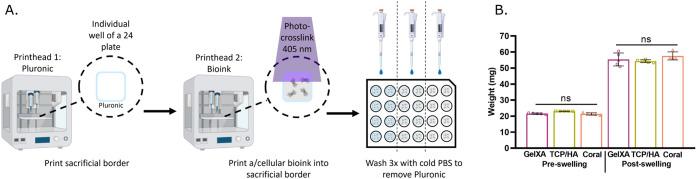
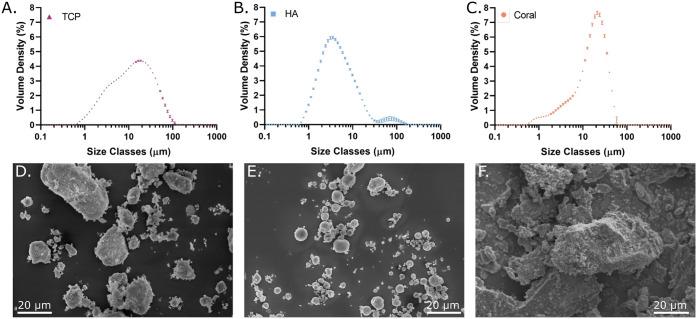
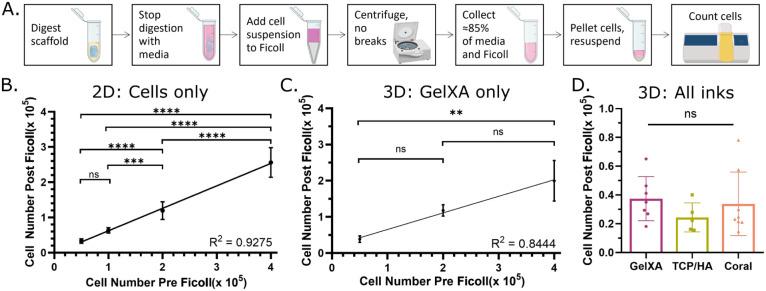
There is a continued increase in demand for novel bone grafting substitutes to reduce reliance on and address challenges associated with allograft and autograft bone grafts. Current synthetic bone grafting substitutes exhibit low mechanical strength and bioactivity, which has inspired the development of novel grafting materials. Accelerating the translation of new bone graft substitutes requires workflows for high-throughput fabrication and analysis of particle-containing models. This study utilized 3D sacrificial printing for the fabrication of reproducible, cellular scaffolds containing tricalcium phosphate (TCP), hydroxyapatite (HA), or natural coral particles. High-throughput analysis of the cellular scaffolds included quantifying cell metabolism, viability, and calcium consumption, as well as nondestructive analysis of collagen accumulation and destructive methods for assessing cell number and morphological changes. Both particle- and non-particle-containing inks sustained cell metabolism with low and decreasing cell death for 7 days post-printing. Collagen staining, scanning electron microscopy imaging, and calcium and collagen quantification suggested that, under osteogenic induction conditions, cells migrated to the surface of the scaffolds and formed a sheet of cells and a collagen-containing extracellular matrix, thereby indicating osteogenic differentiation. The workflow described herein enables the creation of models to study the osteogenic nature of new bone grafting substitute materials. High-throughput printing combined with non-destructive screening techniques resulted in reduced time, resources, and associated costs and could be applicable to a broader range of cell types.
对新型骨移植替代物的需求持续增加,以减少对同种异体骨和自体骨移植的依赖并应对与之相关的挑战。目前的合成骨移植替代物机械强度和生物活性较低,这激发了新型移植材料的开发。加速新型骨移植替代物的转化需要用于高通量制造和分析含颗粒模型的工作流程。本研究利用3D牺牲打印技术制造了含有磷酸三钙(TCP)、羟基磷灰石(HA)或天然珊瑚颗粒的可重复生产的细胞支架。对细胞支架的高通量分析包括量化细胞代谢、活力和钙消耗,以及对胶原蛋白积累的无损分析和评估细胞数量及形态变化的破坏性方法。含颗粒和不含颗粒的墨水在打印后7天内都能维持细胞代谢,细胞死亡较低且呈下降趋势。胶原蛋白染色、扫描电子显微镜成像以及钙和胶原蛋白定量分析表明,在成骨诱导条件下,细胞迁移到支架表面,形成一层细胞和含胶原蛋白的细胞外基质,从而表明发生了成骨分化。本文所述的工作流程能够创建模型来研究新型骨移植替代材料的成骨特性。高通量打印与无损筛选技术相结合可减少时间、资源和相关成本,并且可应用于更广泛的细胞类型。





 Zotero 插件