
纳武利尤单抗联合白蛋白结合型紫杉醇或奥沙利铂作为晚期或转移性胃癌及胃食管交界癌一线治疗的疗效和安全性
The Efficacy and Safety of Nivolumab Combined with Nab-Paclitaxel or Oxaliplatin as a First-Line Treatment for Advanced or Metastatic Gastric Cancer and Gastroesophageal Junction Cancer.
作者信息
Li Juan, Li Shuman, Zhang Ying, Ye Sisi, Liu Rongrui, Shi Weiwei
机构信息
Department of Oncology, First Medical Center, General Hospital of the People'S Liberation Army, Beijing, 100089, China.
The Affiliated Cancer Hospital of Zhengzhou University & Henan Cancer Hospital, Zhengzhou, 450008, China.
出版信息
J Gastrointest Cancer. 2025 Apr 28;56(1):109. doi: 10.1007/s12029-025-01211-1.
OBJECTIVE
This study aims to assess the therapeutic efficacy and safety of nivolumab combined with chemotherapy as a first-line treatment for advanced or metastatic gastric cancer, specifically comparing the outcomes of oxaliplatin-based versus albumin-bound paclitaxel (nab-paclitaxel)-based therapies.
METHODS
We retrospectively analyzed 93 patients with advanced gastric cancer or gastroesophageal junction adenocarcinoma treated at the First Medical Center of Chinese PLA General Hospital from September 2017 to November 2022. Patients were categorized into the nivolumab + oxaliplatin (N-OX group) or nivolumab + nab-paclitaxel (N-AP group) based on the chemotherapy regimen. Progression-free survival (PFS), objective response rate (ORR), disease control rate (DCR), and safety were evaluated as endpoints.
RESULTS
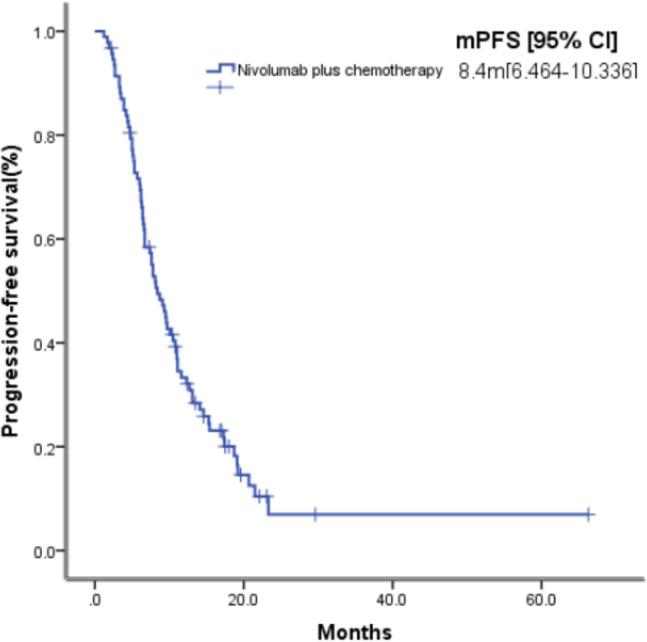
At the end of the follow-up period on September 31, 2023, we reported an ORR of 65.6% and DCR of 95.7% across all patients. The median PFS was 8.4 months, with no significant difference between the N-OX and N-AP groups (median, 7.8 vs 9.5 months; P = 0.450). Notably, patients with diffuse gastric cancer in N-AP group showed a 44.7% reduction in tumor progression risk compared with the N-OX group (P = 0.046). The overall safety profile was acceptable in two groups.
CONCLUSIONS
Our study suggested that nivolumab combined with chemotherapy was effective and safe as a first-line intervention for advanced gastric cancer. While both oxaliplatin and nab-paclitaxel regimens showed similar efficacy, the nab-paclitaxel may offer additional benefits for patients with diffuse gastric cancer. Further research is encouraged to confirm these findings and refine treatment strategies.
目的
本研究旨在评估纳武利尤单抗联合化疗作为晚期或转移性胃癌一线治疗的疗效和安全性,特别是比较基于奥沙利铂与基于白蛋白结合型紫杉醇(纳米紫杉醇)疗法的疗效。
方法
我们回顾性分析了2017年9月至2022年11月在中国人民解放军总医院第一医学中心接受治疗的93例晚期胃癌或胃食管交界腺癌患者。根据化疗方案,将患者分为纳武利尤单抗+奥沙利铂组(N-OX组)或纳武利尤单抗+纳米紫杉醇组(N-AP组)。将无进展生存期(PFS)、客观缓解率(ORR)、疾病控制率(DCR)和安全性作为评估终点。
结果
在2023年9月31日随访期结束时,我们报告所有患者的ORR为65.6%,DCR为95.7%。中位PFS为8.4个月,N-OX组和N-AP组之间无显著差异(中位数,7.8个月对9.5个月;P=0.450)。值得注意的是,与N-OX组相比,N-AP组弥漫性胃癌患者的肿瘤进展风险降低了44.7%(P=0.046)。两组的总体安全性均可接受。
结论
我们的研究表明,纳武利尤单抗联合化疗作为晚期胃癌的一线干预措施是有效且安全的。虽然奥沙利铂和纳米紫杉醇方案显示出相似的疗效,但纳米紫杉醇可能对弥漫性胃癌患者有额外益处。鼓励进一步研究以证实这些发现并完善治疗策略。

 Zotero 插件