
FilmArray肺炎加检测板对培养阳性的呼吸机相关性肺炎中非目标细菌的流行病学及预测:一项回顾性多中心分析
Epidemiology and prediction of non-targeted bacteria by the filmarray pneumonia plus panel in culture-positive ventilator-associated pneumonia: a retrospective multicentre analysis.
作者信息
Berteau F, Kouatchet A, Le Gall Y, Pouplet C, Delbove A, Darreau C, Lemarie J, Jarousseau F, Reizine F, Giacardi C, Allo G, Aubron C, Eveillard M, Dubee V, Mahieu R
机构信息
Réanimation Polyvalente et Soins Continus, Centre Hospitalier des Pays de Morlaix, 15 Rue de Kersaint- Gilly, Morlaix, 29600, France.
Médecine Intensive- Réanimation et Médecine Hyperbare, Centre Hospitalier Universitaire d'Angers, 4 rue Larrey, Angers, 49933, France.
出版信息
Ann Intensive Care. 2025 Apr 28;15(1):57. doi: 10.1186/s13613-025-01468-6.
BACKGROUND
Ventilator-associated pneumonia (VAP) is a prevalent nosocomial infection in intensive care units (ICUs) with significant impacts on patient outcomes and healthcare costs. Multiplex PCR could allow for personalized empirical treatment of VAP and optimize antibiotic therapy.
METHODS
This multicenter retrospective study analyzed culture-positive VAP cases from January 2016 to March 2021 across 12 ICUs in France. The prevalence of non-targeted bacteria was evaluated according to the bacterial species included in the BioFire FilmArray Pneumonia Panel (FAPPP), and associated risk factors were identified. A non-targeted bacteria was defined as a bacterial species isolated during VAP, not included in the FilmArray panel, but considered by the clinician in the final antibiotic therapy.
RESULTS
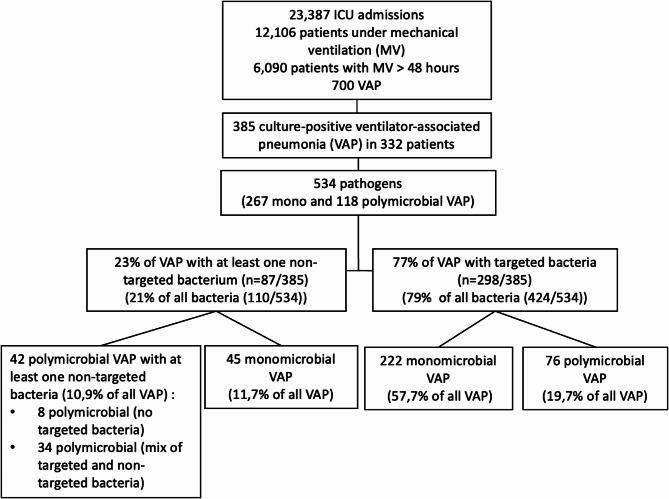
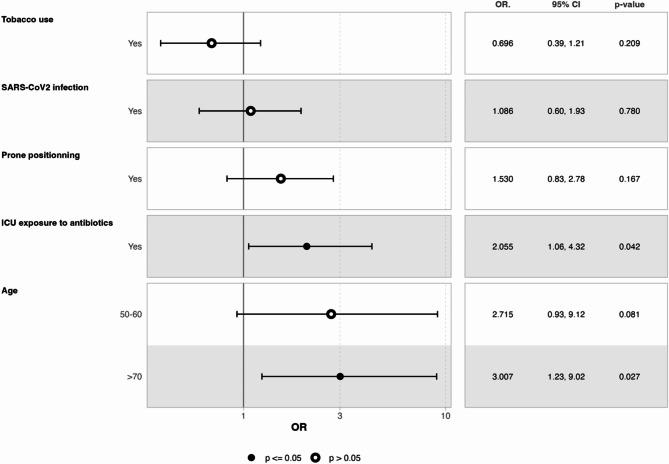
Among 332 patients with 385 culture-positive VAP episodes, non-targeted pathogens were observed in 23% of cases (87/385) and represented 21% (110/534) of isolated bacteria (After excluding bacteria with low pathogenicity, the rate of VAP with a non-targeted bacterium was 21%). The most common non-targeted bacteria identified were Stenotrophomonas maltophilia (22%), Citrobacter koseri, and Hafnia alvei. Gram stain results poorly correlated with definitive cultures (42% of concordance). The proportion of culture-positive VAP with non-targeted bacteria varied significantly between ICUs, ranging from 12 to 37%, (p = 0.013). Polymicrobial culture-positive VAP had a twofold higher risk of non-targeted bacteria (47% vs. 25%, p < 0.001). In the multivariate analysis, in-ICU antibiotic exposure was associated with a twofold increased risk of non-targeted bacteria (25.3% vs. 12.9%, p = 0.042), and age over 70 years was associated with a threefold increased risk (p = 0.027). Among the 48 culture-positive VAP cases with ineffective empiric treatment, Pseudomonas aeruginosa (22%), Stenotrophomonas maltophilia (14%), and Enterobacter cloacae complex (8%) were the most frequent bacteria. Additionally, 67% of the culture-positive VAP cases with ineffective empirical antibiotic therapy involved targeted bacteria, of which 59% could have received effective empirical antibiotic therapy if panel results had been available, according to bacterial species identification and current guidelines.
CONCLUSIONS
A significant rate of culture-positive VAP cases with non-targeted bacteria was observed in this study, raising concerns about the interpretation of FAPPP results. Only positive FAPPP results may assist clinicians in the early personalization of antibiotic therapy for VAP.
背景
呼吸机相关性肺炎(VAP)是重症监护病房(ICU)中一种常见的医院感染,对患者预后和医疗成本有重大影响。多重PCR可实现VAP的个性化经验性治疗并优化抗生素治疗。
方法
这项多中心回顾性研究分析了2016年1月至2021年3月期间法国12个ICU中培养阳性的VAP病例。根据BioFire FilmArray肺炎检测板(FAPPP)中包含的细菌种类评估非目标细菌的患病率,并确定相关危险因素。非目标细菌定义为在VAP期间分离出的、未包含在FilmArray检测板中但临床医生在最终抗生素治疗中考虑的细菌种类。
结果
在332例患者的385次培养阳性VAP发作中,23%(87/385)的病例观察到非目标病原体,占分离细菌的21%(110/534)(排除低致病性细菌后,非目标细菌引起的VAP发生率为21%)。鉴定出的最常见非目标细菌是嗜麦芽窄食单胞菌(22%)、科氏柠檬酸杆菌和蜂房哈夫尼亚菌。革兰氏染色结果与最终培养结果相关性较差(一致性为42%)。不同ICU中培养阳性且伴有非目标细菌的VAP比例差异显著,范围为12%至37%(p = 0.013)。多微生物培养阳性的VAP出现非目标细菌的风险高出两倍(47%对25%,p < 0.001)。在多变量分析中,ICU内抗生素暴露使非目标细菌风险增加两倍(25.3%对12.9%,p = 0.042),70岁以上患者风险增加三倍(p = 0.027)。在48例经验性治疗无效的培养阳性VAP病例中,铜绿假单胞菌(22%)、嗜麦芽窄食单胞菌(14%)和阴沟肠杆菌复合体(8%)是最常见的细菌。此外,67%经验性抗生素治疗无效的培养阳性VAP病例涉及目标细菌,根据细菌种类鉴定和现行指南,如果有检测板结果,其中59%的病例本可接受有效的经验性抗生素治疗。
结论
本研究观察到相当比例的培养阳性VAP病例伴有非目标细菌,这引发了对FAPPP结果解读的担忧。只有FAPPP阳性结果可能有助于临床医生对VAP进行早期抗生素治疗个性化。



 Zotero 插件