
在降低温度时,蓝细菌体内的生物钟通过霍普夫分岔跟随并超越体外蛋白质生物钟。
When lowering temperature, the in vivo circadian clock in cyanobacteria follows and surpasses the in vitro protein clock trough the Hopf bifurcation.
作者信息
Mihalcescu Irina, Kaji Hotaka, Maruyama Hina, Giraud Jerôme, Van Melle-Gateau Mathilde, Houchmandzadeh Bahram, Ito Hiroshi
机构信息
Univ. Grenoble Alpes, CNRS, LIPHY, 38000, Grenoble, France.
Faculty of Design, Kyushu University, Fukuoka, 815-8540, Japan.
出版信息
Sci Rep. 2025 Apr 28;15(1):14884. doi: 10.1038/s41598-025-97412-6.
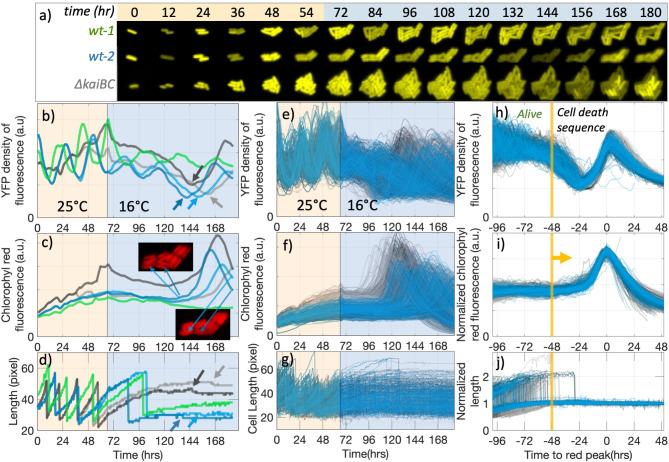
The in vivo circadian clock in single cyanobacteria is studied here by time-lapse fluorescence microscopy when the temperature is lowered below 25°C. We first disentangle the circadian clock behavior from the bacterial cold shock response by identifying a sequence of "death steps" based on cellular indicators. By analyzing only "alive" traces, we show that the dynamic response of individual oscillatory traces to a step-down temperature signal is described by a simple Stuart-Landau oscillator model. The same dynamical analysis applied to in vitro data (KaiC phosphorylation level following a temperature step-down) allows for extracting and comparing both clock's responses to a temperature step down. It appears, therefore, that both oscillators go through a similar supercritical Hopf bifurcation. Finally, to quantitatively describe the temperature dependence of the resulting in vivo and in vitro Stuart-Landau parameters [Formula: see text] and [Formula: see text], we propose two simplified analytical models: temperature-dependent positive feedback or time-delayed negative feedback that is temperature compensated. Our results provide strong constraints for future models by revealing a specific time scale for transitory regimes in the cyanobacterial circadian system and its temperature dependence.
当温度降至25°C以下时,本文通过延时荧光显微镜研究了单个蓝细菌体内的昼夜节律钟。我们首先通过基于细胞指标识别一系列“死亡步骤”,将昼夜节律钟行为与细菌冷休克反应区分开来。通过仅分析“存活”轨迹,我们表明单个振荡轨迹对降温温度信号的动态响应可用一个简单的斯图尔特-朗道振荡器模型来描述。将相同的动力学分析应用于体外数据(降温后KaiC磷酸化水平),可以提取并比较生物钟对降温的两种响应。因此,似乎两个振荡器都经历了类似的超临界霍普夫分岔。最后,为了定量描述所得体内和体外斯图尔特-朗道参数[公式:见正文]和[公式:见正文]的温度依赖性,我们提出了两个简化的分析模型:温度依赖性正反馈或温度补偿的延时负反馈。我们的结果通过揭示蓝细菌昼夜节律系统中过渡状态的特定时间尺度及其温度依赖性,为未来的模型提供了强有力的限制。


 Zotero 插件