
维生素D受体和APRO家族蛋白在癌症干细胞靶向恶性肿瘤治疗发展中的潜在作用。
Promising roles of vitamin D receptor and APRO family proteins for the development of cancer stem cells targeted malignant tumor therapy.
作者信息
Nakashima Moeka, Suga Naoko, Fukumoto Akari, Yoshikawa Sayuri, Matsuda Satoru
机构信息
Department of Food Science and Nutrition, Nara Women's University, Kita-Uoya Nishimachi, Nara, 630-8506, Japan.
出版信息
Oncol Res. 2025 Apr 18;33(5):1007-1017. doi: 10.32604/or.2025.059657. eCollection 2025.
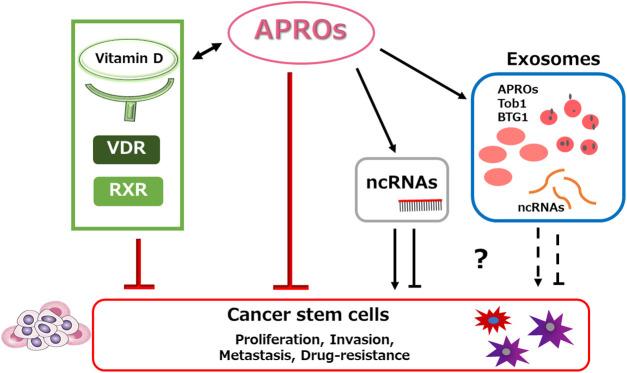
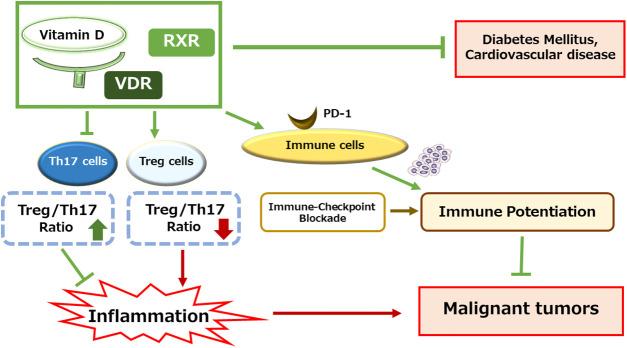
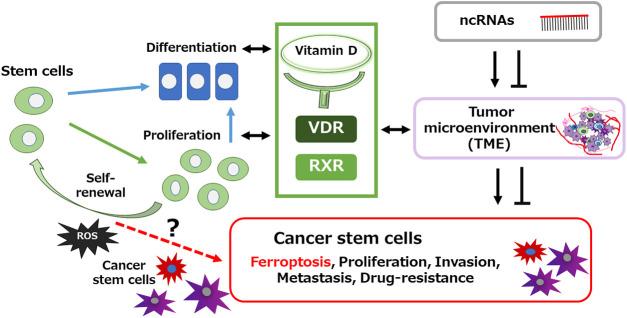
Malignant tumors are heterogeneous diseases characterized by uncontrolled cell proliferation, invasion, metastasis, and/or recurrence of their malignancies. In particular, cancer stem cells (CSCs) within these tumors might be responsible for the property of invasiveness and/or therapies-resistance. CSCs are a self-renewing, awfully tumorigenic subpopulation of cancer cells, which are notorious for strong chemoresistance and are frequently responsible the aggravated invasion, metastasis, and/or recurrence. Developing targeting therapies against CSCs, therefore, may be deliberated a more encouraging mission for the greater cancer therapy. Innovation for a more potent anti-CSC treatment has been required as soon as possible. Interestingly, vitamin D could modulate the inflammatory condition of the tumor microenvironment (TME) by successfully affecting CSCs, which has an imperative role in determining the malignant phenotype of CSCs. In addition, vitamin D may also contribute to the regulation of the malignant behaviors of CSCs. Consistently, vitamin D could have potential applications for the significant inhibition of several tumor growths within various cancer therapies. The biological significance of vitamin D for CSCs regulation may be involved in the function of APRO family proteins. Therefore, vitamin D could be one of the innovative therapeutic modalities for the development of novel CSCs related tumor therapies.
恶性肿瘤是异质性疾病,其特征在于细胞不受控制地增殖、侵袭、转移和/或恶性肿瘤复发。特别是,这些肿瘤中的癌症干细胞(CSCs)可能是侵袭性和/或治疗抗性的原因。CSCs是癌细胞中具有自我更新能力、极具致瘤性的亚群,以强烈的化学抗性而臭名昭著,并且经常导致侵袭、转移和/或复发加剧。因此,开发针对CSCs的靶向治疗可能被认为是一项更具前景的重大癌症治疗任务。迫切需要尽快创新出更有效的抗CSC治疗方法。有趣的是,维生素D可以通过成功影响CSCs来调节肿瘤微环境(TME)的炎症状态,这在决定CSCs的恶性表型方面起着至关重要的作用。此外,维生素D也可能有助于调节CSCs的恶性行为。同样,在各种癌症治疗中,维生素D对于显著抑制多种肿瘤生长可能具有潜在应用价值。维生素D对CSCs调节的生物学意义可能涉及APRO家族蛋白的功能。因此,维生素D可能是开发新型CSCs相关肿瘤治疗方法的创新治疗方式之一。
 Zotero 插件