
资源有限国家12至23个月儿童的基础疫苗接种不完全情况及相关因素:对48个国家近期人口与健康调查数据的空间和多水平回归分析
Incomplete basic vaccination and associated factors among children aged 12-23 months in resource-limited countries: a spatial and multilevel regression analysis of recent DHS data from 48 countries.
作者信息
Getnet Mihret, Jejaw Melak, Belachew Tadele Biresaw, Addis Banchlay, Dellie Endalkachew, Tafere Tesfahun Zemene, Worku Nigusu, Geberu Demiss Mulatu, Yazachew Lake, Teshale Getachew, Tiruneh Misganaw Guadie, Demissie Kaleb Assegid
机构信息
Department of Human Physiology, School of Medicine, College of Medicine and Health Sciences, University of Gondar, Gondar, Ethiopia.
Department of Epidemiology and Biostatistics, Institute of Public Health, College of Medicine and Health Sciences, University of Gondar, Gondar, Ethiopia.
出版信息
Front Public Health. 2025 Apr 14;13:1463303. doi: 10.3389/fpubh.2025.1463303. eCollection 2025.
BACKGROUND
Childhood basic vaccinations are a cost-effective and essential preventive health strategy globally in resource-limited nations. The United Nations Sustainable Development Goals aim to reach these ambitious targets, making it crucial to identify underserved populations and address the barriers they face in accessing life-saving immunizations. To date, no spatial analyses have been performed to identify areas of hotspots of incomplete basic vaccination among children in resource-limited countries globally. Therefore, determining the geographic distribution of incomplete basic vaccinations and associated factors is important for prioritizing intervention programs in resource-limited countries.
OBJECTIVE
This study aims to assess incomplete basic vaccinations and associated factors among children aged 12-23 months in resource-limited countries based on the recent Demographic and Health Survey (DHS) data of 48 countries.
METHODS
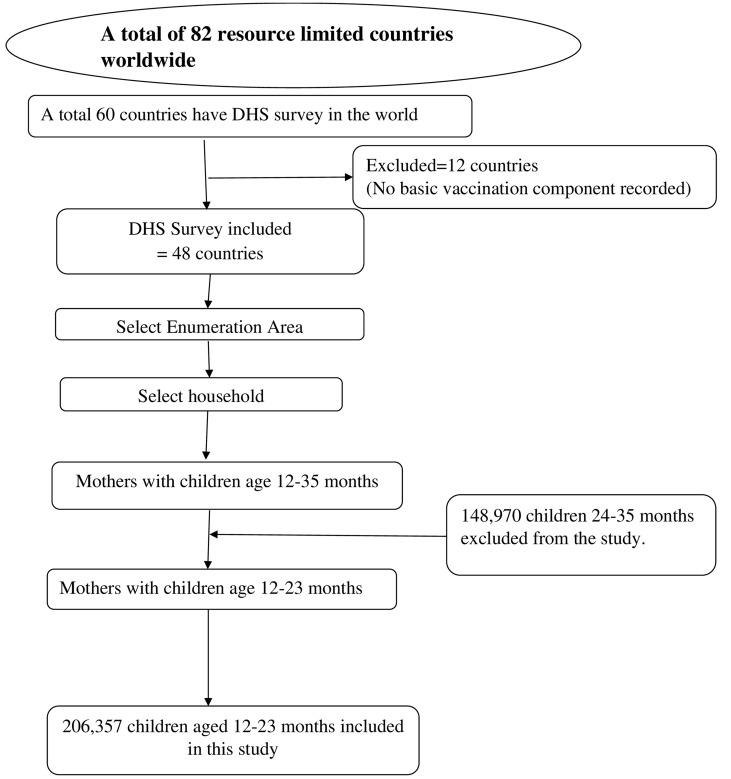
Data for the study were drawn from the DHS, a nationally representative cross-sectional survey conducted by considering the era of Millennium Development Goals and Sustainable Development Goals. A total of 48 resource-limited countries and a total weighted sample of 202,029 children (12-23 months) were included in our study. The data extraction, recoding, and analysis were conducted using STATA V.17. For the spatial analysis (spatial distribution, autocorrelation, and hotspot), ArcGIS version 10.7 software was used, and for the SaTScan analysis, SaTScan version 10.1 software was used. Descriptive statistics were presented using frequency tables and percentages. We employed multilevel logistic regression to investigate the associated factors of incomplete basic vaccination. In the multivariable analysis, variables with a -value of ≤0.05 are considered significant factors associated with incomplete basic vaccination among children aged 12-23 months.
RESULTS
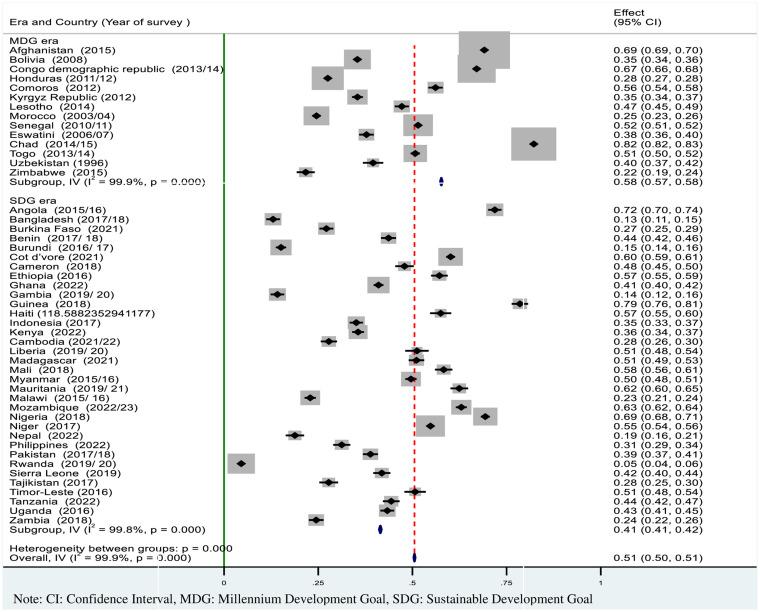
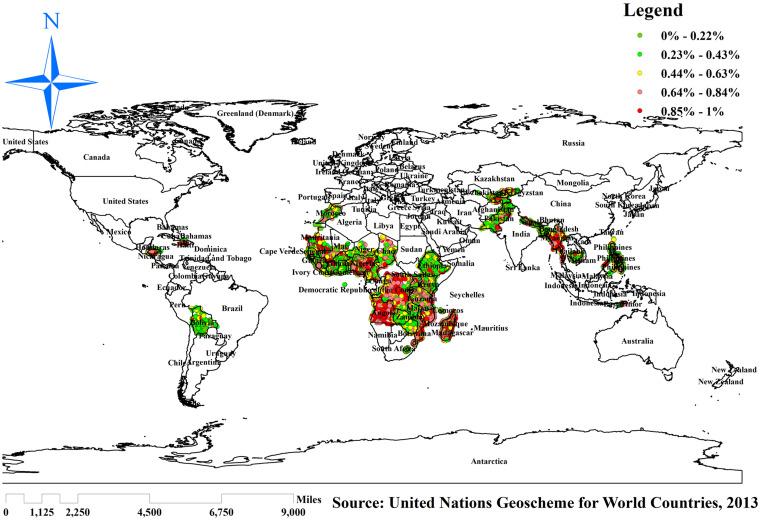
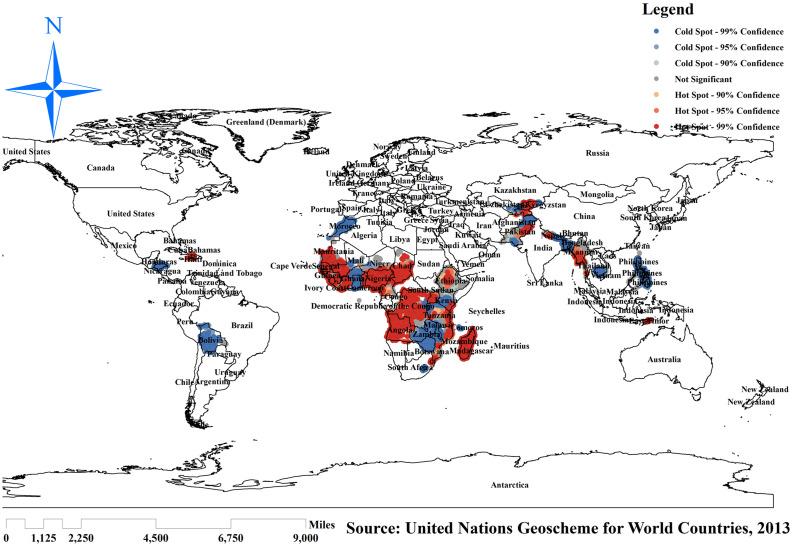
The overall incompleteness of basic vaccination among children in resource-limited countries was 51% (95%CI: 50-51%). The spatial analysis revealed that the incomplete basic vaccination among children significantly varied across resource-limited countries (Global Moran's I = 0.208468, < 0.001). The most likely clusters were located in Nigeria, Chad, Cameroon, and Niger, which were centered at (2.028929N, 15.135990 E)/1425.16 km radius, with a Log-Likelihood Ratio (LLR) of 3519.48 and a Relative Risk (RR) of 1.38 at -value <0.001. Based on the final model of multilevel analysis, the following variables were statistically significant in relation to incomplete basic vaccination: age, marital status, maternal education, husband's education, maternal occupation, media exposure, wealth index, antenatal care (ANC) visits, birth order, place of delivery, mode of delivery, health insurance coverage, perception of distance from a health facility, place of residence, community media exposure, community education, and country-level income status.
CONCLUSION AND RECOMMENDATIONS
The spatial distribution of incomplete basic vaccination was significantly varied across the resource-limited countries. Both individual- and community-level factors were significantly associated with incomplete basic vaccination. Therefore, the World Health Organization and other stakeholders involved in child healthcare should work together to expand childhood vaccination and prioritize the hotspot areas of developing countries.
背景
在资源有限的国家,儿童基础疫苗接种是一项具有成本效益且至关重要的全球预防性健康策略。联合国可持续发展目标旨在实现这些宏伟目标,因此确定服务不足的人群并解决他们在获取救命疫苗接种方面面临的障碍至关重要。迄今为止,尚未进行空间分析以确定全球资源有限国家中儿童基础疫苗接种不完全的热点地区。因此,确定基础疫苗接种不完全的地理分布及其相关因素对于在资源有限的国家确定干预项目的优先级很重要。
目的
本研究旨在根据48个国家最近的人口与健康调查(DHS)数据,评估资源有限国家中12至23个月大儿童的基础疫苗接种不完全情况及其相关因素。
方法
本研究的数据来自DHS,这是一项在考虑千年发展目标和可持续发展目标时代进行的具有全国代表性的横断面调查。我们的研究纳入了48个资源有限的国家以及总共202,029名(12至23个月)儿童的加权样本。数据提取、重新编码和分析使用STATA V.17进行。对于空间分析(空间分布、自相关和热点分析),使用ArcGIS 10.7版本软件,对于时空扫描分析,使用时空扫描10.1版本软件。使用频率表和百分比呈现描述性统计数据。我们采用多水平逻辑回归来研究基础疫苗接种不完全的相关因素。在多变量分析中,p值≤0.05的变量被视为与12至23个月大儿童基础疫苗接种不完全相关的显著因素。
结果
资源有限国家中儿童基础疫苗接种的总体不完全率为51%(95%CI:50 - 51%)。空间分析表明,资源有限国家中儿童基础疫苗接种不完全情况存在显著差异(全局莫兰指数I = 0.208468,p < 0.001)。最可能的聚集区位于尼日利亚、乍得、喀麦隆和尼日尔,以(北纬2.028929,东经15.135990)为中心/半径1425.16公里,对数似然比(LLR)为3519.48,相对风险(RR)为1.38,p值<0.001。基于多水平分析的最终模型,以下变量与基础疫苗接种不完全在统计学上显著相关:年龄、婚姻状况、母亲教育程度、丈夫教育程度、母亲职业、媒体曝光、财富指数、产前检查(ANC)次数、出生顺序、分娩地点、分娩方式、医疗保险覆盖范围、对距离医疗机构远近的认知、居住地点、社区媒体曝光、社区教育以及国家层面的收入状况。
结论与建议
基础疫苗接种不完全的空间分布在资源有限国家中存在显著差异。个体和社区层面的因素均与基础疫苗接种不完全显著相关。因此,世界卫生组织和其他参与儿童医疗保健的利益相关者应共同努力扩大儿童疫苗接种,并将发展中国家的热点地区作为优先事项。


 Zotero 插件