
性类固醇对社会地位的控制:硬骨鱼类的启示
Control of social status by sex steroids: insights from teleost fishes.
作者信息
Munley Kathleen M, Alward Beau A
机构信息
Psychology, University of Houston, Houston, Texas, 77204, USA.
Biology and Biochemistry, University of Houston, Houston, Texas, 77004, USA.
出版信息
Mol Psychol. 2023;2. doi: 10.12688/molpsychol.17571.1. Epub 2023 Sep 28.
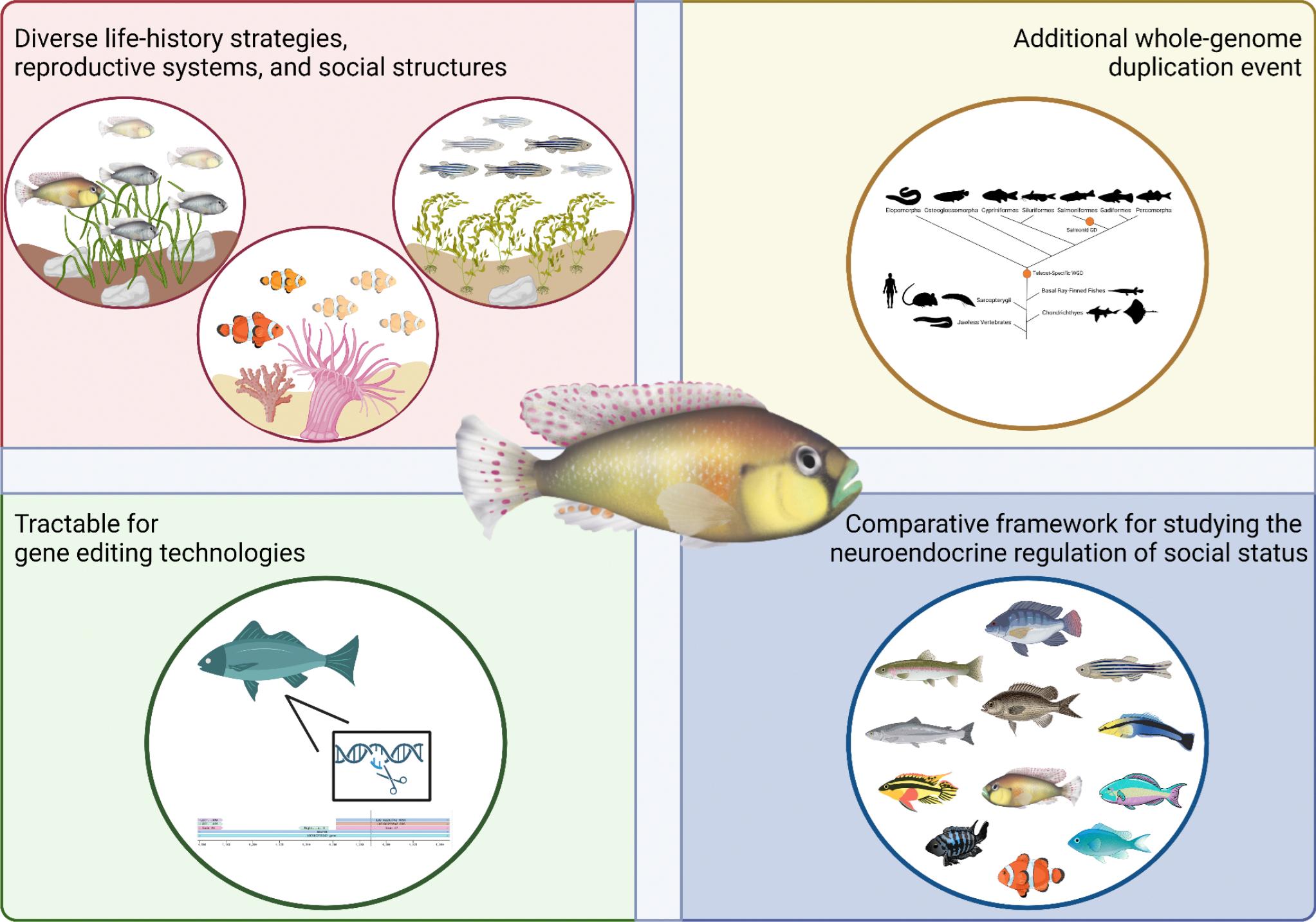
Many animals live in highly social environments, in which individuals must behave in a way that enables them to survive and live harmoniously among conspecifics. Dominance hierarchies are typical among social species and are essential for determining and preserving stability within social groups. Although there is considerable evidence that sex steroid hormones regulate behaviors associated with dominance, such as aggression and mating, fewer studies have examined the role of these hormones in controlling social status, especially in species that exhibit social hierarchies. Furthermore, despite this research, we know remarkably little about the precise neural and molecular mechanisms through which sex steroids modulate traits associated with social rank. Here, we review the neuroendocrine regulation of social status by sex steroids in teleost fishes, the largest and most diverse vertebrate group that shows extensive variation in reproductive systems and social structures between species. First, we describe the function of sex steroids and novel steroid-related genes that teleost fishes possess due to a lineage-specific whole-genome duplication event. Then, we discuss correlational, pharmacological, and molecular genetic studies on the control of social status by sex steroids in teleost fishes, including recent studies that have implemented gene editing technologies, such as CRISPR/Cas9. Finally, we argue that gene editing approaches in teleost studies, within both integrative and comparative frameworks, will be vital for elucidating the role of sex steroids in controlling social rank and characterizing their neural and molecular mechanisms of action. Collectively, ongoing and future research in these species will provide novel insight into the evolution of the regulation of social status by sex steroids and other neuroendocrine substrates across vertebrates.
许多动物生活在高度社会化的环境中,在这种环境中,个体必须以一种能够使它们生存并在同种个体中和谐生活的方式行事。优势等级制度在社会性物种中很典型,对于确定和维持社会群体内部的稳定性至关重要。尽管有大量证据表明性类固醇激素调节与优势相关的行为,如攻击和交配,但较少有研究考察这些激素在控制社会地位方面的作用,尤其是在表现出社会等级制度的物种中。此外,尽管有这项研究,我们对性类固醇调节与社会等级相关特征的精确神经和分子机制知之甚少。在这里,我们综述硬骨鱼类中性类固醇对社会地位的神经内分泌调节,硬骨鱼类是最大且最多样化的脊椎动物类群,其物种间生殖系统和社会结构存在广泛差异。首先,我们描述硬骨鱼类由于特定谱系的全基因组复制事件而拥有的性类固醇和新型类固醇相关基因的功能。然后,我们讨论硬骨鱼类中性类固醇对社会地位控制的相关性、药理学和分子遗传学研究,包括最近实施基因编辑技术(如CRISPR/Cas9)的研究。最后,我们认为在综合和比较框架内,硬骨鱼类研究中的基因编辑方法对于阐明性类固醇在控制社会等级中的作用以及表征其神经和分子作用机制至关重要。总体而言,对这些物种正在进行的和未来的研究将为性类固醇和其他神经内分泌底物在整个脊椎动物中对社会地位调节的进化提供新的见解。
 Zotero 插件