
基于MoSeq的三维行为分析揭示糖尿病小鼠模型中的神经性行为变化。
MoSeq based 3D behavioral profiling uncovers neuropathic behavior changes in diabetic mouse model.
作者信息
Ashiquzzaman Akm, Lee Eunbin, Znaub Brahnu Fentaw, Sakib An Nazmus, Chung Geehoon, Kim Sang Seong, Kim Young Ro, Kwon Hyuk-Sang, Chung Euiheon
机构信息
Department of Biomedical Science and Engineering, Gwangju Institute of Science and Technology, Gwangju, South Korea.
Department of Biomedical Science and Engineering, University of NE-Lincoln, Lincoln, NE, USA.
出版信息
Sci Rep. 2025 Apr 29;15(1):15114. doi: 10.1038/s41598-025-98184-9.
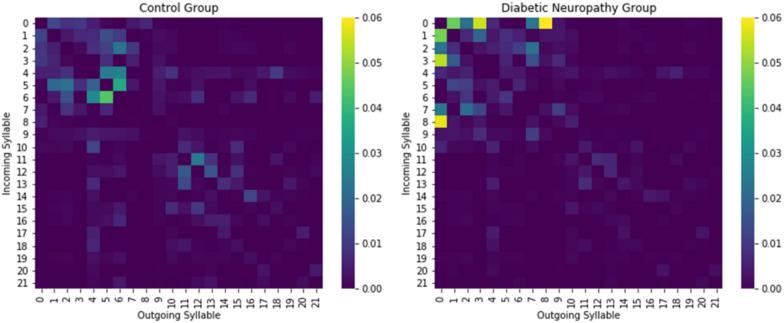
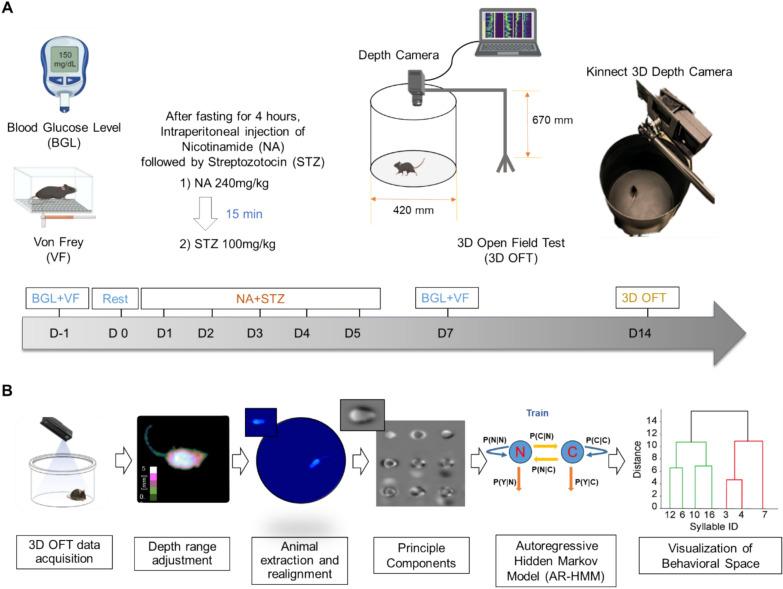
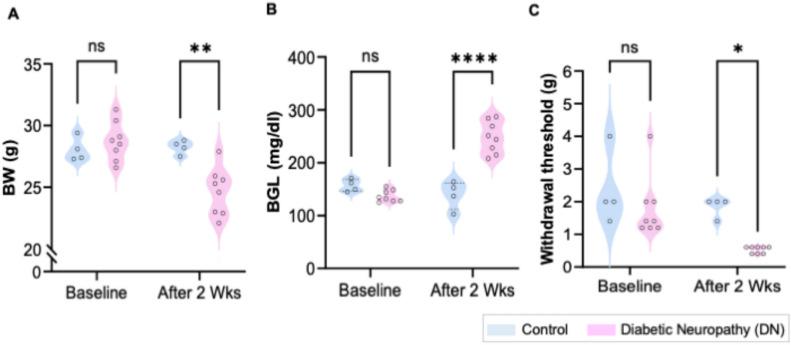
Diabetic neuropathy (DN) is a prevalent and debilitating complication of diabetes, significantly impairing quality of life through chronic pain, sensory deficits, and motor dysfunction. Despite its widespread impact, current rodent behavioral assessments using 2D tracking methods primarily quantify basic locomotion, such as distance and speed, but lack resolution to detect subtle, pattern-based motor impairments characteristic of DN. This study employed MoSeq-based 3D behavioral profiling combined with unsupervised machine learning to identify subtle yet significant alterations in nicotinamide (NA)- and streptozotocin (STZ)-induced DN mouse models. Our analysis identified 22 distinct behavioral syllables, with DN mice exhibiting increased stress-associated behaviors such as head weaving, wall jumping, and nasal hesitancy, while displaying decreased locomotor activities including walking and rearing. These alterations were accompanied by heightened mechanical sensitivity indicative of neuropathic pain and a more predictable, less exploratory behavioral transition pattern, suggesting a restricted behavioral repertoire rather than improved motor coordination. Additionally, MoSeq-based profiling enabled detailed analysis of movement organization and temporal transitions, highlighting stereotyped behavioral sequences and notably decreased exploratory behaviors in DN mice. These behavioral patterns indicate that DN-associated pain is more strongly related to impairments in behavioral adaptability and higher-order motor planning than to simple reductions in movement, suggesting underlying dysfunctions in sensorimotor or cognitive control circuits. These findings indicate that MoSeq can be used as a valuable tool for high-resolution behavioral quantification in diabetic neuropathic animal pain model, enabling refined evaluation of neuropathic phenotypes and therapeutic efficacy in preclinical studies.
糖尿病性神经病变(DN)是糖尿病常见且使人衰弱的并发症,通过慢性疼痛、感觉缺陷和运动功能障碍显著损害生活质量。尽管其影响广泛,但目前使用二维跟踪方法的啮齿动物行为评估主要量化基本运动,如距离和速度,缺乏检测DN特有的细微、基于模式的运动损伤的分辨率。本研究采用基于MoSeq的三维行为分析结合无监督机器学习,以识别烟酰胺(NA)和链脲佐菌素(STZ)诱导的DN小鼠模型中细微但显著的变化。我们的分析确定了22种不同的行为音节,DN小鼠表现出与压力相关的行为增加,如头部摆动、碰壁跳跃和鼻迟疑,同时表现出运动活动减少,包括行走和竖毛。这些变化伴随着机械敏感性增强,表明存在神经性疼痛,以及更可预测、探索性更低的行为转变模式,这表明行为模式受限而非运动协调性改善。此外,基于MoSeq的分析能够详细分析运动组织和时间转换,突出DN小鼠中刻板的行为序列和显著减少的探索行为。这些行为模式表明,与DN相关的疼痛与行为适应性和高级运动计划的损伤关系更大,而不是与简单的运动减少有关,这表明感觉运动或认知控制回路存在潜在功能障碍。这些发现表明,MoSeq可作为糖尿病性神经病变动物疼痛模型中高分辨率行为量化的有价值工具,在临床前研究中能够对神经病变表型和治疗效果进行精细评估。


 Zotero 插件