
肺部感染及抗生素使用对心肌梗死患者再发心肌梗死的影响
Impact of pulmonary infection and antibiotic use on recurrent myocardial infarction in patients with myocardial infarction.
作者信息
Liu Zhican, Gu Zi, Peng Li, Huang Xi, Yang Li, Hu Chao, Guo Kai, Liu Huan, Guo Ling, Luo Yan, Zeng Jianping, Jiang Mingyan
机构信息
Department of Pulmonary and Critical Care Medicine, Xiangtan Central Hospital, The Affiliated Hospital of Hunan University, Xiangtan, 411100, China.
Department of Oncology, Xiangtan Central Hospital, The Affiliated Hospital of Hunan University, Xiangtan, 411100, China.
出版信息
Sci Rep. 2025 Apr 29;15(1):14954. doi: 10.1038/s41598-025-99444-4.
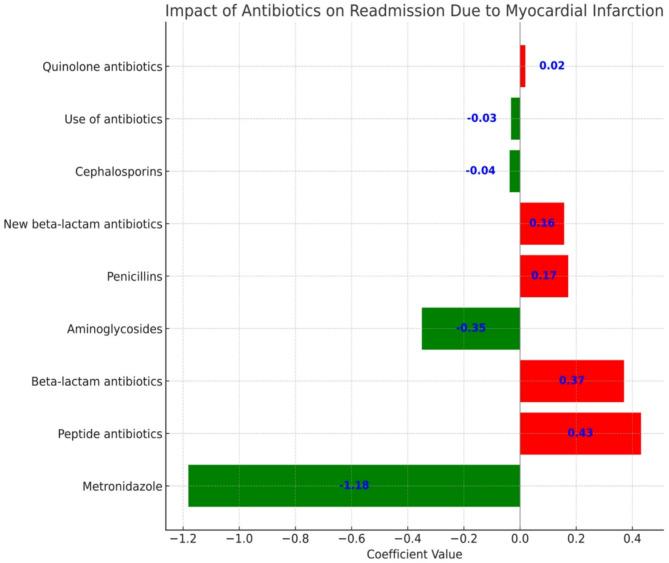
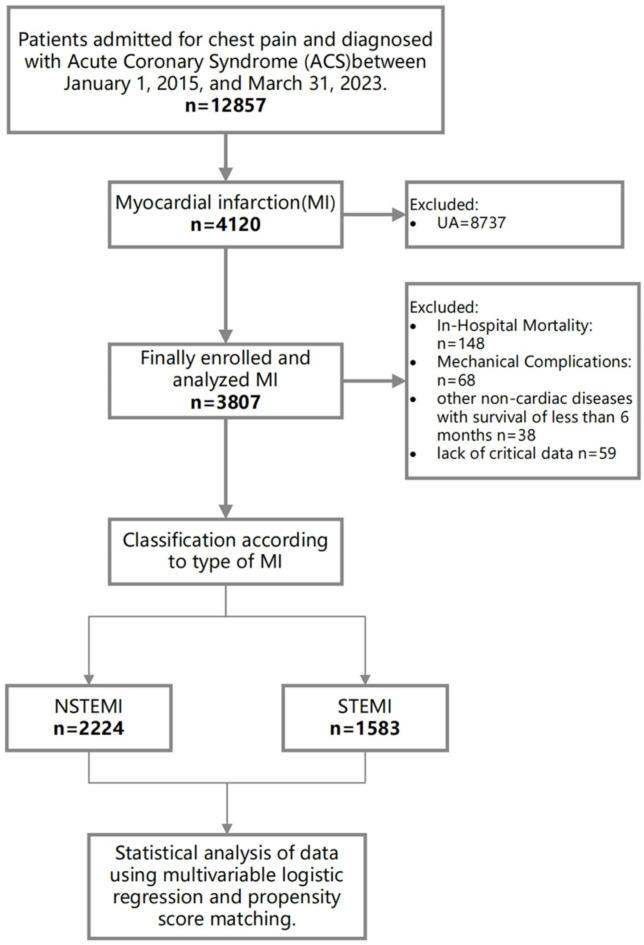
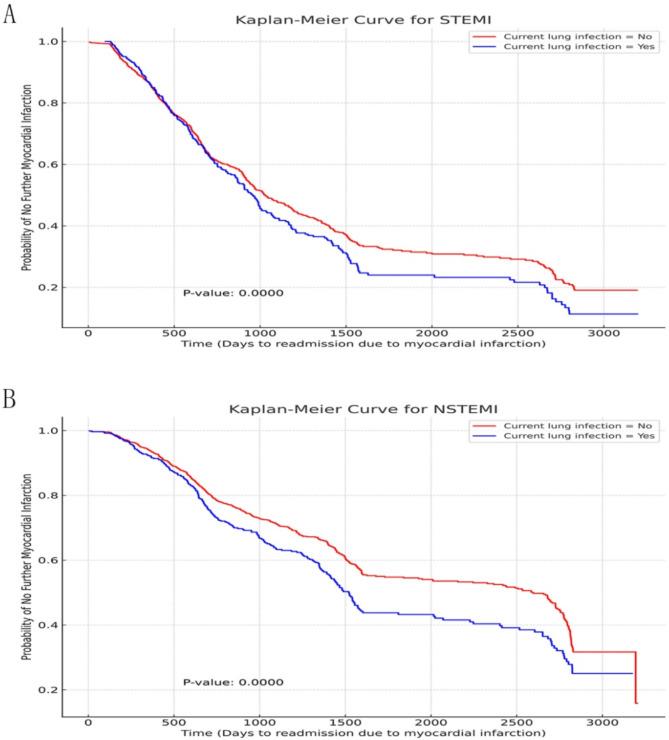
This study aims to evaluate the impact of pulmonary infections and antibiotic use on the recurrence of myocardial infarction (MI) in patients. A total of 3807 MI patients were included in this study. The effects of pulmonary infections and different antibiotics on recurrent MI were investigated using multivariable logistic regression and propensity score matching (PSM) analysis. Kaplan-Meier survival curves were used to compare the risk of recurrent MI between patients with and without pulmonary infections. In the multivariable logistic regression analysis, pulmonary infections significantly increased the risk of recurrent MI in patients with non-ST-segment elevation myocardial infarction (NSTEMI) (odds ratio [OR] = 1.47, 95% confidence interval [CI]: 1.22-1.79, P < 0.0001) and ST-segment elevation myocardial infarction (STEMI) (OR = 1.43, 95% CI: 1.15-1.80, P = 0.0016). PSM analysis showed that, without adjusting for antibiotic use, pulmonary infections significantly increased the risk of recurrent MI (NSTEMI: OR = 1.41, 95% CI: 1.12-1.79, P = 0.004; STEMI: OR = 1.48, 95% CI: 1.13-1.95, P = 0.0051). However, after adjusting for antibiotic use, the impact of pulmonary infections on recurrent MI was no longer significant (NSTEMI: OR = 0.91, 95% CI: 0.57-1.45, P = 0.691; STEMI: OR = 1.06, 95% CI: 0.80-1.41, P = 0.6925). Different antibiotics had significant effects on the risk of recurrent MI: quinolone antibiotics were associated with an increased risk, while cephalosporin antibiotics and metronidazole were associated with a decreased risk. Pulmonary infections significantly increase the risk of recurrent MI in patients, and antibiotic use can modify this effect. Clinically, the use of antibiotics and management of pulmonary infections should be carefully considered to optimize treatment strategies for MI patients.
本研究旨在评估肺部感染和抗生素使用对患者心肌梗死(MI)复发的影响。本研究共纳入3807例MI患者。采用多变量逻辑回归和倾向评分匹配(PSM)分析,研究肺部感染和不同抗生素对MI复发的影响。采用Kaplan-Meier生存曲线比较有和无肺部感染患者MI复发的风险。在多变量逻辑回归分析中,肺部感染显著增加了非ST段抬高型心肌梗死(NSTEMI)患者MI复发的风险(比值比[OR]=1.47,95%置信区间[CI]:1.22-1.79,P<0.0001)以及ST段抬高型心肌梗死(STEMI)患者MI复发的风险(OR=1.43,95%CI:1.15-1.80,P=0.0016)。PSM分析显示,在未调整抗生素使用的情况下,肺部感染显著增加了MI复发的风险(NSTEMI:OR=1.41,95%CI:1.12-1.79,P=0.004;STEMI:OR=1.48,95%CI:1.13-1.95,P=0.0051)。然而,在调整抗生素使用后,肺部感染对MI复发的影响不再显著(NSTEMI:OR=0.91,95%CI:0.57-1.45,P=0.691;STEMI:OR=1.06,95%CI:0.80-1.41,P=0.6925)。不同抗生素对MI复发风险有显著影响:喹诺酮类抗生素与风险增加相关,而头孢菌素类抗生素和甲硝唑与风险降低相关。肺部感染显著增加患者MI复发的风险,而抗生素使用可改变这种影响。临床上,应仔细考虑抗生素的使用和肺部感染的管理,以优化MI患者的治疗策略。
 Zotero 插件