
新辅助化疗周期数及辅助化疗的添加对根治性膀胱切除术治疗肌层浸润性膀胱癌预后的影响
Effects of the Number of Neoadjuvant Cycles and Addition of Adjuvant Chemotherapy on the Prognosis of Muscle-Invasive Bladder Cancer Treated With Radical Cystectomy.
作者信息
Hatakeyama Shingo, Taoka Rikiya, Miki Jun, Saito Ryoichi, Fukuokaya Wataru, Matsui Yoshiyuki, Kawahara Takashi, Matsuda Ayumu, Kawai Taketo, Kato Minoru, Sazuka Tomokazu, Sano Takeshi, Urabe Fumihiko, Kashima Soki, Naito Hirohito, Murakami Yoji, Miyake Makito, Daizumoto Kei, Matsushita Yuto, Hayashi Takuji, Inokuchi Junichi, Sugino Yusuke, Shiga Ken-Ichiro, Yamaguchi Noriya, Taguchi Motohiro, Yasue Keiji, Abe Takashige, Nakanishi Shotaro, Hashine Katsuyoshi, Fujii Masato, Nishihara Kiyoaki, Matsumoto Hiroaki, Tatarano Shuichi, Wada Koichiro, Sekito Sho, Maruyama Ryo, Nishiyama Naotaka, Nishiyama Hiroyuki, Kitamura Hiroshi, Ohyama Chikara
机构信息
Department of Urology, Hirosaki University Graduate School of Medicine, Aomori, Japan.
Department of Urology, Faculty of Medicine, Kagawa University, Kagawa, Japan.
出版信息
Cancer Med. 2025 May;14(9):e70782. doi: 10.1002/cam4.70782.
OBJECTIVE
To evaluate the effects of the number of neoadjuvant chemotherapy (NAC) cycles and the addition of adjuvant chemotherapy (AC) after NAC on overall survival (OS) of patients with muscle-invasive bladder cancer (MIBC).
PATIENTS AND METHODS
We retrospectively evaluated 1687 patients with cT2-4NxM0 MIBC who received radical cystectomy (RC) alone or RC plus perioperative chemotherapy at 36 institutions within the Japanese Urological Oncology Group. We evaluated the effect of the number of NAC cycles (2 vs. ≥ 3 cycles) and the addition of AC on OS.
RESULTS
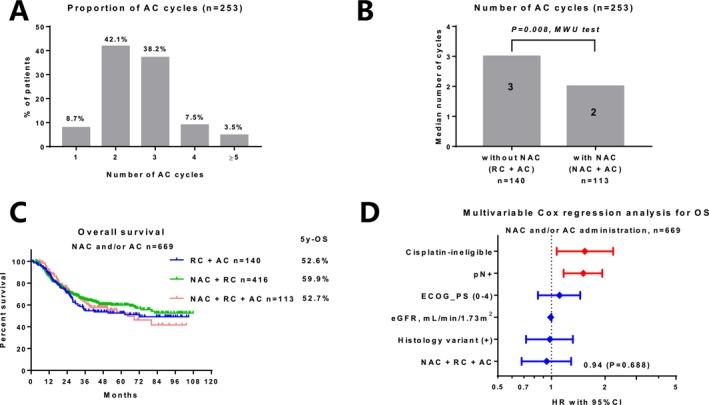
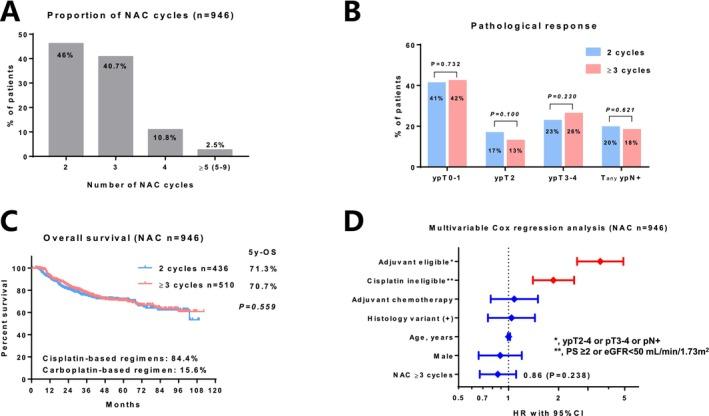
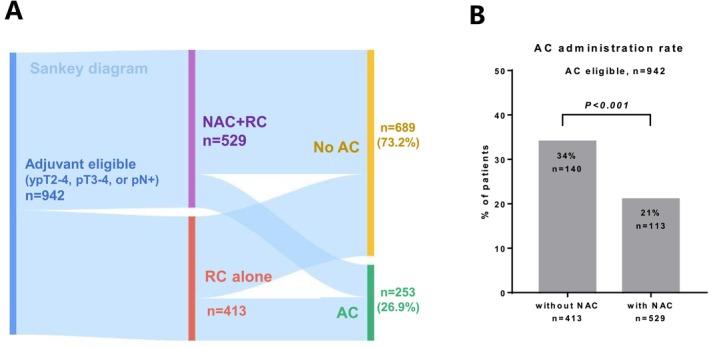
Among the 1687 patients analyzed, 946 received a median of three NAC cycles. The pathologic complete response rate did not significantly differ between those who received 2 (22.9%) and ≥ 3 cycles (27.5%, p = 0.112). Moreover, no significant difference in OS was observed between the groups (p = 0.559). Multivariable Cox regression analysis showed that pathologic high-risk (ypT2-4, pT3-4, or pN+) or cisplatin ineligibility were significantly associated with poor OS but not the number of NAC cycles (p = 0.238). We identified 942 pathologically high-risk patients after RC who were eligible for AC. Notably, no significant OS improvement was observed with the addition of AC as intensive perioperative chemotherapy after NAC. The primary limitation was selection bias from confounding by clinical indication.
CONCLUSIONS
Our findings showed that three or more NAC cycles and the addition of AC may have limited effects on OS in MIBC patients who received RC.
目的
评估新辅助化疗(NAC)周期数以及NAC后辅助化疗(AC)的添加对肌层浸润性膀胱癌(MIBC)患者总生存期(OS)的影响。
患者与方法
我们回顾性评估了1687例cT2-4NxM0期MIBC患者,这些患者在日本泌尿肿瘤学组的36家机构接受了单纯根治性膀胱切除术(RC)或RC联合围手术期化疗。我们评估了NAC周期数(2个周期与≥3个周期)以及AC的添加对OS的影响。
结果
在分析的1687例患者中,946例接受了中位数为3个周期的NAC。接受2个周期(22.9%)和≥3个周期(27.5%,p = 0.112)的患者病理完全缓解率无显著差异。此外,两组之间OS无显著差异(p = 0.559)。多变量Cox回归分析显示,病理高危(ypT2-4、pT3-4或pN+)或顺铂不适用与OS较差显著相关,但与NAC周期数无关(p = 0.238)。我们确定了942例RC术后符合AC条件的病理高危患者。值得注意的是,在NAC后作为强化围手术期化疗添加AC并未观察到OS有显著改善。主要局限性是存在因临床指征混杂导致的选择偏倚。
结论
我们的研究结果表明,对于接受RC的MIBC患者,三个或更多周期的NAC以及添加AC对OS的影响可能有限。

 Zotero 插件