
人乳头瘤病毒(HPV)介导的口咽鳞状细胞癌发病率与美国HPV疫苗接种的地理速率的相关性
Human Papilloma Virus (HPV)-Mediated Oropharyngeal Squamous Cell Carcinoma Incidence Relative to Geographic Rates of HPV Vaccination in the United States.
作者信息
Clark Delaney S, Nguyen Nhu, Coblens Orly, Ranasinghe Viran J, Shabani Sepehr
机构信息
Otolaryngology - Head and Neck Surgery, University of Texas Medical Branch, Galveston, USA.
出版信息
Cureus. 2025 Mar 30;17(3):e81459. doi: 10.7759/cureus.81459. eCollection 2025 Mar.
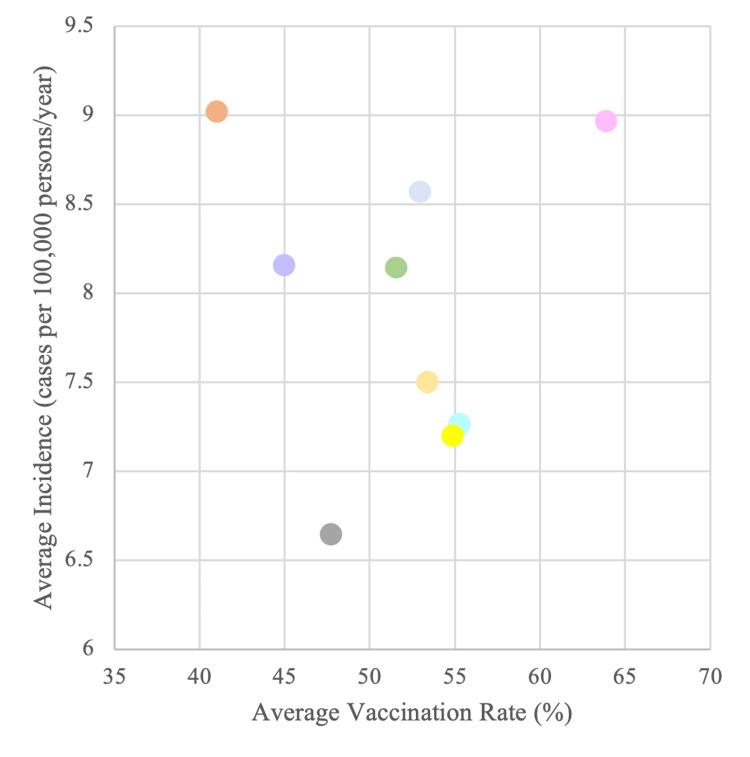
Objective This study aims to analyze the trends in the incidence of human papilloma virus (HPV)-mediated oropharyngeal squamous cell carcinoma (OPSCC) in relation to geographic rates of HPV vaccination in the United States. Methods The US Cancer Statistics (USCS) database and the National Cancer Institute's (NCI's) Surveillance, Epidemiology and End Results (SEER) program were used for incidence and population data collection; the Centers for Disease Control and Prevention's (CDC) Teen National Immunization Survey provided vaccination data. Incidence of HPV-mediated OPSCC and the HPV vaccination rate were compared and analyzed using t-tests, ANOVA analyses, and linear regression analyses. Results Statistically significant differences between regions of the United States were observed when incidence and vaccination rates of OPSCC were analyzed. When incidence as a function of vaccination rate was analyzed, no significance was noted. Each region had an increase in the OPSCC incidence in the post-vaccine era compared to the pre-vaccine era. Conclusion We cannot conclude that any variance in OPSCC by region is due to HPV vaccination at this time. Because some regions show increased vaccination rates compared to others, it is likely that they will reach herd immunity first and be the first to see a decline in cases as the population ages. Because of the currently insignificant relationship between the vaccination rate over time and incidence rates, additional longitudinal analyses and cohort follow-up studies are needed to further assess the vaccine's impact.
目的 本研究旨在分析美国人类乳头瘤病毒(HPV)介导的口咽鳞状细胞癌(OPSCC)发病率与HPV疫苗接种地理比率之间的关系。方法 利用美国癌症统计(USCS)数据库和美国国立癌症研究所(NCI)的监测、流行病学和最终结果(SEER)计划收集发病率和人口数据;疾病控制与预防中心(CDC)的青少年全国免疫调查提供疫苗接种数据。使用t检验、方差分析和线性回归分析对HPV介导的OPSCC发病率和HPV疫苗接种率进行比较和分析。结果 分析OPSCC发病率和疫苗接种率时,在美国各地区之间观察到具有统计学意义的差异。分析发病率作为疫苗接种率的函数时,未发现显著意义。与疫苗接种前时代相比,疫苗接种后时代每个地区的OPSCC发病率均有所上升。结论 目前我们不能得出各地区OPSCC的任何差异是由于HPV疫苗接种所致的结论。由于一些地区的疫苗接种率高于其他地区,随着人口老龄化,这些地区可能首先实现群体免疫,并首先看到病例数下降。由于目前疫苗接种率随时间的变化与发病率之间的关系不显著,需要进行额外的纵向分析和队列随访研究,以进一步评估疫苗的影响。
 Zotero 插件