
吸血飞行昆虫将非洲猪瘟病毒引入高生物安全水平养猪场的可能性。
Potential for Introduction of African Swine Fever Virus into High-Biosecurity Pig Farms by Flying Hematophagous Insects.
作者信息
Stelder Jonno Jorn, Olesen Ann Sofie, Belsham Graham J, Rasmussen Thomas Bruun, Bøtner Anette, Kjær Lene Jung, Boklund Anette Ella, Bødker René
机构信息
Section for Animal Welfare and Disease Control, Department of Veterinary and Animal Sciences, University of Copenhagen, Grønnegårdsvej 8, 1870, Frederiksberg C, Denmark.
Section for Infection Preparedness, Statens Serum Institut, Artillerivej 5, 2300, Copenhagen, Denmark.
出版信息
Transbound Emerg Dis. 2023 Apr 12;2023:8787621. doi: 10.1155/2023/8787621. eCollection 2023.
BACKGROUND
DNA of African swine fever virus (ASFV) has previously been detected in hematophagous insects on ASF outbreak farms. However, it remains unclear whether the viral DNA derived from blood meals that originated from pigs on the outbreak farm or was introduced from infected domestic pigs or wild boar sources located outside of the outbreak farm.
METHODS
We caught 644 hematophagous insects on the windows at two non-outbreak high-biosecurity pig farms (i.e., without ASFV-infected pigs) using plastic meshes coated with sticky glue, as well as 3576 hematophagous insects using H-traps on or around the farms. Using PCR analyses, we identified which insects were present, whether these hematophagous insects carried blood from an external (exogenous) source and if the blood contained ASFV DNA.
RESULTS
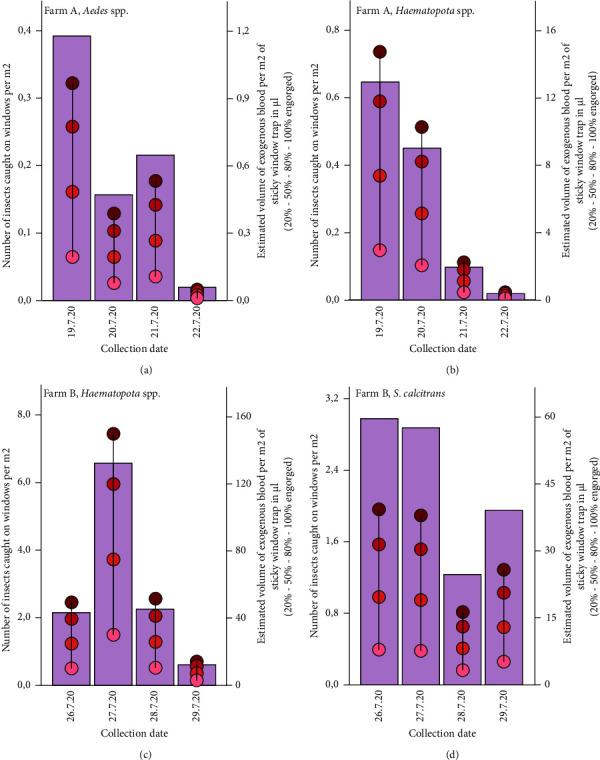
We found blood meals with ASFV DNA in one pool of five spp. in the H-traps. From the window traps, we found 0-2.7% of spp., , and spp. carrying blood meals from exogenous sources into the farms. Some insects carried bovine blood; the closest registered source for this was 2500m from the pig farm.
CONCLUSION
Hematophagous insects carrying ASFV-positive blood meals or blood meals from exogenous sources seem to be attracted to high-biosecurity pig farms and attempt to enter them through their windows. Despite the small percentage of insects carrying blood and the small amounts carried by each insect, the large numbers of insects result in a sufficient volume of exogenous blood, potentially containing ASFV, to constitute a non-negligible risk for ASFV-introduction into unprotected pig stables. This study is the first to provide quantitative data on the number of hematophagous insects trying to enter high-biosecurity pig farms. It is also the first to provide information about the origin of their blood meals, indicating that insect-borne introduction of blood containing ASFV into high-biosecurity pig farms is possible and, therefore, could potentially be responsible for some of the outbreaks observed during the summer peaks of infection.
背景
此前在非洲猪瘟疫情爆发猪场的吸血昆虫体内检测到了非洲猪瘟病毒(ASFV)的DNA。然而,目前尚不清楚这些病毒DNA是来自疫情爆发猪场的猪的血餐,还是从疫情爆发猪场以外受感染的家猪或野猪源引入的。
方法
我们在两个未爆发疫情的高生物安全水平猪场(即无ASFV感染猪)的窗户上,使用涂有粘性胶水的塑料网捕获了644只吸血昆虫,同时在猪场或其周围使用H型诱捕器捕获了3576只吸血昆虫。通过PCR分析,我们确定了存在哪些昆虫,这些吸血昆虫是否携带来自外部(外源)的血液,以及血液中是否含有ASFV DNA。
结果
我们在H型诱捕器捕获的五属昆虫中的一组中发现了含有ASFV DNA的血餐。从窗户诱捕器中,我们发现0 - 2.7%的某属、某属和某属昆虫携带外源血液进入猪场。一些昆虫携带牛血;距离猪场最近的登记牛源距离为2500米。
结论
携带ASFV阳性血餐或外源血餐的吸血昆虫似乎被吸引到高生物安全水平的猪场,并试图通过窗户进入。尽管携带血液的昆虫比例较小,且每只昆虫携带的血量也较少,但大量昆虫导致了足够数量的外源血液,可能含有ASFV,对将ASFV引入未受保护的猪舍构成不可忽视的风险。本研究首次提供了试图进入高生物安全水平猪场的吸血昆虫数量的定量数据。这也是首次提供有关它们血餐来源的信息,表明通过昆虫传播含有ASFV的血液进入高生物安全水平猪场是可能的,因此,这可能是在夏季感染高峰期间观察到的一些疫情爆发的原因之一。


 Zotero 插件