
邻里原型对加利福尼亚州年轻急性白血病患者总体死亡率的影响。
Impact of neighborhood archetypes on overall mortality among young patients with acute leukemia in California.
作者信息
Winestone Lena E, Yang Juan, Banerjee Tanushree, Sangaramoorthy Meera, Kahn Justine, Abrahão Renata, Keegan Theresa H, Cheng Iona, Gomez Scarlett Lin, Shariff-Marco Salma
机构信息
Division of Allergy, Immunology, and BMT, UCSF Benioff Children's Hospitals, San Francisco, California, USA.
UCSF Helen Diller Family Comprehensive Cancer Center, San Francisco, California, USA.
出版信息
Cancer. 2025 May 1;131(9):e35863. doi: 10.1002/cncr.35863.
INTRODUCTION
Residence in lower socioeconomic neighborhoods is associated with lower survival in children, adolescents, and young adults with leukemia. We sought to evaluate the impact of neighborhood archetypes on acute lymphoblastic leukemia (ALL) and acute myeloid leukemia (AML) survival.
METHODS
Patients aged 0 to 39 years diagnosed with ALL or AML from 2006 through 2016 in the California Cancer Registry were included. Nine-class neighborhood archetypes, generated by latent class analysis of 39 social and built environment attributes at the census tract level, were the primary exposure of interest. Cox proportional hazards models were used for statistical analyses, stratified by age.
RESULTS
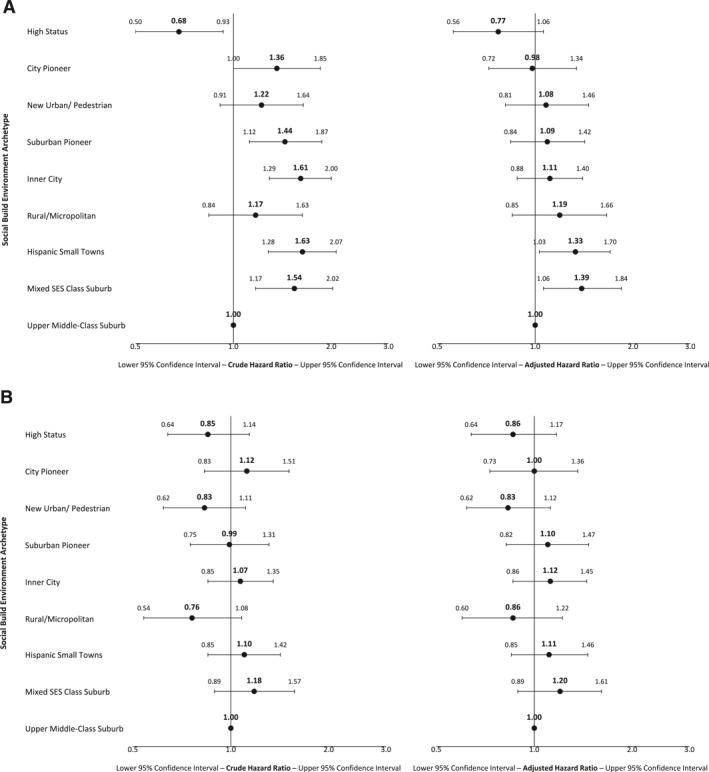
Among 8776 patients, 72% had ALL and 28% had AML. For ALL, increased risk of mortality was observed in mixed socioeconomic status suburbs (adjusted hazard ratio, 1.39; 95% CI, 1.06-1.84) and Hispanic small towns (adjusted hazard ratio, 1.33; 95% CI, 1.03-1.84) relative to upper middle-class suburbs. For AML, neighborhood archetypes were not associated with mortality. When stratified by age, we observed associations between neighborhood archetypes (mixed socioeconomic status class suburb, inner city, Hispanic small towns) and mortality in pediatric but not young adult ALL patients.
CONCLUSIONS
Our findings demonstrate that neighborhood archetypes efficiently account for complex interactions across social and built environment attributes with leukemia survival. The greater effects of neighborhood archetype in pediatric ALL survival, as compared to AML, may be related to the prolonged, outpatient nature of ALL maintenance therapy and the challenges associated with treatment adherence among patients residing in disadvantaged neighborhoods.
引言
居住在社会经济地位较低的社区与白血病儿童、青少年和年轻成年人的生存率较低有关。我们试图评估社区原型对急性淋巴细胞白血病(ALL)和急性髓细胞白血病(AML)生存率的影响。
方法
纳入2006年至2016年在加利福尼亚癌症登记处诊断为ALL或AML的0至39岁患者。通过对人口普查区层面的39个社会和建筑环境属性进行潜在类别分析生成的九类社区原型是主要的研究暴露因素。使用Cox比例风险模型进行统计分析,并按年龄分层。
结果
在8776名患者中,72%患有ALL,28%患有AML。对于ALL,与上层中产阶级郊区相比,在社会经济地位混合的郊区(调整后的风险比为1.39;95%置信区间为1.06-1.84)和西班牙裔小镇(调整后的风险比为1.33;95%置信区间为1.03-1.84)观察到死亡风险增加。对于AML,社区原型与死亡率无关。按年龄分层时,我们在儿科ALL患者而非年轻成人ALL患者中观察到社区原型(社会经济地位混合的郊区、市中心、西班牙裔小镇)与死亡率之间的关联。
结论
我们的研究结果表明,社区原型有效地解释了社会和建筑环境属性与白血病生存率之间的复杂相互作用。与AML相比,社区原型对儿科ALL生存率的影响更大,这可能与ALL维持治疗的长期门诊性质以及居住在弱势社区的患者治疗依从性相关的挑战有关。
 Zotero 插件