
创伤性骨折患者心理弹性的影响因素分析及其对创伤后成长的作用
Analysis of influencing factors of psychological resilience in patients with traumatic fractures and its effect on posttraumatic growth.
作者信息
Chen Dao-Zhen, Chen Kun-Feng, Xu Ji-Sheng, Gao Kun
机构信息
Department of Traumatology, The First People's Hospital of Shangqiu, Shangqiu 476100, Henan Province, China.
Department of Orthopedics, Henan Province People's Hospital, Zhengzhou 462000, Henan Province, China.
出版信息
World J Psychiatry. 2025 Apr 19;15(4):100819. doi: 10.5498/wjp.v15.i4.100819.
BACKGROUND
Traumatic fractures are mainly caused by various exogenous traumatic events, which not only damage patients' physical health but also affect their psychological state and aggravate stress responses.
AIM
To analyze the influencing factors of psychological resilience of patients with traumatic fractures and the effect of psychological resilience on posttraumatic growth (PTG).
METHODS
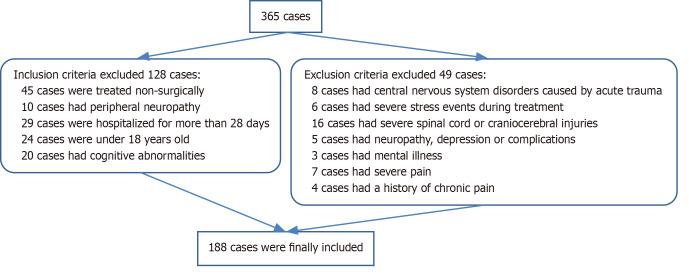
This study included 188 patients with traumatic fractures admitted to the First People's Hospital of Shangqiu from November 2022 to November 2023. The participants were categorized based on the patient's psychological resilience assessed by the Connor-Davidson Resilience Scale (CD-RISC) into the better resilience group (CD-RISC score ≥ 60 points, = 80) and the poor resilience group (CD-RISC score < 60 points, = 108). Patients' sleep quality was assessed with the Pittsburgh Sleep Quality Index (PSQI). The identification of the influencing factors of psychological resilience in patients with traumatic fractures was realized by binary Logistic regression (with factors such as sex, age, injury cause, trauma severity, fracture site, personality, and PSQI included for analysis). The determination of the PTG status of all participants used the Chinese version of the Posttraumatic Growth Inventory (C-PTGI). Furthermore, a Spearman correlation analysis was conducted to analyze the association between psychological resilience and PTG.
RESULTS
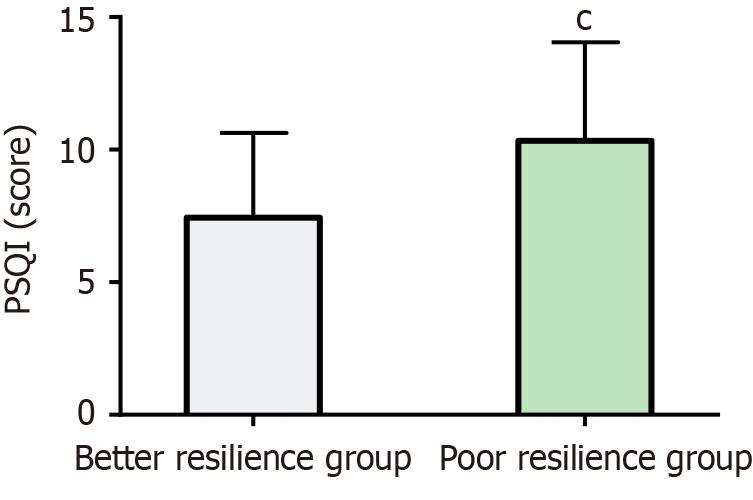
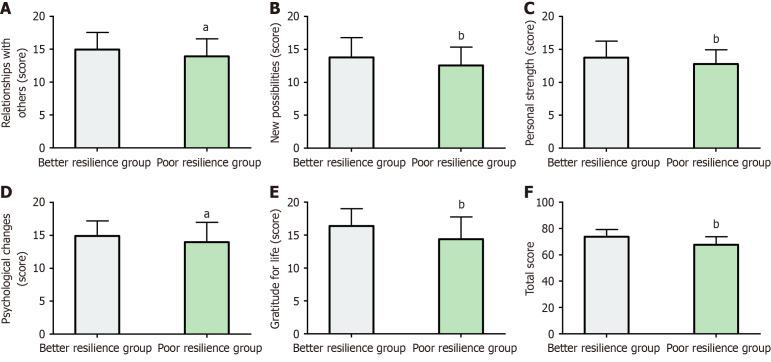
The psychological resilience of patients with traumatic fractures was related to age, sex, trauma severity, and personality. The better resilience group demonstrated statistically lower PSQI scores than the poor resilience group ( < 0.05). The Logistic regression analysis revealed sex, age, trauma severity, personality, and sleep quality as influencing factors of CD-RISC scores in patients with traumatic fractures (all < 0.05). The score of each C-PTGI dimension and the total score (relating to others, new possibilities, personal strength, spiritual change, and appreciation of life) were higher in the better resilience group than in the poor resilience group (all < 0.05). Spearman correlation analysis indicated a positive association of the CD-RISC score in patients with traumatic fractures with the scores of all dimensions of C-PTGI and the total C-PTGI score (all < 0.05).
CONCLUSION
The factors influencing the psychological resilience of patients with traumatic fractures include age, sex, trauma severity, personality, and sleep quality, and psychological resilience is closely associated with PTG.
背景
创伤性骨折主要由各种外部创伤事件引起,不仅损害患者的身体健康,还会影响其心理状态并加重应激反应。
目的
分析创伤性骨折患者心理韧性的影响因素以及心理韧性对创伤后成长(PTG)的影响。
方法
本研究纳入了2022年11月至2023年11月在商丘市第一人民医院收治的188例创伤性骨折患者。根据Connor-Davidson韧性量表(CD-RISC)评估的患者心理韧性,将参与者分为韧性较好组(CD-RISC评分≥60分,n = 80)和韧性较差组(CD-RISC评分<60分,n = 108)。采用匹兹堡睡眠质量指数(PSQI)评估患者的睡眠质量。通过二元Logistic回归(纳入性别、年龄、受伤原因、创伤严重程度、骨折部位、性格和PSQI等因素进行分析)来确定创伤性骨折患者心理韧性的影响因素。使用中文版创伤后成长量表(C-PTGI)来确定所有参与者的PTG状态。此外,进行Spearman相关性分析以分析心理韧性与PTG之间的关联。
结果
创伤性骨折患者的心理韧性与年龄、性别、创伤严重程度和性格有关。韧性较好组的PSQI评分在统计学上低于韧性较差组(P<0.05)。Logistic回归分析显示,性别、年龄、创伤严重程度、性格和睡眠质量是创伤性骨折患者CD-RISC评分的影响因素(均P<0.05)。韧性较好组的每个C-PTGI维度得分和总分(与他人的关系、新的可能性、个人力量、精神变化和对生活的欣赏)均高于韧性较差组(均P<0.05)。Spearman相关性分析表明,创伤性骨折患者的CD-RISC评分与C-PTGI各维度得分及C-PTGI总分呈正相关(均P<0.05)。
结论
影响创伤性骨折患者心理韧性的因素包括年龄、性别、创伤严重程度、性格和睡眠质量,且心理韧性与PTG密切相关。

 Zotero 插件