
中国血液系统恶性肿瘤幸存者疾病进展恐惧的潜在类别分析
Latent profile analysis of fear of progression in Chinese hematologic malignancy survivors.
作者信息
Liu Yating, Zhang Qianqian, Zhao Jinying, Zhang Tiantian, Tian Fei, Wang Zhixin, Shao Zhuli, Li Xiaobin, Xie Wenjun, Yang Fan, Li Qiuyan, Li Junjie
机构信息
State Key Laboratory of Experimental Hematology, National Clinical Research Center for Blood Diseases, Haihe Laboratory of Cell Ecosystem, Institute of Hematology & Blood Diseases Hospital, Chinese Academy of Medical Sciences & Peking Union Medical College, No. 288, Nanjing Road, Heping District, Tianjin, 300020, China.
Tianjin Institutes of Health Science, Tianjin, 301600, China.
出版信息
Sci Rep. 2025 May 1;15(1):15265. doi: 10.1038/s41598-025-00415-6.
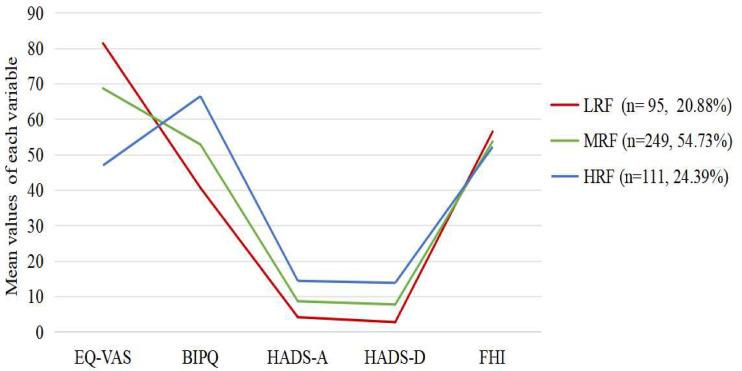
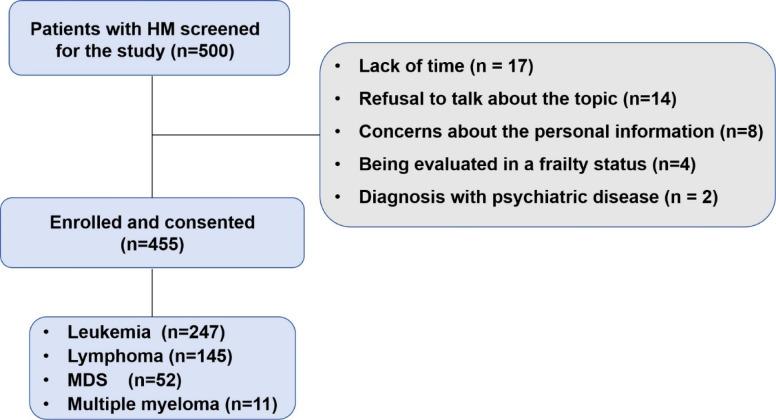
Fear of disease progression (FoP) is a multidimensional concept that refers to the fear or worry about disease progress. Little is known about the distinct FoP profiles and their determinants in culturally specific contexts, especially among hematologic malignancies (HM) patients in China. This study aimed to identify heterogeneous profiles of FoP and their associated predictors among Chinese patients with HM. A convenience sample of patients suffering from HM were enrolled from March 2023 to February 2024. To gather multidimensional data from the Fear of Progression Questionnaire-Short Form (FoP-Q-SF), the Brief Illness Perception Questionnaire (BIPQ), the Hospital Anxiety and Depression Scale (HADS), the Family Hardiness Index (FHI), and the EuroQol-Visual Analogue Scale (EQ-VAS), we performed a questionnaire-based cross-sectional study on 455 survivors with HM. The statistical method included latent profile analysis (LPA) and multivariate logistic regression. Three latent profiles of FoP were found: the low-risk fear group (20.88%), the moderate-risk fear group (54.73%), and the high-risk fear group (24.49%). Patients with higher levels of illness perception, anxiety, and depression were more likely to report higher levels of FoP. The study revealed that female gender (OR 2.295-2.577), age > 65 years (OR 4.140-9.363), lower education (OR 0.270-0.365), and lymphoma diagnosis (OR 2.95) significantly predicted higher FoP risk (all P < 0.05), while higher income (OR 0.390-0.477, P < 0.05) and greater family resilience showed protective effects. The findings underscore the need for risk-stratified interventions targeting psychosocial vulnerabilities, particularly in elderly and female adults with HM. This study provides empirical evidence supporting the application of precision psycho-oncology approaches in HM survivorship management. It also contributes to the broader comprehension of FoP and highlights the importance of family-centered interventions .
对疾病进展的恐惧(FoP)是一个多维度概念,指对疾病进展的恐惧或担忧。在特定文化背景下,尤其是中国血液系统恶性肿瘤(HM)患者中,关于不同的FoP概况及其决定因素知之甚少。本研究旨在确定中国HM患者中FoP的异质性概况及其相关预测因素。2023年3月至2024年2月纳入了方便样本的HM患者。为了从《疾病进展恐惧问卷简表》(FoP-Q-SF)、《简短疾病认知问卷》(BIPQ)、《医院焦虑抑郁量表》(HADS)、《家庭坚韧性指数》(FHI)和《欧洲五维度健康量表视觉模拟量表》(EQ-VAS)收集多维度数据,我们对455名HM幸存者进行了基于问卷的横断面研究。统计方法包括潜在类别分析(LPA)和多变量逻辑回归。发现了三种FoP潜在类别:低风险恐惧组(20.88%)、中度风险恐惧组(54.73%)和高风险恐惧组(24.49%)。疾病认知、焦虑和抑郁水平较高的患者更有可能报告较高水平的FoP。研究表明,女性(比值比2.295 - 2.577)、年龄>65岁(比值比4.140 - 9.363)、受教育程度较低(比值比0.270 - 0.365)和淋巴瘤诊断(比值比2.95)显著预测更高的FoP风险(均P<0.05),而较高收入(比值比0.390 - 0.477,P<0.05)和更强的家庭复原力显示出保护作用。研究结果强调了针对心理社会脆弱性进行风险分层干预的必要性,特别是在老年和成年女性HM患者中。本研究提供了支持在HM生存管理中应用精准心理肿瘤学方法的实证证据。它还有助于更广泛地理解FoP,并突出了以家庭为中心干预措施的重要性。
 Zotero 插件