
臭氧应用于屠宰场冷藏室中牛胴体的效果。
Effect of ozone application on bovine carcasses in abattoir cold chambers.
作者信息
Brusa Victoria, Restovich Viviana, Cap Mariana, Chiapparoli Virginia, Grigioni Gabriela, Giannuzzi Leda, Vaudagna Sergio, Leotta Gerardo
机构信息
IGEVET - Instituto de Genética Veterinaria "Ing. Fernando N. Dulout" (UNLP-CONICET LA PLATA), Facultad de Ciencias Veterinarias UNLP, La Plata, Argentina.
Frigorífico Arrebeef, Pérez Millan, Buenos Aires, Argentina.
出版信息
PLoS One. 2025 May 2;20(5):e0321146. doi: 10.1371/journal.pone.0321146. eCollection 2025.
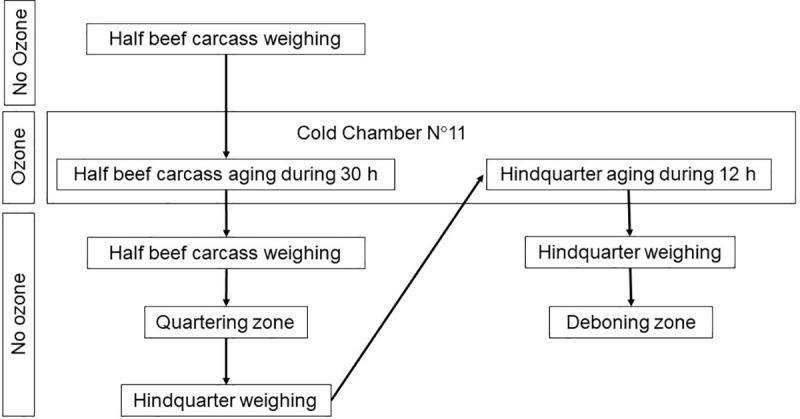
Different technologies have been evaluated to promote food safety and improve the microbiological quality and shelf life of food. The aim of this work was to determine the effect of gaseous ozone on beef carcass weight loss and indicator microorganism counts in an exporting abattoir. Two gaseous ozone concentrations (3 and 10 ppm) were applied on carcasses from Experiment 1 (Exp. 1, n = 100 test, n = 100 control) and Experiment 2 (Exp. 2, n = 100 test, n = 100 control), respectively. Cold chamber without ozone was used as control in both experiments. For mesophilic aerobic organism (MAO), coliform and Escherichia coli counts, 100 cm2 of each carcass was swabbed before and 10, 20 and 30 h after ozone application. In Exp. 1, the carcass entire surface was swabbed for Shiga-toxin (stx) gene detection. The counts of MAO were influenced by treatment and sampling time in both experiments. In Exp. 1, control carcasses had higher counts than ozonated carcasses at all sampling times, whereas the opposite occurred in Exp. 2. Coliform count was affected by sampling time in Exp. 2, whereas E. coli count was not affected in any experiment. All samples analyzed were stx-negative. Differences in carcass weight loss were not significant. In conclusion, gaseous ozone was not effective to reduce bacterial load or carcass weight loss. To our knowledge, this is the first study evaluating ozone effect on beef carcasses conducted in a commercial abattoir, not at laboratory scale. Future research would help demonstrate whether the use of ozone impacts on the quality and sensory characteristics of beef.
人们已经评估了不同技术,以促进食品安全并改善食品的微生物质量和保质期。这项工作的目的是确定气态臭氧对一家出口屠宰场中牛肉胴体失重和指示微生物数量的影响。分别对实验1(实验1,n = 100个测试组,n = 100个对照组)和实验2(实验2,n = 100个测试组,n = 100个对照组)的胴体施加两种气态臭氧浓度(3 ppm和10 ppm)。在两个实验中,均使用无臭氧的冷藏间作为对照。对于嗜温需氧菌(MAO)、大肠菌群和大肠杆菌计数,在施加臭氧前以及施加臭氧后10、20和30小时,对每个胴体的100 cm²进行擦拭取样。在实验1中,擦拭胴体整个表面以检测志贺毒素(stx)基因。在两个实验中,MAO计数均受处理和取样时间的影响。在实验1中,在所有取样时间,对照胴体的计数均高于经臭氧处理的胴体,而在实验2中情况则相反。在实验2中,大肠菌群计数受取样时间影响,而在任何实验中大肠杆菌计数均不受影响。所有分析的样品stx均为阴性。胴体失重差异不显著。总之,气态臭氧在减少细菌负荷或胴体失重方面无效。据我们所知,这是第一项在商业屠宰场而非实验室规模下评估臭氧对牛肉胴体影响的研究。未来的研究将有助于证明臭氧的使用是否会影响牛肉的质量和感官特性。

 Zotero 插件