
鼠伤寒沙门氏菌中wzy基因座的可逆切除可能有助于噬菌体捕食后的恢复。
Reversible excision of the wzy locus in Salmonella Typhimurium may aid recovery following phage predation.
作者信息
Charity Oliver Jd, Thilliez Gaetan, Al-Khanaq Haider, Acton Luke, Kolenda Rafał, Bawn Matt, Petrovska Liljana, Kingsley Robert A
机构信息
Quadram Institute Bioscience, Norwich, United Kingdom.
University of East Anglia, Norwich Research Park, Norwich, United Kingdom.
出版信息
PLoS Genet. 2025 May 2;21(5):e1011688. doi: 10.1371/journal.pgen.1011688. eCollection 2025 May.
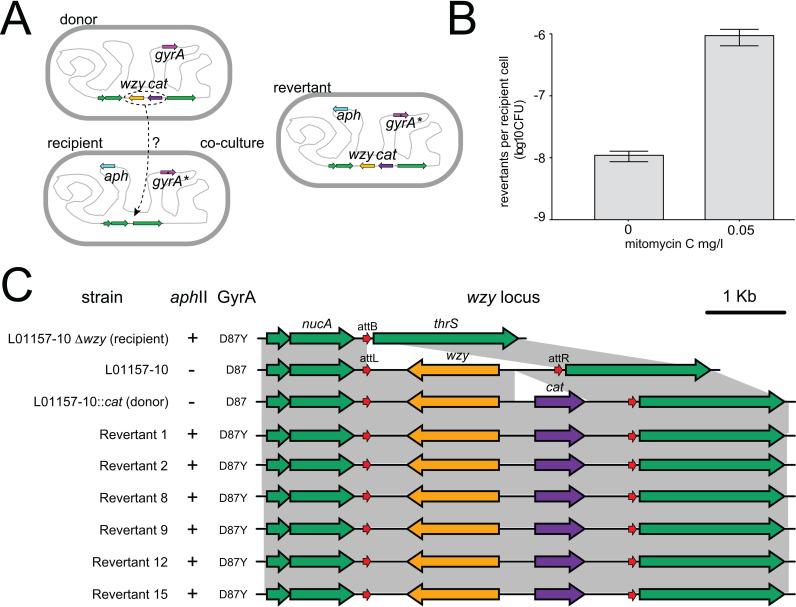
Bacteriophage (phage) are promising novel antimicrobials but a key challenge to their effective implementation is the rapid emergence of phage resistance. An improved understanding of phage-host interactions is therefore needed. The Anderson phage typing scheme differentiates closely related strains of Salmonella enterica serovar Typhimurium (S. Typhimurium) based on sensitivity to a panel of phage preparations. Switches in phage type are indicative of changes in phage sensitivity and inform on the dynamics of phage interaction with their host bacteria. We investigated the molecular basis of switches between the relatively phage sensitive S. Typhimurium DT8 and phage resistant DT30 strains that are present in the same phylogenetic clade. DT30 strains emerged from DT8 strains predominantly by deletion of a genomic region affecting the wzy locus encoding an O-antigen polymerase. The deletion site was flanked by two perfect direct repeats designated attL and attR. During broth culture in the presence of a typing phage that used O-antigen as primary receptor the Δwzy genotype increased in frequency compared with culture in the absence of phage and removal of attL prevented deletion of the wzy locus. Co-culture of S. Typhimurium DT8 with a strain lacking wzy resulted in reversion of the latter to wild type. We propose a model in which reversible deletion of the wzy locus enables recovery of S. Typhimurium DT8 following predation by phage that use O-antigen as their primary receptor. This was consistent with ancestral state reconstruction of DT8 and DT30 phylogeny that supported a model of reversible transition from DT8 to DT30 in natural populations.
噬菌体有望成为新型抗菌剂,但其有效应用面临的一个关键挑战是噬菌体抗性的迅速出现。因此,需要更好地理解噬菌体与宿主之间的相互作用。安德森噬菌体分型方案基于对一组噬菌体制剂的敏感性,区分密切相关的肠炎沙门氏菌鼠伤寒血清型菌株(鼠伤寒沙门氏菌)。噬菌体类型的转变表明噬菌体敏感性的变化,并反映噬菌体与其宿主细菌相互作用的动态。我们研究了同一系统发育分支中相对噬菌体敏感的鼠伤寒沙门氏菌DT8和噬菌体抗性DT30菌株之间转变的分子基础。DT30菌株主要通过缺失影响编码O抗原聚合酶的wzy基因座的基因组区域,从DT8菌株演变而来。缺失位点两侧有两个完美的直接重复序列,分别命名为attL和attR。在以O抗原作为主要受体的分型噬菌体存在下进行肉汤培养时,与无噬菌体培养相比,Δwzy基因型的频率增加,去除attL可防止wzy基因座的缺失。将鼠伤寒沙门氏菌DT8与缺乏wzy的菌株共培养,导致后者恢复为野生型。我们提出了一个模型,其中wzy基因座的可逆缺失使鼠伤寒沙门氏菌DT8在被以O抗原作为主要受体的噬菌体捕食后能够恢复。这与DT8和DT30系统发育的祖先状态重建一致,该重建支持了自然种群中从DT8到DT30的可逆转变模型。



 Zotero 插件