
用于绘制组织中细胞聚集体空间特征的高度适应性分析工具。
Highly Adaptable Analysis Tools for Mapping Spatial Features of Cellular Aggregates in Tissues.
作者信息
Sawyer Andrew, Weingaertner Nick, Patrick Ellis, Feng Carl G
机构信息
School of Medical Sciences, Faculty of Medicine and Health, The University of Sydney, Sydney, NSW, Australia.
Centenary Institute, The University of Sydney, Sydney, NSW, Australia.
出版信息
Curr Protoc. 2025 May;5(5):e70135. doi: 10.1002/cpz1.70135.
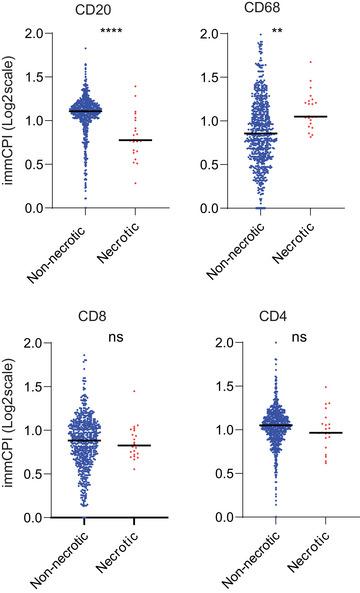
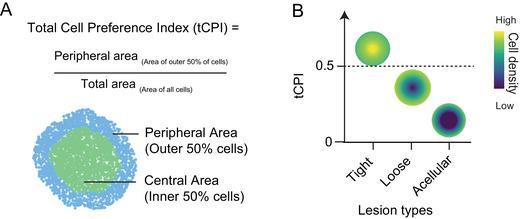
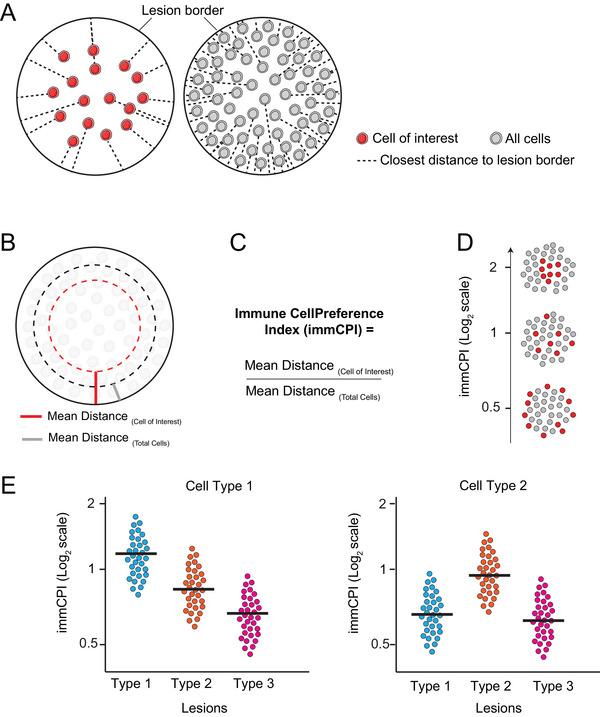
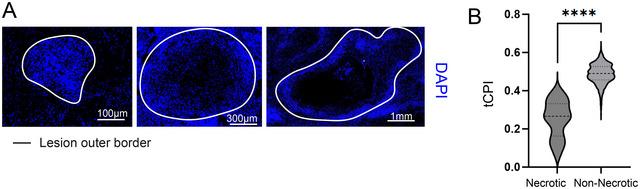
Multiplex imaging technologies have developed rapidly over the past decades. The advancement of multiplex imaging has been driven in part by the recognition that the spatial organization of cells can represent important prognostic biomarkers and that simply studying the composition of cells in diseased tissue is often insufficient. There remains a lack of tools that can perform spatial analysis at the level of cellular aggregates (a common histopathological presentation) such as tumors and granulomas, with most analysis packages focusing on smaller regions of interest and potentially missing patterns in the overall lesion structure and cellular distribution. Here, we present protocols to quantitatively describe the cellular structure of entire tissue lesions, built around two novel metrics. The Total Cell Preference Index reports whether a lesion tends to change in density in its central versus peripheral areas and can indicate the extent of necrosis across the entire lesion. The Immune Cell Preference Index then reports whether each immune cell type is located more centrally or peripherally across the entire lesion. The output of both indexes is a single number readout for simple interpretation and visualization, and these indexes can be applied to lesions of any size or shape. This simplifies cross-lesion comparison compared to traditional Euclidian distance-based analysis, which outputs multiple values for each lesion (one for output for each band used in the infiltration analysis). Additionally, this approach can be applied to any slide-scanning multiplexed imaging system, based on either protein or nucleic acid staining. Finally, the approach uses the open-source software QuPath and can be utilized by researchers with a basic understanding of QuPath, with the full analysis able to be applied to pre-generated images within 1 hr. © 2025 The Author(s). Current Protocols published by Wiley Periodicals LLC. Basic Protocol 1: Image preparation and lesion selection Basic Protocol 2: Total Cell Preference Index and Immune Cell Preference Index.
在过去几十年中,多重成像技术发展迅速。多重成像的进步部分得益于人们认识到细胞的空间组织可以代表重要的预后生物标志物,而且仅仅研究病变组织中的细胞组成往往是不够的。目前仍然缺乏能够在细胞聚集体(如肿瘤和肉芽肿等常见的组织病理学表现)层面进行空间分析的工具,大多数分析软件包都聚焦于较小的感兴趣区域,可能会遗漏整个病变结构和细胞分布中的模式。在此,我们提出了围绕两个新指标构建的方案,用于定量描述整个组织病变的细胞结构。总细胞偏好指数报告病变在其中心区域与周边区域的密度是否有变化趋势,并可指示整个病变的坏死程度。然后,免疫细胞偏好指数报告每种免疫细胞类型在整个病变中是更集中还是更分散地分布。这两个指数的输出都是一个单一的数值读数,便于简单的解释和可视化,并且这些指数可应用于任何大小或形状的病变。与传统的基于欧几里得距离的分析相比,这简化了跨病变比较,传统分析会为每个病变输出多个值(浸润分析中使用的每个波段输出一个值)。此外,这种方法可应用于任何基于蛋白质或核酸染色的玻片扫描多重成像系统。最后,该方法使用开源软件QuPath,对QuPath有基本了解的研究人员即可使用,完整的分析能够在1小时内应用于预先生成的图像。© 2025作者。由Wiley Periodicals LLC出版的《当前协议》。基本方案1:图像制备和病变选择 基本方案2:总细胞偏好指数和免疫细胞偏好指数

 Zotero 插件