
罕见病药物的重新利用。
Rare Disease Drug Repurposing.
作者信息
Nijim Sally, Korsunska Ania, Zinski Joseph, Bolden Sarah E, Zuccato Mary, Repasky Mileva, Fajgenbaum David C
机构信息
Castleman Disease Collaborative Network, Paso Robles, California.
Center for Cytokine Storm Treatment and Laboratory, University of Pennsylvania Perelman School of Medicine, Philadelphia.
出版信息
JAMA Netw Open. 2025 May 1;8(5):e258330. doi: 10.1001/jamanetworkopen.2025.8330.
IMPORTANCE
Treatments are urgently needed for the more than 9500 rare diseases with no US Food and Drug Administration-approved therapies. Although repurposing can be less time- and cost-intensive compared with novel drug development, hurdles have impeded systematic repurposing. Rare disease nonprofit organizations (RDNPs) are well-positioned to overcome barriers and have spearheaded rare disease repurposing efforts for decades. However, no comprehensive data are available on the state of rare disease repurposing or features of successful efforts.
OBJECTIVE
To characterize the state of rare disease drug repurposing, identify factors associated with successful outcomes, and share thematic insights using the interactive Repurposing of All Drugs, Mapping All Paths (ROADMAP) Project web tool.
DESIGN, SETTING, AND PARTICIPANTS: The ROADMAP study was a qualitative study using a mixed-methods analysis of US-based RDNP leaders and their stakeholders, including a national survey and semistructured interviews of RDNP leaders, conducted from September 29, 2021, to January 6, 2022. Surveys and interviews revealed themes associated with RDNP strategies, timelines, and support mechanisms. Data were analyzed from January 22, 2024, to April 23, 2024.
MAIN OUTCOMES AND MEASURES
The primary survey outcome was the repurposing project stage (abandoned, early, clinical, late, or successful). Qualitative outcomes included themes characterizing repurposing experiences. Two random forest models of drug- and disease- specific as well as organization-specific variables were used to evaluate factor importance toward inferring the project stage. Orthogonal significance testing was conducted using Spearman rank correlation, and P values in each model were corrected for multiple hypothesis testing using a Benjamini-Hochberg procedure.
RESULTS
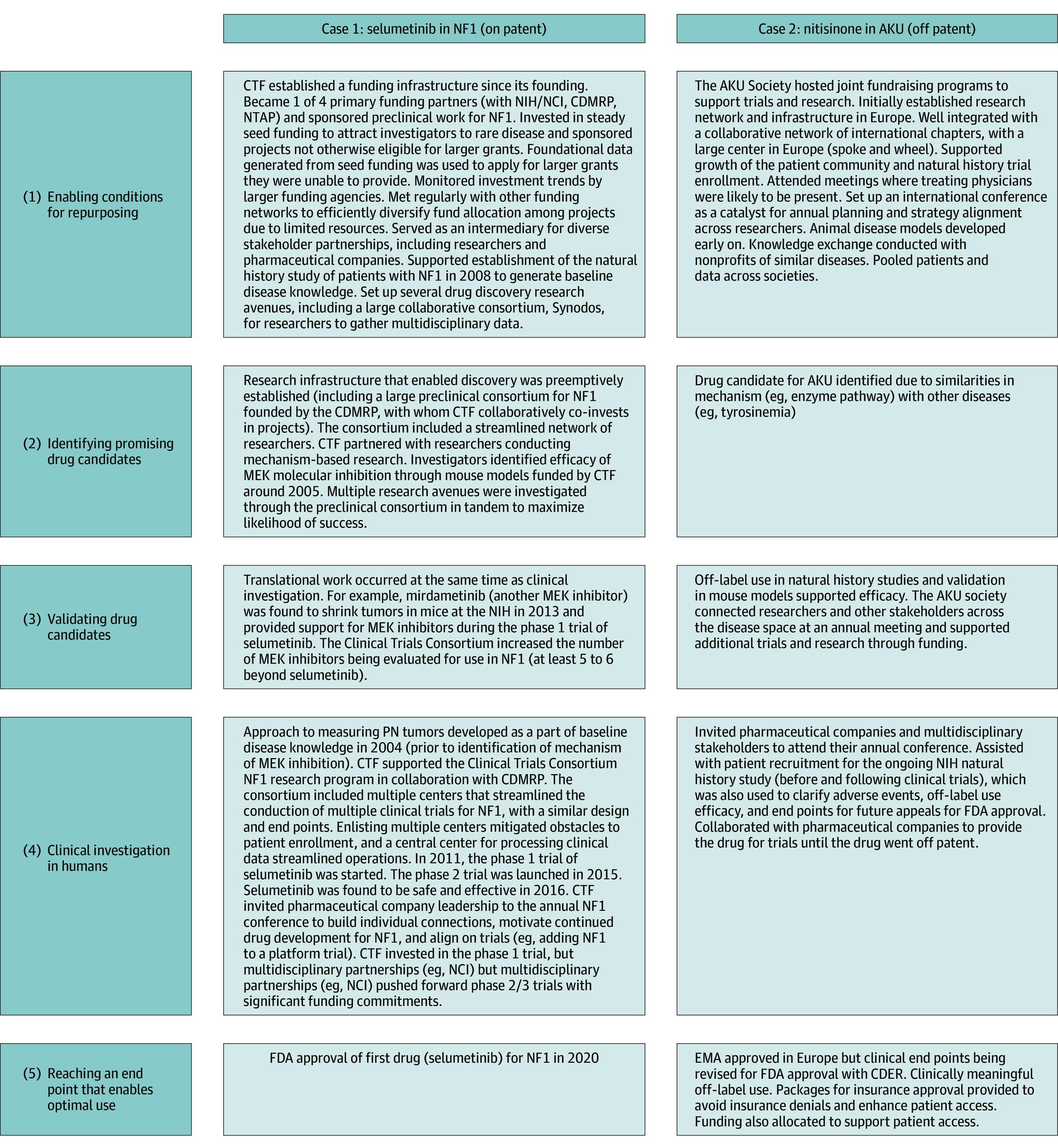
Representative organizations submitted survey responses, including 147 of 698 potential US-based RDNPs. The median RDNP age was 10 years (IQR, 5-20 years), and the median annual revenue was $355 390 (IQR, $90 028-$946 108). Among 34 leaders who were interviewed, representing 25 RDNPs, 23 were female (67.6%), and the RDNPs had a median age of 15 years (IQR, 6-19 years) and a median revenue of $670 719 (IQR, $193 587-$1 830 890). Among the surveyed RDNPs, 58 of 138 (42.0%) specifically identifying their involvement in repurposing supported repurposing projects, and 94 drugs were in various stages of repurposing, of which 23 met success criteria (5 with US Food and Drug Administration approval and 18 with off-label use with subjective benefit). Survey factors associated with successful outcomes included nonprofit-supported patient recruitment into trials (Gini importance, 3.90; ρ = 0.50; adjusted P < .001) and provision of nonfinancial research support (Gini importance, 0.69; ρ = 0.33; adjusted P = .02). Interview themes were synthesized into a 5-stage repurposing framework with roadblocks and recommendations that included (1) enabling drug repurposing, (2) identifying a drug therapy, (3) validating a drug therapy, (4) clinical use and testing, and (5) reaching an optimal end point for clinical practice.
CONCLUSIONS AND RELEVANCE
The findings of this qualitative study of RDNP repurposing suggest that several opportunities were associated with successful outcomes and can be considered to optimize systematic repurposing among RDNPs, external collaborators, and policymakers with the use of an interactive tool showcasing insights to facilitate data-driven drug repurposing.
重要性
美国食品药品监督管理局(FDA)尚未批准任何疗法的9500多种罕见病急需治疗方法。与新型药物研发相比,药物重新利用可能所需时间和成本更低,但存在一些障碍阻碍了系统性的重新利用。罕见病非营利组织(RDNP)有能力克服这些障碍,并且几十年来一直引领着罕见病药物重新利用的努力。然而,目前尚无关于罕见病药物重新利用状况或成功案例特征的全面数据。
目的
利用交互式“所有药物重新利用,绘制所有路径”(ROADMAP)项目网络工具,描述罕见病药物重新利用的状况,识别与成功结果相关的因素,并分享主题见解。
设计、背景和参与者:ROADMAP研究是一项定性研究,采用混合方法对美国的RDNP领导者及其利益相关者进行分析,包括一项全国性调查以及对RDNP领导者的半结构化访谈,调查于2021年9月29日至2022年1月6日进行。调查和访谈揭示了与RDNP策略、时间表和支持机制相关的主题。数据于2024年1月22日至2024年4月23日进行分析。
主要结果和测量指标
主要调查结果是重新利用项目阶段(放弃、早期、临床、后期或成功)。定性结果包括描述重新利用经验的主题。使用针对药物和疾病特定以及组织特定变量的两个随机森林模型来评估对推断项目阶段的因素重要性。使用斯皮尔曼等级相关性进行正交显著性检验,并使用本贾尼-霍奇伯格程序对每个模型中的P值进行多重假设检验校正。
结果
有代表性的组织提交了调查回复,包括698个潜在的美国RDNP中的147个。RDNP的年龄中位数为10年(四分位间距,5 - 20年),年收入中位数为355390美元(四分位间距,90028 - 946108美元)。在接受访谈的34位领导者中,代表25个RDNP,其中23位为女性(67.6%),这些RDNP的年龄中位数为15年(四分位间距,6 - 19年),收入中位数为670719美元(四分位间距,193587 - 1830890美元)。在接受调查的RDNP中,138个中有58个(42.0%)明确表示参与了重新利用,支持重新利用项目,并且94种药物处于重新利用的不同阶段,其中23种达到了成功标准(5种获得了FDA批准,18种有主观获益的非标签使用情况)。与成功结果相关的调查因素包括非营利组织支持患者参与试验招募(基尼重要性,3.90;ρ = 0.50;校正后P <.001)以及提供非财务研究支持(基尼重要性,0.69;ρ = 0.33;校正后P = 0.02)。访谈主题被综合成一个5阶段的重新利用框架,包括障碍和建议,其中包括(1)促进药物重新利用,(2)确定药物治疗方法,(3)验证药物治疗方法,(4)临床使用和测试,以及(5)达到临床实践的最佳终点。
结论和相关性
这项关于RDNP重新利用的定性研究结果表明,几个因素与成功结果相关,可被视为优化RDNP、外部合作者和政策制定者之间系统性重新利用的因素,通过使用一个交互式工具展示见解,以促进数据驱动的药物重新利用。

 Zotero 插件