
美国老年人社区食物环境与认知衰退的差异:一项队列研究。
Disparities in neighborhood food environment and cognitive decline among US older adults: a cohort study.
作者信息
Kim Boeun, Thorpe Roland J, Szanton Sarah L, Adkins-Jackson Paris B, Samuel Laura J
机构信息
College of Nursing, University of Iowa, 50 Newton Road, Room 436, Iowa City, IA, 52242, USA.
Bloomberg School of Public Health, Johns Hopkins University, 624 N. Broadway, Hampton House 708, Baltimore, MD, 21205, USA.
出版信息
BMC Med. 2025 May 6;23(1):259. doi: 10.1186/s12916-025-04091-1.
BACKGROUND
Disparities in neighborhood food environments in the United States, attributed to numerous complex economic, social, and political factors, likely to contribute to disparities in access to healthy food and cognitive function in older adults. However, the role of food environment in cognitive function is not well understood. Accordingly, this study examined the association of residing a low food access and low-income neighborhood with changes in cognitive function among older adults in urban areas.
METHODS
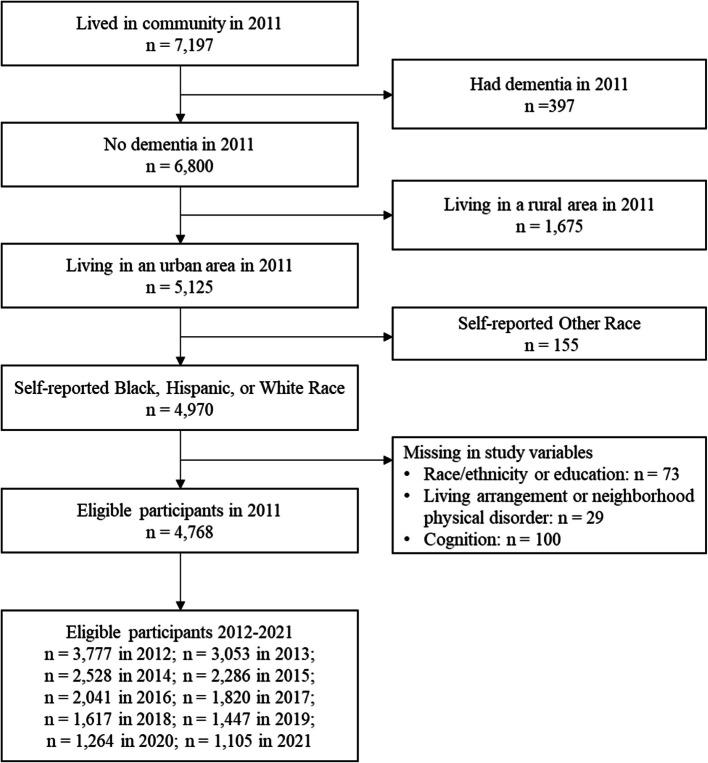
This is a cohort study leveraging existing datasets. The 2010 Food Access Research Atlas data was linked to the 2011-2021 National Health and Aging Trends Study (NHATS). A total of 4768 urban-dwelling older adults aged 65 years and older were included in this analysis. Total cognitive function (range: 0-33) was assessed through tests of orientation, executive function, immediate memory, and delayed memory. An unhealthy food environment was defined as residing in census tracts with both low access to healthy food stores and low income. Survey-weighted mixed-effects models were fitted, adjusting for individual- and area-level covariates.
RESULTS
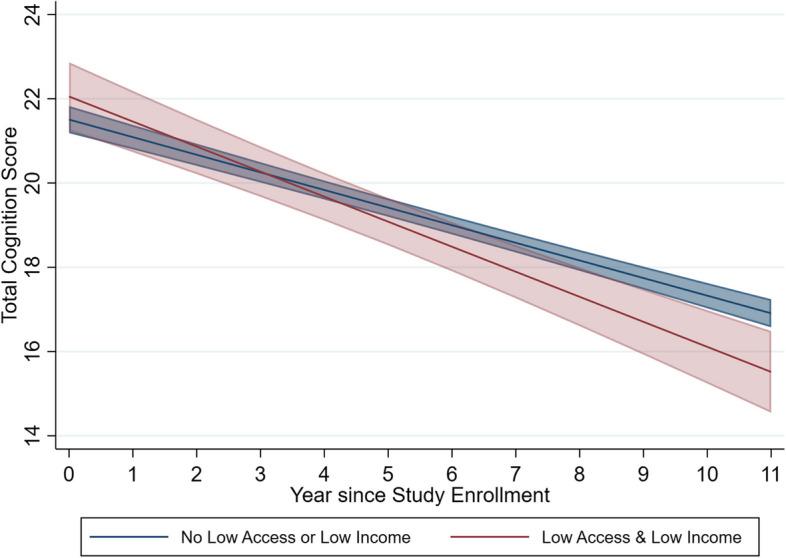
The mean age of participants was 77.1 years (SD = 7.6), and 2779 were women (weighted % = 56.7). A total of 1238 participants (weighted % = 9.9%) were racialized as Black, 365 (weighted % = 9.1%) racialized as Latinx, and 3165 (weighted % = 81.1%) racialized as White. In adjusted models, older urban- and community-dwelling adults living in neighborhoods with low access and low income had faster annual cognitive decline than their peers (β = - 0.19; 95% CI = - 0.32, - 0.05).
CONCLUSIONS
Living in neighborhoods with both low food access and low income may be a risk factor for accelerated cognitive decline among urban-dwelling older adults and contribute to widening disparities in healthy food access and cognitive decline.
背景
美国社区食物环境的差异归因于众多复杂的经济、社会和政治因素,这可能导致老年人在获取健康食物和认知功能方面存在差异。然而,食物环境在认知功能中的作用尚未得到充分理解。因此,本研究调查了居住在食物获取机会少和低收入社区与城市地区老年人认知功能变化之间的关联。
方法
这是一项利用现有数据集的队列研究。2010年食物获取研究地图集数据与2011 - 2021年国家健康与老龄化趋势研究(NHATS)相链接。本分析共纳入了4768名年龄在65岁及以上的城市老年人。通过定向、执行功能、即时记忆和延迟记忆测试评估总体认知功能(范围:0 - 33)。不健康的食物环境被定义为居住在健康食品商店获取机会少且收入低的普查区。采用调查加权混合效应模型进行拟合,并对个体和地区层面的协变量进行调整。
结果
参与者的平均年龄为77.1岁(标准差 = 7.6),其中2779名为女性(加权百分比 = 56.7%)。共有1238名参与者(加权百分比 = 9.9%)被归类为黑人,365名(加权百分比 = 9.1%)被归类为拉丁裔,3165名(加权百分比 = 81.1%)被归类为白人。在调整后的模型中,居住在食物获取机会少且低收入社区的城市和社区老年人,其每年的认知衰退速度比同龄人更快(β = -0.19;95%置信区间 = -0.32,-0.05)。
结论
居住在食物获取机会少且低收入的社区可能是城市老年人认知衰退加速的一个风险因素,并导致健康食物获取和认知衰退方面的差距不断扩大。
 Zotero 插件