
消除肿瘤“氧合”障碍:癌症治疗中消耗谷胱甘肽的纳米酶
Removing Barriers to Tumor 'Oxygenation': Depleting Glutathione Nanozymes in Cancer Therapy.
作者信息
Sun Ruilong, Liu Ruitang, Tian Yongzheng, Li Yunfei, Fan Bo, Li Songkai
机构信息
Spine Surgery, The 940th Hospital of the Joint Logistic Support Force of Chinese People's Liberation Army, Lanzhou, People's Republic of China.
First Clinical Medical College, Gansu University of Chinese Medicine, Lanzhou, People's Republic of China.
出版信息
Int J Nanomedicine. 2025 May 1;20:5613-5643. doi: 10.2147/IJN.S515734. eCollection 2025.
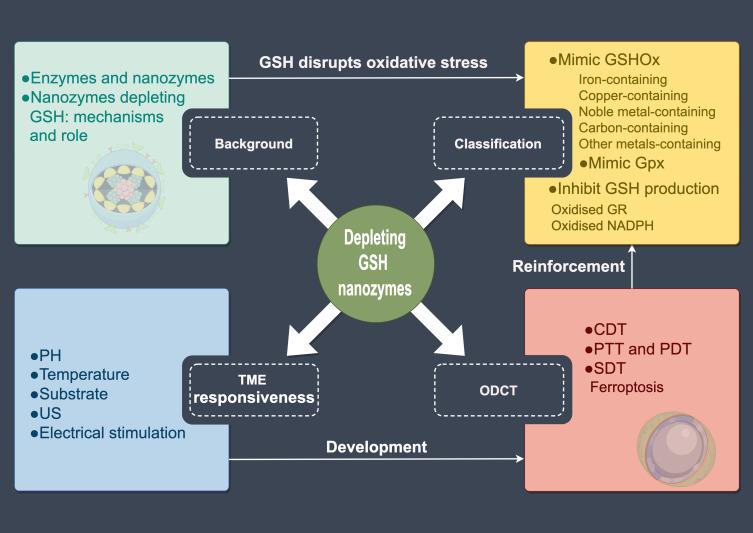
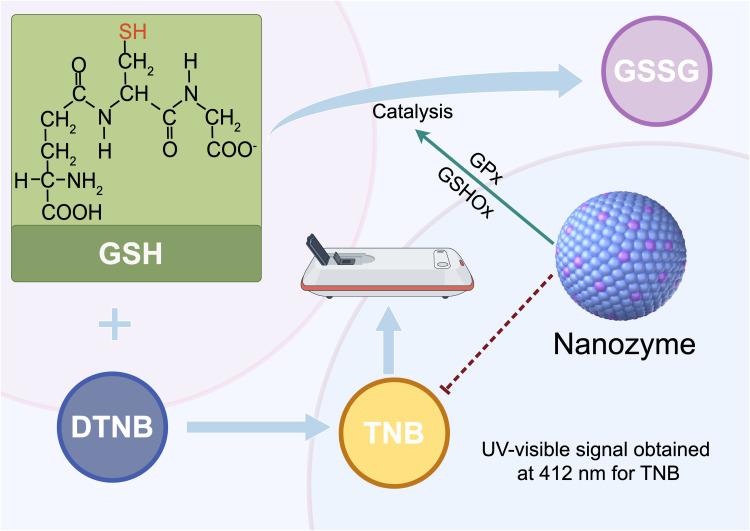
Nanozymes are nanomaterials capable of mimicking natural enzyme catalysis in the complex biological environment of the human body. Due to their good stability and strong catalytic properties, nanozymes are widely used in various fields of biomedicine. Among them, nanozymes that trigger intracellular reactive oxygen species (ROS) levels for cancer therapy have gained significant attention. However, the 'explosion' of ROS in tumor cells was prevented by the high levels of glutathione (GSH) in the tumor microenvironment (TME). GSH, a prominent endogenous antioxidant, increases the resistance of tumor cells to oxidative stress by scavenging ROS. Certain nanozymes can deplete intracellular GSH levels by mimicking GSH oxidase (GSHOx), GSH peroxidase (GPx) or by interfering with the reduction of oxidized glutathione (GSSG). On the one hand, elevated the level of intracellular ROS and induced lipid peroxidation reaction leading to ferroptosis. On the other hand, it creates favorable conditions for the treatment of tumors with photodynamic therapy (PDT), sonodynamic therapy (SDT), chemodynamical therapy (CDT) and targeted therapy. In this paper, we present a comprehensive analysis of GSH-depleting nanozymes reported in recent years, including classification, mechanism, responsiveness to TME and their roles in cancer therapy, and look forward to future applications and developments.
纳米酶是能够在人体复杂生物环境中模拟天然酶催化作用的纳米材料。由于其良好的稳定性和强大的催化性能,纳米酶在生物医学的各个领域得到了广泛应用。其中,通过触发细胞内活性氧(ROS)水平用于癌症治疗的纳米酶受到了广泛关注。然而,肿瘤微环境(TME)中高水平的谷胱甘肽(GSH)阻止了肿瘤细胞中ROS的“爆发”。GSH是一种重要的内源性抗氧化剂,通过清除ROS增加肿瘤细胞对氧化应激的抗性。某些纳米酶可以通过模拟谷胱甘肽氧化酶(GSHOx)、谷胱甘肽过氧化物酶(GPx)或干扰氧化型谷胱甘肽(GSSG)的还原作用来消耗细胞内GSH水平。一方面,提高细胞内ROS水平并诱导脂质过氧化反应导致铁死亡。另一方面,它为光动力疗法(PDT)、声动力疗法(SDT)、化学动力疗法(CDT)和靶向治疗等肿瘤治疗创造了有利条件。在本文中,我们对近年来报道的消耗GSH的纳米酶进行了全面分析,包括分类、作用机制、对TME的响应及其在癌症治疗中的作用,并展望了未来的应用和发展。




 Zotero 插件