
韩国H5Nx高致病性禽流感的流行病学与病理生物学(2003 - 2024年):综述
Epidemiology and pathobiology of H5Nx highly pathogenic avian influenza in South Korea (2003-2024): a comprehensive review.
作者信息
Lee Sun-Hak, Kwon Jung-Hoon, Youk Sungsu, Lee Sang-Won, Lee Dong-Hun, Song Chang-Seon
机构信息
Avian Disease Laboratory, College of Veterinary Medicine, Konkuk University, Seoul, Republic of Korea.
Wildlife Health Laboratory, College of Veterinary Medicine, Konkuk University, Seoul, Republic of Korea.
出版信息
Vet Q. 2025 Dec;45(1):23-38. doi: 10.1080/01652176.2025.2498918. Epub 2025 May 7.
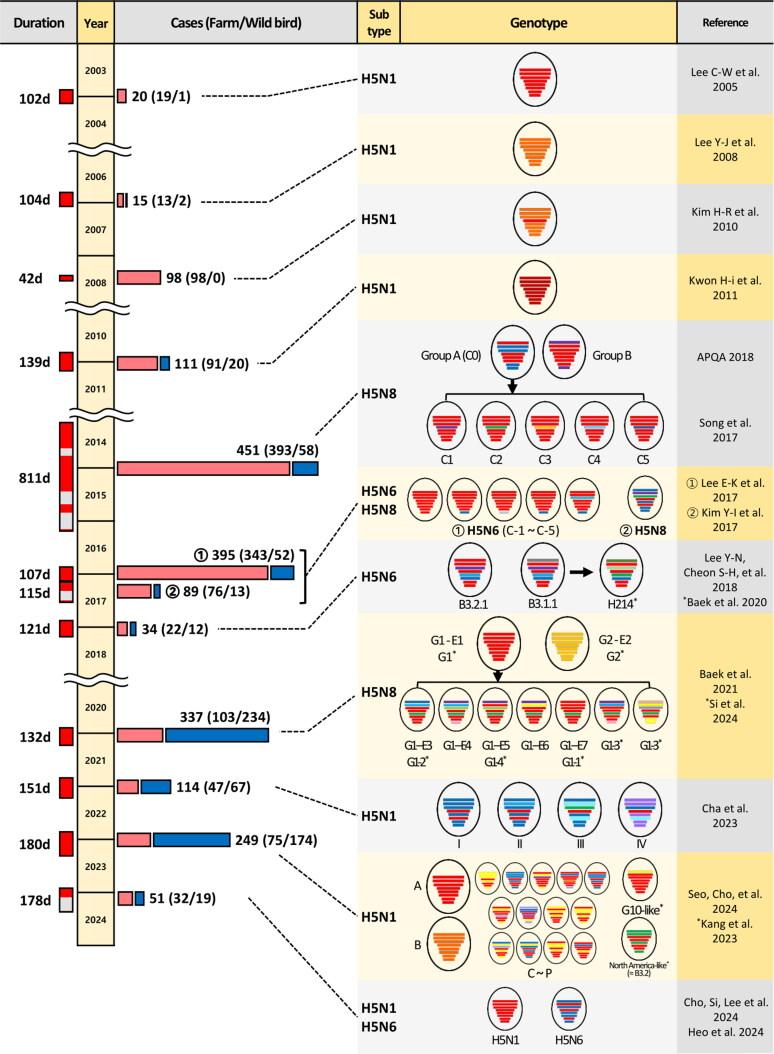
Since their emergence in Guangdong, China, in 1996, Gs/GD H5 highly pathogenic avian influenza viruses (HPAIVs) have diversified into multiple clades, spreading globally through wild bird migrations and causing substantial losses in poultry and wildlife. In South Korea, HPAIVs, including H5N1, H5N8, and H5N6 subtypes, have been repeatedly introduced since 2003. This review examines the epidemiology, genetic characteristics, and pathobiological features of these viruses in South Korea. Outbreaks typically occur between October and December, aligning with the arrival of wintering migratory birds. While outbreaks in poultry farms dominated before 2018, wild bird cases became more prevalent in subsequent years. Seasonal outbreaks in poultry have declined, but large-scale mortality events in wild birds emerged biennially from 2020. Genotypic diversity has increased since 2014 due to reassortment with low pathogenic viruses, with novel genomic traits detected in recent seasons. Infection studies show consistently fatal outcomes in chickens, while high mortality in domestic ducks was observed only with two of the studied strains, despite efficient transmission. Wild bird studies reveal species-specific roles in viral shedding and transmission. This review underscores the dynamic nature of HPAI outbreaks, highlighting the importance of surveillance, biosecurity, and genetic and pathogenicity analyses to mitigate future risks.
自1996年在中国广东出现以来,Gs/GD H5高致病性禽流感病毒(HPAIVs)已分化为多个分支,通过野生鸟类迁徙在全球传播,并给家禽和野生动物造成了重大损失。在韩国,自2003年以来,包括H5N1、H5N8和H5N6亚型在内的HPAIVs已多次传入。本综述研究了这些病毒在韩国的流行病学、遗传特征和病理生物学特征。疫情通常发生在10月至12月之间,与越冬候鸟的到来时间一致。虽然2018年之前家禽养殖场的疫情占主导,但随后几年野生鸟类病例变得更加普遍。家禽季节性疫情有所下降,但自2020年起野生鸟类每隔一年就会出现大规模死亡事件。自2014年以来,由于与低致病性病毒的重配,基因型多样性有所增加,最近几个季节检测到了新的基因组特征。感染研究表明,鸡感染后始终会出现致命结果,尽管传播效率高,但在家鸭中只有两种研究毒株观察到高死亡率。野生鸟类研究揭示了病毒传播和扩散中物种特异性的作用。本综述强调了HPAI疫情的动态性质,突出了监测、生物安全以及遗传和致病性分析对于降低未来风险的重要性。
 Zotero 插件