
猪血中顺序酶解的优化及其对制备水解产物的肽谱和生物活性的影响
Optimization of Sequential Enzymatic Hydrolysis in Porcine Blood and the Influence on Peptide Profile and Bioactivity of Prepared Hydrolysates.
作者信息
Moreno-Mariscal Cristina, Moroni Federico, Pérez-Sánchez Jaume, Mora Leticia, Toldrá Fidel
机构信息
Instituto de Agroquímica y Tecnología de Alimentos (IATA-CSIC), Avenue Agustín Escardino 7, 46980 Paterna, Spain.
Instituto de Acuicultura Torre de la Sal (IATS-CSI), 12595 Ribera de Cabanes, Spain.
出版信息
Int J Mol Sci. 2025 Apr 10;26(8):3583. doi: 10.3390/ijms26083583.
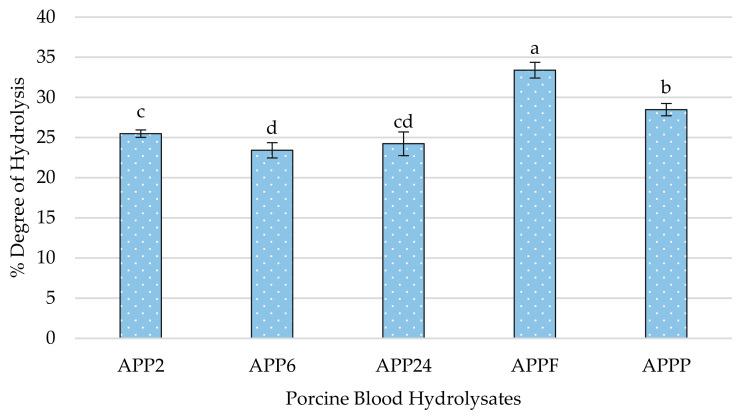
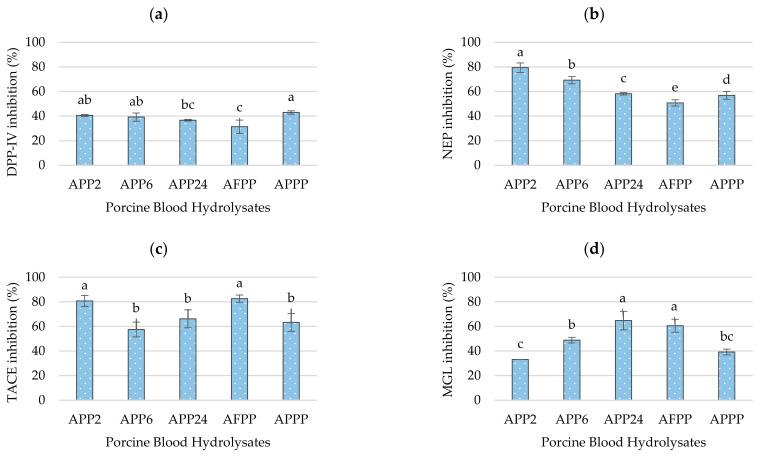
The search for new alternatives for the revalorization of porcine blood is crucial due to the large quantities that are annually generated in slaughterhouses. In this study, a sequential enzymatic hydrolysis of pig blood was optimized using different combinations of the enzymes, namely, Alcalase 4.0 L and Protana™ Prime, Flavourzyme 1000 L, and Protamex, as a sustainable method for obtaining extracts rich in bioactive peptides. All the assayed hydrolysates exhibited different peptide profiles and showed in vitro antioxidant, hypoglycemic, and anti-inflammatory activity, although their values differed significantly depending on the type of hydrolysis in ABTS, FRAP, and ORAC assays, as well as in the determination of the inhibitory activity of DPP-IV, NEP, TACE, and MGL enzymes. The hydrolysate obtained by the combination of Alcalase 4.0 L, Flavourzyme 1000 L, and Protana™ Prime (AFPP) resulted in the highest hydrolysis degree (33.39 ± 0.98%), and its peptide profile reflected a higher amount of peptides < 3 kDa. This hydrolysate also obtained significantly higher values for ABTS and the inhibition of TACE and MGL. However, APP2 stood out in NEP inhibition (79.39 ± 3.91%), while APPP was notable for DPP-IV inhibition (43.02 ± 1.39%). The analysis of the hydrolysates using mass spectrometry in tandem allowed for the identification of those sequences that are potentially responsible for the biological activities determined, which were characterized using in silico bioinformatic tools. The results show the potential of using sequential enzymatic hydrolysis in porcine blood to obtain multifunctional peptides.
由于屠宰场每年会产生大量猪血液,因此寻找猪血液再利用的新替代方法至关重要。在本研究中,使用不同酶组合(即Alcalase 4.0 L和Protana™ Prime、Flavourzyme 1000 L以及Protamex)对猪血进行顺序酶水解优化,作为获得富含生物活性肽提取物的可持续方法。所有测定的水解产物均呈现不同的肽谱,并表现出体外抗氧化、降血糖和抗炎活性,尽管它们在ABTS、FRAP和ORAC测定中的值以及在DPP-IV、NEP、TACE和MGL酶抑制活性测定中因水解类型不同而有显著差异。由Alcalase 4.0 L、Flavourzyme 1000 L和Protana™ Prime组合(AFPP)获得的水解产物水解度最高(33.39 ± 0.98%),其肽谱显示<3 kDa的肽含量更高。该水解产物在ABTS以及TACE和MGL抑制方面也获得了显著更高的值。然而,APP2在NEP抑制方面表现突出(79.39 ± 3.91%),而APPP在DPP-IV抑制方面表现显著(43.02 ± 1.39%)。使用串联质谱对水解产物进行分析,能够鉴定出那些可能对所测定的生物活性负责的序列,并使用计算机生物信息学工具对其进行表征。结果表明,在猪血中使用顺序酶水解获得多功能肽具有潜力。




 Zotero 插件