
基于病毒基因组组成预测基序介导的相互作用。
Predicting Motif-Mediated Interactions Based on Viral Genomic Composition.
作者信息
Idrees Sobia, Paudel Keshav Raj, Banik Mithila, Suwal Newton, Thapa Rajan, Bashyal Saroj
机构信息
School of Biotechnology and Biomolecular Sciences, University of New South Wales, Sydney, NSW 2033, Australia.
Centre for Inflammation, Centenary Institute and the University of Technology Sydney, School of Life Sciences, Faculty of Science, Sydney, NSW 2007, Australia.
出版信息
Int J Mol Sci. 2025 Apr 13;26(8):3674. doi: 10.3390/ijms26083674.
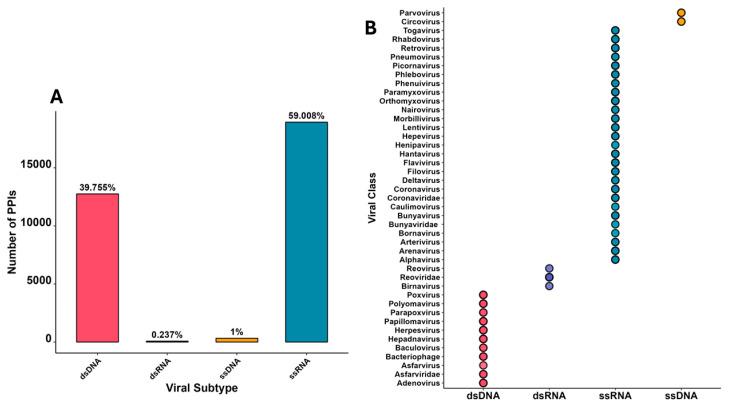
Viruses manipulate host cellular machinery to propagate their life cycle, with one key strategy being the mimicry of short linear motifs (SLiMs) found in host proteins. While databases continue to expand with virus-host protein-protein interaction (vhPPI) data, accurately predicting viral mimicry remains challenging due to the inherent degeneracy of SLiMs. In this study, we investigate how viral genomic composition influences motif mimicry and the mechanisms through which viruses hijack host cellular functions. We assessed domain-motif interaction (DMI) enrichment differences, and also predicted new DMIs based on known viral motifs with varying stringency levels, using SLiMEnrich v.1.5.1. Our findings reveal that dsDNA viruses capture significantly more known DMIs compared to other viral groups, with dsRNA viruses also exhibiting higher DMI enrichment than ssRNA viruses. Additionally, we identified new vhPPIs mediated via SLiMs, particularly within different viral genomic contexts. Understanding these interactions is vital for elucidating viral strategies to hijack host functions, which could inform the development of targeted antiviral therapies.
病毒操纵宿主细胞机制以推进其生命周期,其中一个关键策略是模仿宿主蛋白中发现的短线性基序(SLiMs)。虽然随着病毒 - 宿主蛋白质 - 蛋白质相互作用(vhPPI)数据的数据库不断扩展,但由于SLiMs固有的简并性,准确预测病毒模仿仍然具有挑战性。在本研究中,我们调查了病毒基因组组成如何影响基序模仿以及病毒劫持宿主细胞功能的机制。我们评估了结构域 - 基序相互作用(DMI)富集差异,并使用SLiMEnrich v.1.5.1基于具有不同严格程度的已知病毒基序预测新的DMI。我们的研究结果表明,与其他病毒组相比,双链DNA病毒捕获的已知DMI明显更多,双链RNA病毒的DMI富集也高于单链RNA病毒。此外,我们鉴定了通过SLiMs介导的新的vhPPI,特别是在不同的病毒基因组背景下。了解这些相互作用对于阐明病毒劫持宿主功能的策略至关重要,这可为靶向抗病毒疗法的开发提供信息。



 Zotero 插件