
一项关于eptinezumab预防偏头痛有效性和安全性的24周前瞻性、多中心、真实世界研究(EMBRACE II)。
A 24-week prospective, multicenter, real-world study on eptinezumab's effectiveness and safety in migraine prevention (EMBRACE II).
作者信息
Barbanti Piero, Aurilia Cinzia, Egeo Gabriella, Doretti Alberto, d'Onofrio Florindo, Scatena Paola, Rinalduzzi Steno, Vinciguerra Luisa, Sansone Mattia, Vecchio Rosario, Drago Valeria, Viticchi Giovanna, Bartolini Marco, Ranieri Angelo, Bandettini di Poggio Monica, Baldisseri Francesco, Mascarella Davide, Brusaferri Fabio, Caputi Luigi, Messina Stefano, Autunno Massimo, Valenza Alessandro, Orlando Bianca, Distefano Marisa, Borrello Laura, Pistoia Francesca, Camarda Cecilia, Saporito Gennaro, Querzola Giacomo, Torelli Paola, Salerno Antonio, Gragnani Francesca, Petolicchio Barbara, Carnevale Antonio, Messina Roberta, Filippi Massimo, Tavani Sofia, Fiorentini Giulia, Bonassi Stefano, Cevoli Sabina, Mannocci Alice
机构信息
Headache and Pain Unit, IRCCS San Raffaele Roma, Via della Pisana 235, 00163, Rome, Italy.
Department for the Promotion of Human Sciences and Quality of Life, University San Raffaele, Rome, Italy.
出版信息
J Neurol. 2025 May 7;272(6):382. doi: 10.1007/s00415-025-13095-z.
INTRODUCTION
We evaluated the effectiveness, tolerability, and safety of eptinezumab in preventing high-frequency episodic migraine (HFEM) and chronic migraine (CM) over 24 weeks in real-world. We also assessed its impact during the first treatment week, in patients failing monoclonal antibodies targeting the calcitonin gene-related peptide (anti-CGRP mAbs), and the effects of dose escalation to 300 mg in patients requiring enhanced control.
METHODS
EMBRACE II is a multicenter (n = 22), prospective, 24-week, real-world study involving consecutive patients with HFEM or CM who had failed > 3 preventive treatments. Eptinezumab (100 mg, with the option for escalation to 300 mg at week 12) was administered quarterly.
PRIMARY ENDPOINT
change in monthly migraine days (MMD), for HFEM or monthly headache days (MHD), for CM, between weeks 21-24 and baseline. Secondary endpoints: changes in monthly analgesic intake (MAI), Numerical Rating Scale (NRS), Headache Impact Test (HIT-6), Migraine Disability Assessment Scale (MIDAS), Migraine Interictal Burden Scale (MIBS-4), and responder rates.
RESULTS
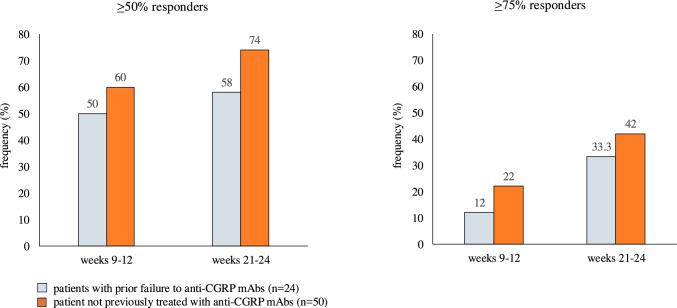
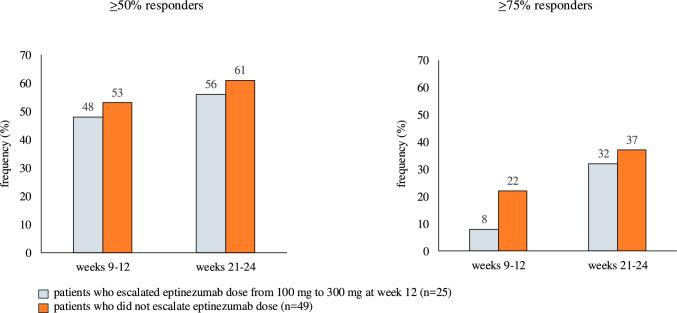
Of the 215 participants who had received ≥ 1 eptinezumab dose, 74 were treated for ≥ 24 weeks and considered for effectiveness analysis. Eptinezumab significantly (p < 0.001) reduced MMD/MHD (- 10.5), MAI (- 15.6), NRS (- 2.2), HIT-6 (- 9.9), MIDAS (- 48.7), and MIBS-4 (- 4.3). ≥ 50% responders were 69%, ≥ 75% responders 39.2%, and 100% responders 4.1%. Comparing the first week with the last baseline week, a significant reduction in migraine days was observed (- 3.7; p < 0.001). Significant improvements were seen in patients failing anti-CGRP mAbs (32.4%) and in those escalating to 300 mg (33.8%). Half of the subjects reported being "very much improved" or "much improved". The adverse events were infrequent (2.8%).
CONCLUSIONS
This real-world study documents that 24-week eptinezumab treatment is rapidly effective and well tolerated in migraine patients with multiple therapeutic failures (including anti-CGRP mAbs). One-third of patients escalated to 300 mg at week 12, achieving further significant migraine-related disability reduction.
引言
我们评估了eptinezumab在现实世界中24周内预防高频发作性偏头痛(HFEM)和慢性偏头痛(CM)的有效性、耐受性和安全性。我们还评估了其在首个治疗周对靶向降钙素基因相关肽的单克隆抗体(抗CGRP mAbs)治疗失败患者的影响,以及对需要强化控制的患者增加至300mg剂量的效果。
方法
EMBRACE II是一项多中心(n = 22)、前瞻性、为期24周的现实世界研究,纳入连续的HFEM或CM患者,这些患者接受过超过3种预防性治疗但均失败。每季度给予eptinezumab(100mg,可在第12周增至300mg)。
主要终点
21 - 24周与基线相比,HFEM患者的每月偏头痛天数(MMD)变化,或CM患者的每月头痛天数(MHD)变化。次要终点:每月镇痛药摄入量(MAI)、数字评定量表(NRS)、头痛影响测试(HIT - 6)、偏头痛残疾评估量表(MIDAS)、偏头痛发作间期负担量表(MIBS - 4)的变化以及缓解率。
结果
在接受≥1剂eptinezumab治疗的215名参与者中,74名接受治疗≥24周并纳入有效性分析。eptinezumab显著(p < 0.001)降低了MMD/MHD(-10.5)、MAI(-15.6)、NRS(-2.2)、HIT - 6(-9.9)、MIDAS(-48.7)和MIBS - 4(-4.3)。缓解率≥50%的为69%,≥75%的为39.2%,100%缓解的为4.1%。将第一周与最后一个基线周进行比较,偏头痛天数显著减少(-3.7;p < 0.001)。抗CGRP mAbs治疗失败的患者(32.4%)以及增加至300mg的患者(33.8%)均有显著改善。一半的受试者报告“非常改善”或“大有改善”。不良事件发生率较低(2.8%)。
结论
这项现实世界研究表明,24周的eptinezumab治疗对多种治疗失败(包括抗CGRP mAbs)的偏头痛患者迅速有效且耐受性良好。三分之一的患者在第12周增至300mg,偏头痛相关残疾进一步显著降低。


 Zotero 插件