
噻唑烷二酮与钠-葡萄糖协同转运蛋白2抑制剂对2型糖尿病患者代谢功能障碍相关脂肪性肝病的协同益处:一项为期24周的开放标签随机对照试验
Synergistic benefit of thiazolidinedione and sodium-glucose cotransporter 2 inhibitor for metabolic dysfunction-associated steatotic liver disease in type 2 diabetes: a 24-week, open-label, randomized controlled trial.
作者信息
Lee Minyoung, Hong Sukchul, Cho Yongin, Rhee Hyungjin, Yu Min Heui, Bae Jaehyun, Lee Yong-Ho, Lee Byung-Wan, Kang Eun Seok, Cha Bong-Soo
机构信息
Department of Internal Medicine, Yonsei University College of Medicine, Seoul, 03722, Republic of Korea.
Institute of Endocrine Research, Yonsei University College of Medicine, Seoul, Korea.
出版信息
BMC Med. 2025 May 7;23(1):266. doi: 10.1186/s12916-025-04017-x.
BACKGROUND
The close interplay between metabolic dysfunction-associated steatotic liver disease (MASLD) and type 2 diabetes supports the need to identify beneficial combination therapies of antidiabetic medications targeted for the treatment of MASLD. This study aimed to investigate the complementary effects of combination therapy with pioglitazone (PIO) and empagliflozin (EMPA) on MASLD in individuals with type 2 diabetes.
METHODS
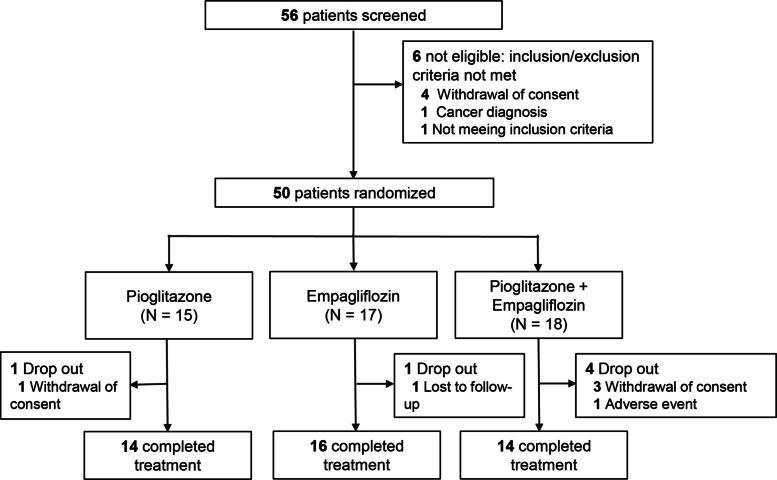
In a randomized, open-label trial, 50 participants with type 2 diabetes and MASLD were assigned 1:1:1 to receive PIO 15 mg, EMPA 10 mg, or a combination (PIO 15 mg plus EMPA 10 mg) daily for 24 weeks. Liver fat fraction and stiffness were evaluated using magnetic resonance imaging-proton density fat fraction (MRI-PDFF) and magnetic resonance elastography (MRE), respectively.
RESULTS
Combination therapy resulted in the largest reduction in liver fat and stiffness among treatment groups. Participants experiencing a relative reduction ≥ 30% or an absolute reduction ≥ 5% in liver fat were the most prevalent in the combination group (100.0% vs. 57.1% in PIO and 87.5% in EMPA, p = 0.010). In addition, the combination group showed the highest proportion of individuals with a relative reduction ≥ 30% in liver fat and ≥ 20% in liver stiffness than the monotherapy groups (50.0% vs. 21.4% in PIO and 6.3% in EMPA, p = 0.029). Combination therapy did not induce the changes in subcutaneous fat deposition observed in the monotherapy groups, but it did show the most substantial reduction in visceral fat, concurrently showing the largest increase in adiponectin level across the three groups (p = 0.036).
CONCLUSIONS
Combination therapy of PIO with EMPA showed synergistic benefits for MASLD in individuals with type 2 diabetes, compensating for the inadequate or unfavorable effects of monotherapies; ClincialTrials.gov number, NCT03646292.
TRIAL REGISTRATION
The trial was registered at ClinicalTrials.gov (registration number: NCT03646292).
背景
代谢功能障碍相关脂肪性肝病(MASLD)与2型糖尿病之间存在密切的相互作用,这表明有必要确定针对MASLD治疗的抗糖尿病药物的有益联合疗法。本研究旨在探讨吡格列酮(PIO)和恩格列净(EMPA)联合治疗对2型糖尿病患者MASLD的互补作用。
方法
在一项随机、开放标签试验中,50例2型糖尿病合并MASLD患者按1:1:1分配,分别每日接受15mg PIO、10mg EMPA或联合用药(15mg PIO加10mg EMPA),持续24周。分别采用磁共振成像-质子密度脂肪分数(MRI-PDFF)和磁共振弹性成像(MRE)评估肝脏脂肪分数和硬度。
结果
联合治疗组肝脏脂肪和硬度的降低幅度在各治疗组中最大。肝脏脂肪相对减少≥30%或绝对减少≥5%的参与者在联合治疗组中最为常见(100.0%,PIO组为57.1%,EMPA组为87.5%,p = 0.010)。此外,与单药治疗组相比,联合治疗组肝脏脂肪相对减少≥30%且肝脏硬度相对减少≥20%的个体比例最高(50.0%,PIO组为21.4%,EMPA组为6.3%,p = 0.029)。联合治疗未引起单药治疗组中观察到的皮下脂肪沉积变化,但内脏脂肪减少最为显著,同时三组中脂联素水平升高幅度最大(p = 0.036)。
结论
PIO与EMPA联合治疗对2型糖尿病合并MASLD患者具有协同益处,弥补了单药治疗的不足或不良影响;ClinicalTrials.gov编号,NCT03646292。
试验注册
该试验在ClinicalTrials.gov注册(注册号:NCT03646292)。

 Zotero 插件