
mTOR介导的营养感知和氧化应激途径调节自噬:中药改善糖尿病肾病的关键机制。
mTOR-mediated nutrient sensing and oxidative stress pathways regulate autophagy: a key mechanism for traditional Chinese medicine to improve diabetic kidney disease.
作者信息
Li Liu, Zou Junju, Zhou Tongyi, Liu Xiu, Tan Danni, Xiang Qin, Yu Rong
机构信息
School of Traditional Chinese Medicine, Hunan University of Chinese Medicine, Changsha, China.
Hunan Key Laboratory of Traditional Chinese Medicine Prescription and Syndromes Translational Medicine, Hunan University of Chinese Medicine, Changsha, China.
出版信息
Front Pharmacol. 2025 Apr 23;16:1578400. doi: 10.3389/fphar.2025.1578400. eCollection 2025.
CONTEXT
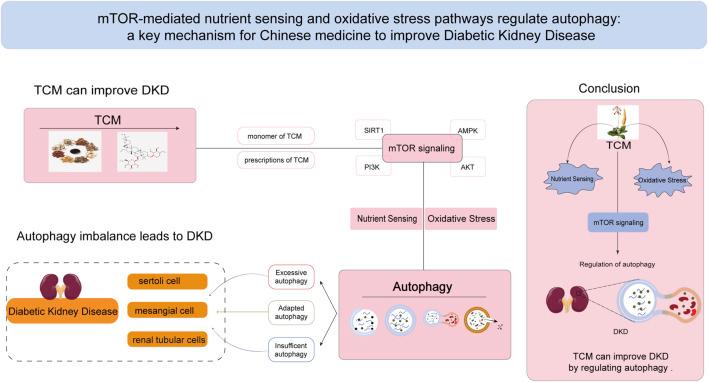
Autophagy plays a pivotal role in the pathogenesis of DKD, and the mechanistic target of rapamycin (mTOR) pathway, which regulates nutrient sensing and oxidative stress responses, is a key regulator of autophagy. Traditional Chinese Medicine (TCM) has garnered attention for its potential to treat DKD by modulating the mTOR signaling pathway, reducing oxidative stress, and restoring autophagic function.
OBJECTIVE
The objective of this study is to examine how mTOR-mediated regulation of nutrient sensing and oxidative stress impacts autophagy in DKD, and to explore how TCM modulates these pathways to improve the condition.
METHODS
A systematic review was conducted using PubMed, Web of Science, Wanfang Data, and China National Knowledge Infrastructure (CNKI), with the search extended to December 2024. The search subject terms included 'diabetic kidney disease,' 'Traditional Chinese Medicine,' 'mTOR,' 'nutrient sensing,' and 'oxidative stress.' Studies were rigorously screened by two investigators.
RESULTS
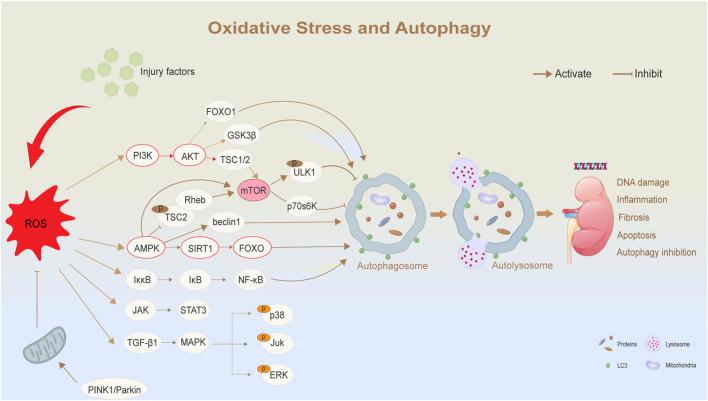
This review systematically examines the pathogenesis of mTOR-mediated nutrient sensing dysfunction and oxidative stress in DKD, highlighting their impact on autophagy. It further clarifies how these mechanisms are targeted by Chinese medicine in the treatment of DKD. The review summarizes the potential mechanisms by which TCM, including monomers (e.g., Astragaloside IV), individual botanical drugs (e.g., Lindl.), and compound formulations (e.g., Tongluo Digui Decoction), regulate autophagy in DKD through pathways such as AMP-activated protein kinase (AMPK), mTOR, sirtuins (Sirt), and the phosphatidylinositol three kinase (PI3K)/Akt/mTOR signaling pathway. TCM compound formulas share a common foundational framework, with the majority being formulated based on therapeutic principles such as 'Yiqi', 'Yangyin', 'Tongluo', and 'Huashi'.
CONCLUSION
TCM shows promise in treating DKD, with unique advantages in modulating key signaling pathways. However, the underlying mechanisms remain complex and warrant further investigation.
背景
自噬在糖尿病肾病(DKD)的发病机制中起关键作用,而调节营养感知和氧化应激反应的雷帕霉素机制性靶点(mTOR)通路是自噬的关键调节因子。中药因其通过调节mTOR信号通路、减轻氧化应激和恢复自噬功能来治疗DKD的潜力而受到关注。
目的
本研究的目的是探讨mTOR介导的营养感知和氧化应激调节如何影响DKD中的自噬,并探索中药如何调节这些通路以改善病情。
方法
使用PubMed、Web of Science、万方数据和中国知网(CNKI)进行系统综述,检索截至2024年12月。检索主题词包括“糖尿病肾病”“中药”“mTOR”“营养感知”和“氧化应激”。由两名研究人员严格筛选研究。
结果
本综述系统地研究了mTOR介导的营养感知功能障碍和氧化应激在DKD中的发病机制,强调了它们对自噬的影响。它进一步阐明了中药在治疗DKD时如何针对这些机制。该综述总结了中药(包括单体,如黄芪甲苷IV;单味植物药,如……;复方制剂,如通络地黄汤)通过AMP激活蛋白激酶(AMPK)、mTOR、沉默调节蛋白(Sirt)和磷脂酰肌醇三激酶(PI3K)/Akt/mTOR信号通路等途径调节DKD中自噬的潜在机制。中药复方制剂有共同的基础框架,大多数是基于“益气”“养阴”“通络”和“化湿”等治疗原则配方而成。
结论
中药在治疗DKD方面显示出前景,在调节关键信号通路方面具有独特优势。然而,其潜在机制仍然复杂,值得进一步研究。


 Zotero 插件